

In a post-apocalyptic world, a virus wipes out humanity. Survivors face roaming scavengers called Reapers. Protagonist Hig, a pilot, survived the flu but lost his wife.
End-of-the-world films are a dime a dozen. They have been around for eons, and when done well, they can be inspiring or disheartening, depending on the narrative’s trajectory. Ridley Scott’s “The Dog Stars” is a captivating epic that focuses more on the loss of family and human connection than on present-day chaos and devastation. The story centers on Hig (Jacob Elordi) and Bangley (Josh Brolin), two men who are survivors after a devastating flu pandemic has eradicated most of humanity.
They live in an abandoned airport hangar on an empty airfield in Erie, Colorado. Hig flies his vintage Cessna with his dog Jasper, watching for threats from the sky, while Bangley, a hardened, gun-toting survivalist and former Marine, watches the ground, using his trailer full of guns and ammunition. Occasionally, Hig flies into Denver to pick up food and supplies from box stores, celebrating simple scores like a case of soda or olive oil, but he also picks up supplies for a small community of Mennonites who live on an old turkey farm located in a nearby valley, ten miles from the airport compound where he and Bangley live.
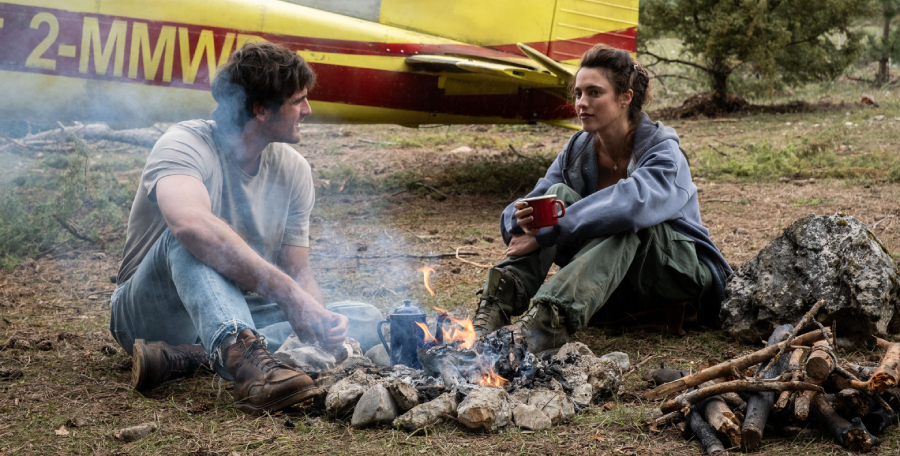
Hig is convinced there is life outside Erie, and tells Bangley that, on occasion, while flying his Cessna, he has picked up a faint, static-broken voice from an unknown person at an airfield in Grand Junction, and he attempts to persuade Bangley to go with him. He refuses, telling him that the world is irretrievably lost. So he sets off for Grand Junction. Along the way, however, he encounters engine trouble and is forced to land in a field near a stone house. There, he meets Cima (Margaret Qualley), a young medic who lives with her dad, Pops (Guy Pearce), a former Navy SEAL. In a kill-or-be-killed world, Pops views any outsider as an immediate threat to him and Cima, but over time, he realizes that he is not a threat, and eventually he warms up to him. Hig tells them he plans to fly on to Grand Junction solo, upsetting Cima, as the two have become close.
When a band of Reapers, violent, murderous scavengers who prey on remaining human survivors, attack Cima and Pops’ house, Hig helps them escape, narrowly fleeing the attackers in his plane. Eventually, they reach Grand Junction and are greeted by an eccentric stewardess named Darlene (Allison Janney), flanked by armed guards. Once her true intentions are revealed, Hig realizes his quest for hope has led them into grave danger. Now he must find a way to save himself, Cima, and Pops before it’s too late.
I went into the press screening for this film completely blind. I watched part of the trailer, but when I realized it was Ridley Scott, Josh Brolin, and the end of times, I turned it off, not willing to taint the experience by knowing too much. I didn’t even realize it was based on a book, so my enjoyment was probably amped up even more by preserving the story’s surprises. Josh Brolin, Guy Pearce, and Margaret Qualley are uniformly strong and credible. Their characters are rendered with depth and nuance, but sadly, Jacob Elordi proves less compelling. I never found Elordi to be much of an actor. Good-looking? Yes. Towering build? Absolutely. Heartthrob? For many, yes, but as an actor, he struggles to bring out the complicated grief that Hig is supposed to carry. The script demands subtlety and emotional resonance, and Elordi’s approach feels one-note. His character, Hig, and his wife Melissa lost their unborn child a year before the flu pandemic killed most of humanity, after which Melissa died from the flu, and with all that grief simmering under the surface, you’d expect a raw, emotional performance, but Elordi never really makes you feel it.
Throughout the film, we see Hig return to his former home in Denver, where he always goes to their old house and sits on the bed he shared with Melissa, haunted by memories of her. From his perspective, it is a poignant scene, but the emotional impact is not fully conveyed through Elordi’s performance. He fares much better during action and dialogue scenes, but when the role calls for vulnerability, his acting fails to convince. And the entire film hinges on this aspect: memories of his past life, his deceased wife, and the simple joys he used to experience before the pandemic. His emotional arc centers on trying to move past this grief to find a reason to live, rather than just exist, and by the end of the film, he does find that reason, but Elordi doesn’t express it convincingly. Had the producers cast someone like Austin Butler, Tom Holland, Mason Thames, or Lucas Hedges, Hig would have been so much more relatable, and we would be more invested in him and his journey.
I liked that we don’t have zombies running around; it’s an overused cliché. Instead, the Reapers serve as a far more convincing and compelling threat — their presence feels grounded in the narrative, lending a sense of realism that the undead simply cannot provide. The film has moments of earnestness, levity, and action, and Scott blends them all to create a narrative that feels honest and realistic. When Hig and Cima begin to fall for each other, they both wrestle with guilt at the idea of moving on from their deceased spouses, but they also know that they would want them to be happy in a world that has very little of it.
“The Dog Stars” presents a future that is both restrained and affecting. There was no nuclear holocaust, no zombie outbreaks, and America is not a post-apocalyptic wasteland. Buildings are abandoned but still stand tall. Cars sit parked where their owners left them, and animals still roam as if nothing happened, creating a sense of visual normalcy in this new world. But for all its darkness, it suggests that, even in a world stripped of almost everything, the capacity for kindness and connection endures. In that, there is a glimmer of hope.
In Theaters Friday, August 28th

 10k
10k 20k
20k 1.5k
1.5k 2.2k
2.2k