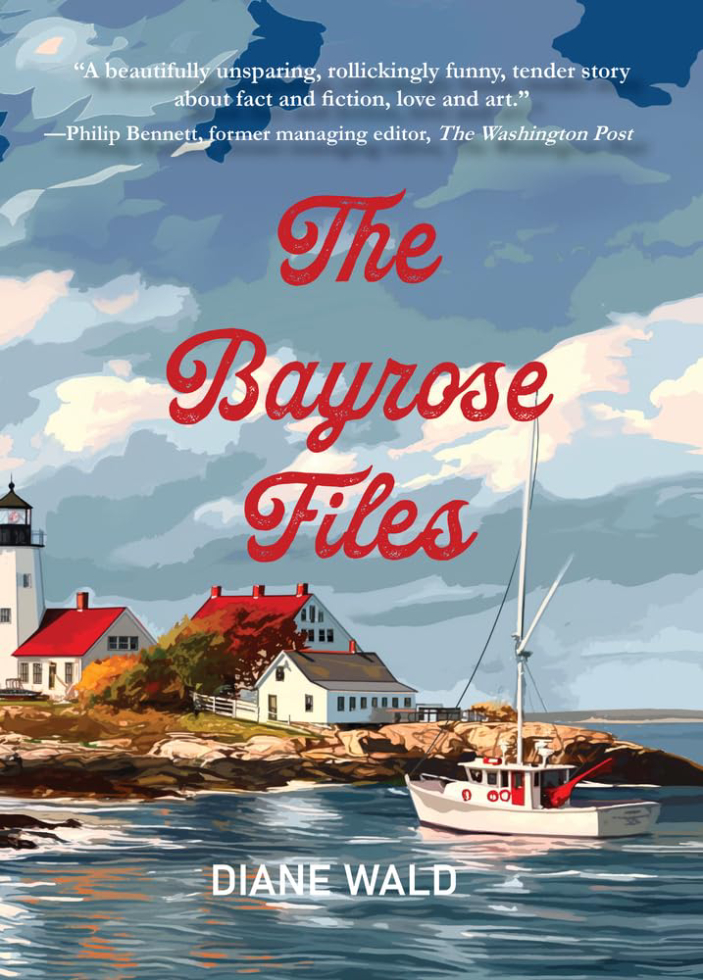

Ambitious young journalist Violet Maris secures a coveted residency at a prestigious artists’ and writers’ colony in 1980s Provincetown, armed with a file of stories written by a dear, older gay friend. Her intention: to write a captivating exposé based on these narratives. However, Violet’s promising start at the colony takes a dark turn when tragedy strikes— her friend, the true author of the stories, succumbs to AIDS.
‘The Bayrose Files’ opens – as perhaps all good stories should – with a cryptic revelation. The first line of prose feels like a John Grisham novel, immediately capturing one’s attention and leaving the reader wanting more. The protagonist, Violet Maris, introduces herself and wistfully intones that she has done something terrible. What did she do? To whom? What was her motivation? All the questions eventually get answered in due time.
Principally set in Provincetown at the tip of Cape Cod, Massachusetts, the novella paints an endearing portrait of a fishing community that caters to large tourist contingents in the temperate summer months. Although Violet shares a history with the coastal community, she nonetheless learns of a place called the Provincetown Home for Artists and Writers (PHEW) only inadvertently from a young poet applying for a fellowship.
While something of an aspiring writer, Violet has settled over the years on the more realistic profession of journalism – a field which she believes more closely aligns with her talents. To learn more about PHEW, Violet makes an exploratory two-hour drive from her apartment in Boston to Provincetown to gather information. She hopes to craft an exposé that will result in a freelance sale to a prestigious publication.
Upon arriving in Provincetown on her reconnaissance trip, she steers clear of an obvious tourist hangout, opting instead to start at the locals’ bar. There she meets Eugene Pelletier, who goes by Gene, whom she quickly learns is on the board of PHEW – more frequently referred to as The Home. Unfortunately for Violet, Gene politely declines to divulge any details that would make for a good story. Other locals she encounters in Provincetown are similarly close-lipped.
Disappointed, she returns to Boston and shares her desire to uncover the secrets of The Home with her dear gay friend Spencer Bayrose. During their conversation, Spencer decides to share his unpublished writing samples, which they both agree are quite good. Rather than seeking a publisher for his work, Spencer proposes that Violet use them to apply for the eight-month fellowship at The Home to get a look behind the curtain.
Initially reluctant, Violet agrees to Spencer’s plan and so sets in motion her tale of deceit and lies. She applies to The Home and is accepted. She quickly sublets her Boston apartment and moves her belongings in one carload to Provincetown.
As Violet gets to know the other fellows, she realizes that much of her concocted backstory must remain hidden because the writing samples submitted for admission are not her own. The challenge is exacerbated by the fact that the stories, penned by Spencer, are written in a male voice.
A sort of sixth sense Violet possesses is the ability to sense prospective peril by a somewhat unusual means – it occurs when she touches an object that is unexpectedly warm, signaling that something may be amiss As events progress, however, it appears that the warning is not supernatural so much as a manifestation of her subconscious guilt.
Set in the early 1980s, ‘The Bayrose Files’ explores Violet’s nearly year-long journey into a world of writers, poets, and artists, each with their own unique story. Although the novella maintains a brisk and engaging pace, it also takes the time to savor the atmosphere of the small harbor town, which also hosts outsiders on a seasonal basis. Violet’s exploits take several emotional twists and turns along the way, which will both satisfy and engage readers. Although she is eventually found out, the book leaves the last scene to the imagination – a potentially uncomfortable reunion with Gene that provides a nice touch, allowing the audience the opportunity to write their own ending to this delightful tale.
In Bookstores, May 27th