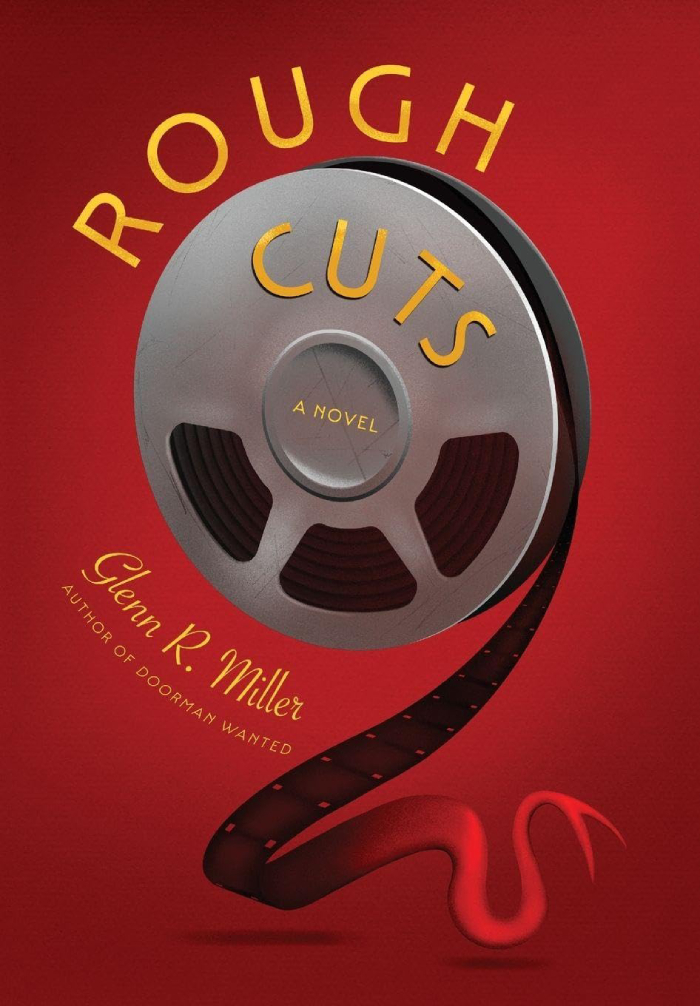

It’s 1926, and the world of film is about to change forever. On the cusp of “talkies,” directors and actors fear their greatest days might soon be behind them. Patrick J. Shepard, a director at the end of his career, has just completed his masterpiece, his vehicle for eternal fame. But there’s one problem: Ohio.
Written by Glenn R. Miller, ‘Rough Cuts’ slices through the censorship and pretense endemic during the Prohibition Era. It is a study in contrasts between West Coast and Midwestern sensibilities in the Roaring Twenties ahead of the coming depression. As the book opens, Hollywood had transitioned from mostly short films – essentially a novelty – to feature-length movies, spurred in no small part by D.W. Griffith’s innovative, popular, and blatantly racist “The Birth of a Nation,” released in 1915. The emerging studio system subsequently ushered in significant cultural and economic changes using the medium of motion pictures that persist to this day.
Miller examines the period largely through the eyes of famed director Patrick J. Shepard, beginning with the wrap-up of his penultimate production, “The French Student,” in 1926, shortly before the advent of talkies. Despite his notable successes to date, Shepard has his sights set on a grand finale called “The Mating Seas-On” that he believes will seal his legacy in Tinseltown.
Meanwhile, out in the backwaters of Marietta, Ohio, Reverend Harold Dawdry struggles to increase attendance for his 9 a.m. Sunday service at Grace Episcopal Church. He fancies himself a conservative Midwesterner, albeit a sophisticated one, barely acknowledging his recent arrival from Brooklyn. Nonetheless, he dreams of bigger things. When the senior pastor, Reverend Cox, suggests that Dawdry take an open slot on the state film review board, the young minister sees the opportunity for greater visibility and power, and readily accepts the offer.
From an early age, Dawdry has maintained a jaundiced view of movies, so he’s somewhat out of place at his first screening. Once inside, he marvels at the local Hippodrome, with its velvet seats and suspended chandeliers, and at the large number of patrons.
Here, it’s worthwhile to digress to note that during the 1920s, “picture palace” attendance grew from 40 million in 1922 to 60+ million by 1927. Prior to the widespread introduction of television after World War II, Americans frequented theaters as many as two or three times a week. In addition to radio broadcasts and newspapers, Movietone newsreels provided a significant source of current events, which were shown before the main feature film.
The early movie industry was largely self-censored, though a 1915 Supreme Court decision (later reversed in 1952) ruled that movies were not entitled to First Amendment protection. As such, state and local boards were given the right to ban films at their discretion. Beginning in 1930, the Hays Code formalized allowable film content until 1968, when the Motion Picture Association established its own rating system.
Meanwhile, getting back to ‘Rough Cuts,’ Dawdry’s initial encounter in the movie palace does not go well – his personality doesn’t mesh with the other patrons – and he is ejected by an usher. Nonetheless, Dawdry perseveres and begins to incorporate his findings – or scorecard, as he calls it – as a state movie censor into his weekly sermons, thereby increasing attendance among both newcomers to the church and defectors from Reverend Cox’s 11 a.m. service. Dawdry almost gleefully emphasizes his perspective on the more tawdry aspects of the films, ironically to the congregation’s delight. The scandalous descriptions have an unintended effect – folks love it – and Dawdry is pleased at the response.
As a result of shifting attendance between the two weekly services, Dawdry and Cox engage in a not-so-subtle power struggle regarding the politics at Grace Episcopal. Cox, the old-timer, appears to have bitten off more than he can chew by elevating Dawdry to the state commission, with its corresponding influence over churchgoers. However, the seasoned cleric is nobody’s fool and has a trick or two up his sleeve.
Back in Hollywood, studio head Edward Patschwald, known affectionately as Patches, regularly spars with Shepard, primarily over budgets and cost overruns – a familiar story. It’s a love-hate relationship, with the arguments invariably forgotten over their subsequent lunch. Similarly, despite sarcasm and intermittent teasing with cast and crew, Shepard builds a strong sense of camaraderie on his movie sets.
Upon completion of principal photography and post-production for “The Mating Seas-On,” with the film headed to nationwide release, Dawdry becomes an obstacle. The ambitious minister, breaking away from his fellow board members, wants a substantial number of changes and edits before the film is distributed in Ohio. Shepard jumps into action, taking counsel from the wily Reverend Cox along the way. Ultimately, Dawdry’s hypocrisy allows him to be co-opted by Shepard, almost like a mark who doesn’t know he’s been had.
References to period film and stars such as Charlie Chaplin, Gloria Swanson, and Buster Keaton, among many others, abound. The push and pull among the conflicting interests of popular entertainment, artistic expression, and regulatory oversight provides an engaging backdrop for the well-crafted storyline. “Rough Cuts” offers a humorous look, sort of a slice of life during a year in the 1920s movie business.
Available in Bookstores September 26th