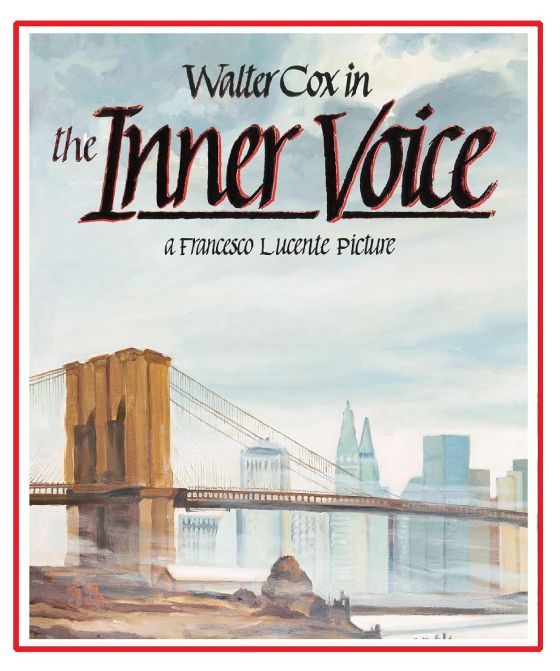
“The Inner Voice” is the story of one man’s mission to become a famous motion picture director. Blind ambition drives him to lose sight of everything and everyone around him, as if he were on a “mission” from “God”, until he loses it all and learns that respect and friendship are the only values that matter.
“The Inner Voice” is a 1995 motion picture directed by Francesco Lucente about an aspiring writer-director who will do almost anything to get his indie film produced. Toward that end, he falls prey to an unscrupulous intermediary who claims to have access to a money man who can underwrite crews and equipment.
Director Johnny Penn’s (Walter Cox) project is titled “Fatal Suspicions,” based on a true story from the newspapers. Johnny runs with the idea, fleshing out a script he hopes to direct, which isn’t unusual for independent filmmakers.
His screenplay centers on a group of children who play a make-believe war game once a week. They look ominous, but they’re still just kids. As Johnny narrates the action, armed with their stick guns and stalking pretend enemies in a grassy field, he envisions a soundtrack of shooting and bombs, not the real thing, of course, to heighten the impact for viewers. As the teenage Cloak (Claudio Gagliardi) and Dagger (Joseph R. Straface) track the other team, one of the kids finds a pistol, accidentally shoots and kills another, and thus scars him for life.
As Johnny writes, his girlfriend Veronica (Liese McDonald) offers suggestions to make the writing punchier, which he appreciates. As the couple is roused from bed in the morning, a fellow named Leon (Brian Gromoff) enters their warehouse apartment via the freight elevator, more or less uninvited, accompanied by his son, Cy (Roman Danylo). Leon claims to have lined up financing with a producer who likes Johnny’s outline for a movie.
 Over several days, Leon and Johnny meet for breakfast, lunch, and after-hours drinks to check on the status of the script and the money. Lots of talk but not much action from Leon, who always picks up the check. Eventually, Leon springs the trap on Johnny, saying the producer is leaving for Italy but they need to start shooting right away. Leon says he can put up ten thousand dollars if Johnny can also front some funds. Johnny’s only source is a joint bank account with Veronica that could add as much as twenty thousand to the venture.
Loath to betray Veronica’s trust, Johnny counsels with his buddy Rick (Lee Barringer), who advises against tapping the shared account. His childhood friend Father Joe (Joe Barille) also says it’s a bad idea. Despite his inner turmoil, Johnny uses Veronica’s money to start shooting, handing it over to Leon, who arranges for the camera and crew; shortly after, he disappears.
When Veronica finds out what happened, she is furious and eventually breaks up with Johnny. After being kicked out of their apartment, Johnny is forced to move in with his sister, falling into a deep depression. Months later, Cy unexpectedly shows up. He feels bad about how Leon swindled Johnny and wants to use money he stashed away to help. Cy actually has enough to pay Johnny back and finance the completion of the film.
When Johnny returns the twenty-thousand dollars to Veronica, they have an awkward moment, unsure of what to do. Later, as he concludes shooting of his refinanced film, Veronica appears on set, and they reconcile.
In another scene, karma catches up with Leon when hoodlum debt collectors shoot him on a fire escape. Though Johnny saves Leon, he pledges to distance himself from any more shady deals, revealing that his desperate desire to direct a feature film at any cost was appallingly misguided and morally wrong. Perhaps as a kind of redemption, Johnny makes the cover of Rolling Stone and other publications touting his acumen as an independent filmmaker, finally achieving the fame he coveted.
The plot of Johnny’s movie borrows from “The Godfather” on the day the Corleone family takes care of business at the end of the trilogy, when enemies are systematically killed. Similarly, Cloak (Giuseppe Lucente) and Dagger (Joseph Romano) locate and assassinate the other kids, now adults, involved in the accidental shooting years earlier.
Written by Joseph Bitonti, the two threads comprise a promising narrative spark, though the marginal acting and a languid pace drag down the production. Now available in restored Blu-ray format, the set includes a soundtrack CD featuring Ludek Drizhal’s compositions. “The Inner Voice” is a partially successful attempt to create a psychological study of a director obsessed with success, no matter the cost.
Now available on Collector’s Edition Blu-ray™ from RUBY MAX ENTERTAINMENT