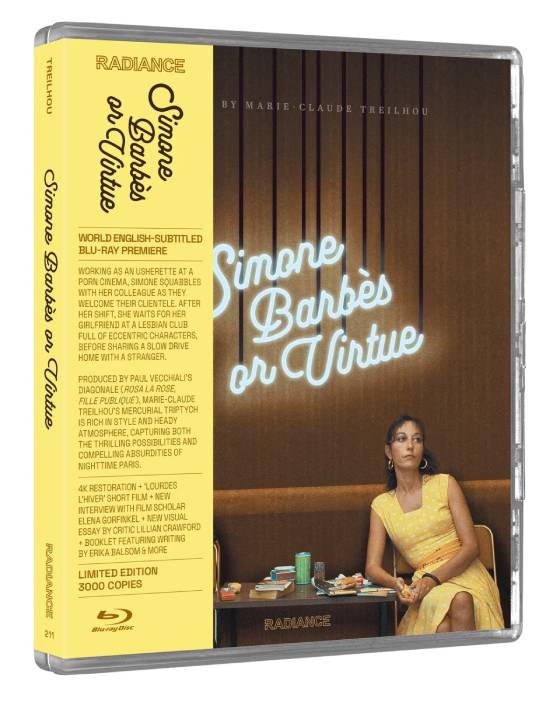

Simone and Martine are usherettes in a porno cinema in Montparnasse. Installed in the hall, they greet regulars, put men in their place, chat, and pass the time. At midnight, Simone departs to a lesbian nightclub.
Ingrid Bourgoin, as the title character, plays an usher in a porn cinema house converted from a restaurant years before. Her employee Martine (Martine Simonet) sits beside Simone, their two plain chairs separated by a similarly nondescript table in the Spartan lobby. Behind the women hangs a pair of yellow neon eyes, one raised slightly as an arched brow, implying mild disapproval. The framing suggests a nod to the eyes of Dr. T.J. Eckleburg on the billboard in F. Scott Fitzgerald’s “The Great Gatsby” overlooking the Valley of Ashes, a metaphor for nostalgia and regret.
The two women talk, giggle, and smirk at the predictable, awkward nature of the clientele. It’s pretty ordinary stuff: two women chatting openly about their everyday lives in front of oblivious men. Martine is chronically late to work, complaining about problems with her boyfriend, whom she says is being unfaithful. Simone applies some tough love, assuring her friend that he couldn’t live without her and there’s no need to worry. Like several characters in the film who hope to transcend the mundane, Martine yearns for the stage, reciting lines from movies or plays to unimpressed customers who came for other reasons altogether.
Men of all races, classes, and religions descend the stairs from the street through the glass entrance, all drawn by the same thing. Despite disparate backgrounds, a shared motivation unifies them as they cross the threshold into one of four screening rooms, disappearing for a peek into the dark. It’s not great art, but as Simone counsels a customer, “What kind of movie do you like? Because we don’t show ‘Gone with the Wind’ here.”
A Belgian director (Noël Simsolo) of one of the films stops in, emerging unhappily because he claims the format of his film is incorrect and that it’s out of focus. Simone replies that the customers don’t care. Here again, the women find the egotistical male histrionics laughable as the director leaves the theater in disgust.
Similarly, when a customer complains that the show’s content is second-rate, Simone tells him to get lost, along with generous helpings of profanity. Later, a pretentious amateur critic voices his opinion to the convenient audience of Simone and Martine, which mostly reveals his own shallowness and the empty life that requires an escape into vapid fare. Somehow, he and the others hope to find meaning through the raw, graphic performances.
In but one example of how the film takes the glamour out of the porn business, Simone crosses her legs to massage her foot, saying that her feet ache. Though unquestionably attractive, Bourgoin hardly appears sexy in the moment. The unctuous moans and screams emanating from behind the doors each time someone enters or exits provide more than enough detail about what’s going on inside the darkened rooms.
At midnight, Simone takes her leave of Martine and goes out seemingly to nowhere in particular. She finds her way to a club at the top of a wide, marble staircase lit in red. On the wall is a mural with green lights peering from Paris skyline windows, capped with a view of a windmill just outside the Moulin Rouge cabaret entrance. She meets her lover at the lesbian nightclub, where a diverse set of patrons and performers exhibit shamelessly. It’s a surreal setting, full of expressive faces and edgy, stylistic French culture. Despite the pageant, it’s late, and Simone grows weary of waiting for her friend, so she heads for home.
As she walks, an older man in a Volvo drives alongside, propositioning her. In a twist, she tells the man she will accompany him but insists on doing the driving. As they cruise the streets of Paris, the two talk about life and sex, each glancing furtively at the other along the way. On a different night in a different mood, Simone and the gentleman might have spent the night together. Instead, they simply part amicably as the credits roll.
Directed and co-written by Marie-Claude Treihou, “Simone Barbès or Virtue” unfolds in three acts over a single night. Set in the seedy Montparnasse section of Paris, the streetscapes are enticing, both gritty and vibrant at the same time. The Blu-ray disc special feature includes a brief behind-the-scenes analysis of the symbolism and a snapshot of the 70s in the incomparable, cosmopolitan city of Paris.
Now available on Limited Edition Blu-ray™ from RADIANCE FILMS