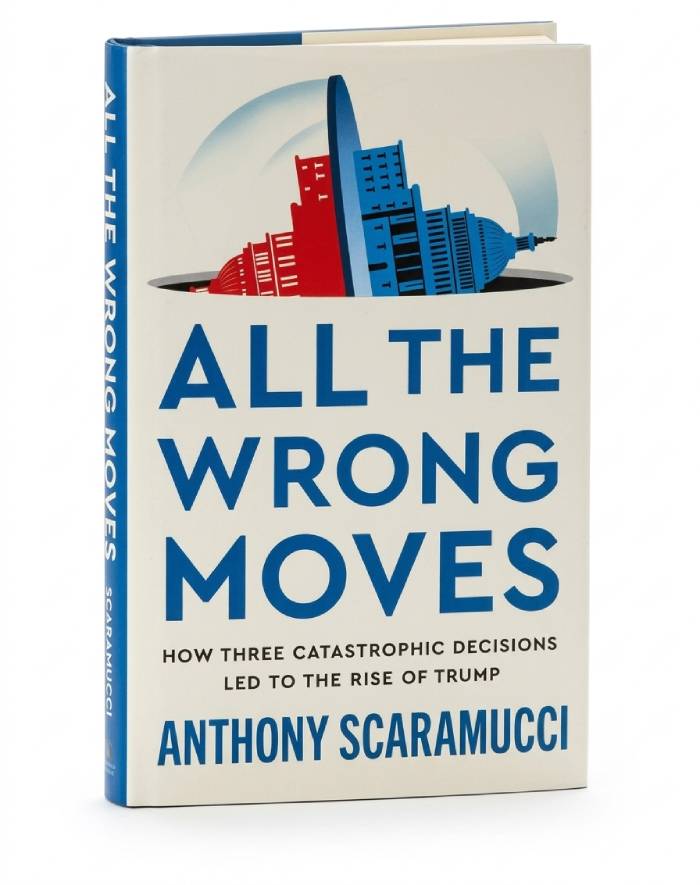

We’re living in an age of deep political anger and frustration. Where did it come from? All the Wrong Moves offers a new, eye-opening answer, rooted in history, business, and the author’s firsthand experience, that reveals the true origins of America’s current political crisis.
Any sort of comprehensive knowledge of history remains a challenge for most Americans. Some of that may be due to K-12 education systems that emphasize dates of events rather than narrative structures, similar to the way math grades rely on memorizing multiplication tables instead of developing a more comprehensive understanding of the elegance and ultimate clarity of the discipline. Even more disconcerting in the case of U.S. economic and political history is that many of the challenges that confront us stem from measures that have occurred within living memory.
Anthony Scaramucci is uniquely positioned to chronicle the timeline for a variety of reasons. The most obvious is his tenure inside the first Trump administration. However, at least one other noteworthy experience is his extensive familiarity with the financial sector, summarized by what he calls the Money Point of View of History. While seemingly simplistic, it actually brings to light a clearly important element of daily life that our better angels tend to want to discard or minimize in favor of alternative motivations like love or altruism. In reality, everybody wants a fair shake, and wealth as a scoring mechanism figures prominently in most people’s minds. For with money, especially really large sums of the stuff, comes power, which can and does get wielded around imperiously in America.
With enough assets, a microscopically small percentage of the population can leverage outsized influence over the rest of us, enabled by a single person that most of the elite, according to Scaramucci, regard as an imbecile. Trump and his coterie of willing conspirators represent the culmination of a short list of actions dating back only to around the turn of the 21st century.
It’s worth noting that Scaramucci writes as an equal-opportunity critic, lambasting public figures on both the left and right sides of the political spectrum. The shift in economic policy by the government has been keenly documented by other geopolitical analysts such as Chris Hedges and Peter Zeihan. Scaramucci refreshes the perspective, offering an update essentially in real time, though the results of the recent midterm election blowout were not yet known when the book went to press.
Basically, the precursors leading up to the surprise election of Donald J. Trump to the presidency in 2016 consist of:
- The Clinton administration’s support for China’s admission into the World Trade Organization as a full member, which gave the country-wide access to American markets, had devastating impacts on American workers. NAFTA’s inclusion of Mexico in the trade deal contributed significantly as well.
- Similar to the way LBJ escalated the Vietnam War without raising taxes to support it, George W. Bush invaded Iraq under specious claims while simultaneously cutting taxes, thus shifting the burden of the misguided conflict to middle America.
- Obama and Bush policies bailed out Wall Street while again penalizing average Americans, essentially serving up socialism for the wealthy and hard-edged capitalism for everyone else, including many future Trump supporters.
Notably, two of the three Catastrophic Decisions above, as Scaramucci refers to them, were accompanied by significant grassroots protests. China’s admission into the WTO was met with severe pushback in Seattle in 1999. And the Wall Street bailouts were opposed by the majority of Americans, with protests in New York, yet essentially ignored by Congress. Both events served to reinforce belief in the Deep State.
To his credit, Scaramucci delves into the economic history of the U.S. by covering the rise of industrialization and the associated politics with President Lincoln. He also addresses the social programs associated with FDR through the national emergencies of the Great Depression and World War II. Both men expanded presidential power, but neither advocated for unrestrained power residing with one person, the so-called unitary theory baselessly promoted by neocons and the current administration.
Perhaps most interestingly, Scaramucci quotes Lincoln saying that labor is superior to capital and deserves much higher consideration in our political economy. Human effort precedes capital. In fact, without labor, there is no capital at all. Yet many business leaders and economic theorists give little or no regard to the value of labor. In the spirit of FDR in the years following the Great Depression and World War II, both the Truman and Eisenhower administrations held to the view that returns from increases in productivity should be shared more or less equally between capital and labor. However, since the late 1970s, all of that began to change, with the damage to the middle class exacerbated by the three key milestones detailed by Scaramucci.
As potential remedies to address the recent excesses, the author offers five policy changes and three Constitutional amendments. The proposed prescriptions deal with mergers and acquisitions, taxation, tariffs, election spending, gerrymandering, and Department of Justice independence. Some are clearly long shots, but well worth contemplation nonetheless. The picture of the economic landscape painted by Scaramucci provides for fascinating and engaging reading. It will give prescient insight for those folks inclined to pick up a copy, and as far as that goes, the more the better.
Now available in Bookstores