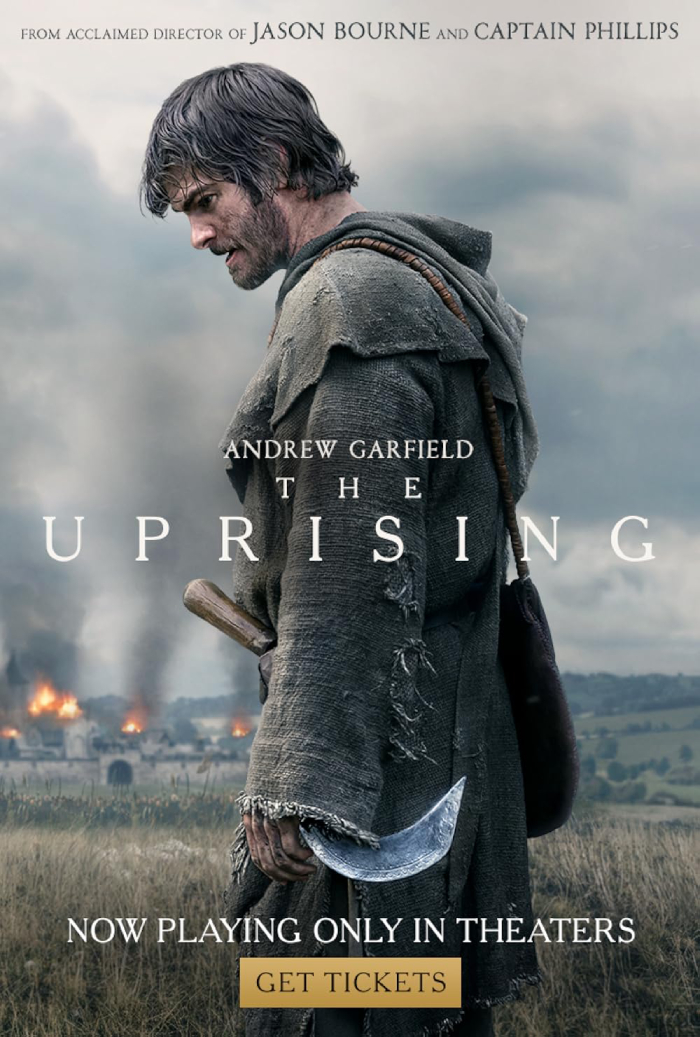
Based on the true story of the uprising that inspired the legend of Robin Hood, Andrew Garfield stars as the leader of a rebellion against King Richard II’s tyranny in a fight for justice.
Paul Greengrass has never been particularly interested in making history look pretty. With “The Uprising,” the filmmaker behind “United 93” and “Captain Phillips” transports audiences to medieval England for a muddy, bloody, and thoroughly engaging depiction of the 1381 Peasants’ Revolt.
Andrew Garfield stars as a man simply referred to as “Ploughman,” a common farmer living in the devastating aftermath of the Black Death. England may have survived the plague, but the ceaseless death has left them questioning their place under a tyrant’s rule. The Ploughman carries tremendous loss and grief with him, and Garfield beautifully conveys a man who has already endured more suffering than anyone reasonably should. Yet grief hasn’t broken him.
When he witnesses the royal court continuing to abuse and exploit peasants already struggling to survive, he refuses to look the other way. There’s something quietly heroic about the Ploughman. He isn’t introduced as some proud warrior destined to lead a revolution. He’s an ordinary man whose decency won’t allow him to remain silent while others suffer. And, as he quickly discovers, he’s not alone.
Jamie Bell is terrific as radical preacher John Ball, while Cosmo Jarvis brings a zen-like intensity to veteran rebel leader Wat Tyler. Thomasin McKenzie similarly impresses as Alyce, a young woman violated by a noble, giving the uprising another deeply human face as simmering resentment across England finally explodes into open rebellion.
Greengrass wisely avoids making any of this look like a glossy Hollywood epic. The extensive use of natural lighting gives “The Uprising” a dirty, lived-in quality. Its peasants emerge from muddy fields and dim gathering places looking as though they’ve literally sprung from the earth itself.
It creates a striking visual contrast with the royal forces. The ruling class hides behind polished armor, stone walls, and ceremony, while the rebels are covered in dirt, sweat, and blood. One side feels protected from the world, the other feels at one with it.
Once the rebellion grows, Greengrass puts his trademark immediacy to excellent use. Massive crowds fill the frame as ordinary men and women march toward London, and the sheer number of people joining the cause makes the revolt feel genuinely overwhelming. I found the level of brutality appropriate, but Greengrass never loses sight of the humanity caught behind this conflict.
The pacing of “The Uprising” keeps the rebel spirit alive. Even with the spirit of Robin Hood, the film is more about rebellion. At just over two hours, “The Uprising” only loses its momentum just before the final act. Its sprawling ensemble leaves certain characters underdeveloped. Still, Garfield’s soulful performance and Greengrass’s visceral filmmaking keep the story grounded.
This is ultimately what makes “The Uprising” work: these people have survived disease, death, poverty, and grief, only to discover that those ruling them still want more. Eventually, somebody has to say enough.
In Theaters Friday, September 11th