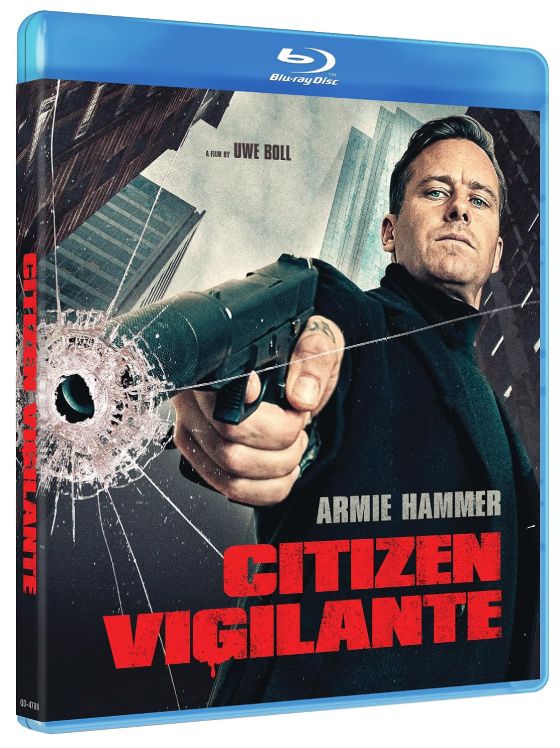
A man takes justice into his own hands and hunts down criminals. His vigilante crusade makes him a social media star but puts him at odds with the local police chief.
Uwe Boll’s Citizen Vigilante is crude, angry, and very difficult to disentangle from the political controversy surrounding it; it is both an action thriller, a revenge fantasy, and an ideological attack, and it tackles topics which mainstream studios generally handle with much more caution. The film aims to speak frankly on the issues of migration, violent crime and institutional failure. At some points, that frankness is its main strength. Just as frequently, however, it serves as an excuse for a superficial and inflammatory narrative.
Armie Hammer portrays Michael Sanders, a wealthy American businessman and ex-soldier who lives in Europe. Believing that violent offenders are avoiding proper punishment, Sanders starts to target criminals as well as the officials that he thinks have allowed them to get away with it. As a result, he becomes an online folk hero even though the authorities are approaching him. The clash between personal revenge and the rule of law is at the heart of the story, although the film shows its more general concerns from the beginning: what occurs when people cease to trust the courts, the police, and public officials to protect them?
The fact that Boll is willing to put that question is one of the film’s more positive features. By taking on issues such as European migration, leniency of the judicial system, urban crime, the decline of institutions, and people administering justice upon themselves, the film makes a bold stand. Boll and the film’s supporters maintain that such topics are raw and provocative ones which mainstream Hollywood studios generally avoid, especially when crime and migration are linked together. There is some merit in being willing to enter such a sensitive political area. Films ought to be able to present people’s uneasy fears and public resentment without smoothing over every aspect of them.
The film also has a rather rough and ready charm as a nod to unfiltered vigilante movies; it fits into the tradition of exploitation cinema in which the official institutions fail, and a single angry man then reacts with violence. There is no refinement in it and very little restraint is shown. Rather than attempting to convince the audience, Boll provides a low-budget revenge fantasy that seems designed for being watched in the late hours of the night, for sparking heated arguments and causing strongly divided reactions. It is not so much concerned with persuading viewers as with confronting them.
The film gains more significance than its building suggests. In his high-profile comeback to a leading role, Armie Hammer puts himself into the part with commitment, physical confidence and a strongly controlled intensity. There is a cold and deliberate quality to his performance, which is appropriate for a character who considers himself morally entitled to pass judgment on others.
The screenplay doesn’t do much for Sanders. Rather than being presented as a fully realized individual, he is treated more like a vehicle for expressing the film’s political views. Sanders is almost never shown as vulnerable, doubtful, or truly conflicted, which gives Hammer very little opportunity to demonstrate how the character’s moral reasoning evolves over the course of the story. Yet the actor gives a full commitment and, even when the dialogue becomes stiff or preachy, retains a strong presence and prevents Sanders from disappearing into the overall production.
The film is considerably less well-controlled; its non-linear timeline is chaotic, and the editing tends to blur the story rather than clarify it. The scenes are presented with insufficient preparation, characters appear and disappear without much regard, and significant developments are not always given adequate dramatic emphasis. Rather than gradually building up to a moral and emotional crisis, the narrative is more like a series of loosely linked confrontations.
The movie has no clear or coherent overall structure. Although Sanders shifts from one target to another, his actions seldom result in any significant personal growth. There is some impetus provided by the legal aspect, but this cannot make up for the lack of a strong narrative backbone. If the poor production quality had generated a sense of urgency or danger, it might have been appropriate to the material; too frequently, however, it just gives the film the impression that it’s incomplete.
The real issue is the way Citizen Vigilante deals with political matters. The story makes heavy use of fear-mongering, anti-immigrant language, and broad generalizations. Migrant groups are usually portrayed in a criminal light, while judges, the police and other authorities are shown as weak, gullible or corrupt. Since the film presents the social system as entirely broken, Sanders’ act of violence can seem not only sensible but also inevitable.

There is very little scope for complexity in this approach, since each individual criminal is made to stand for the whole of a community and institutional failure is used as proof of a broad cultural censure. Critics who have described the film as racist and reactionary have a good reason for doing so. The issue is not that the movie shows migrant crime or public fear since both of these can be valid subjects for a dramatic treatment. The real problem is that it constantly uses ethnicity and migration status as stand-ins for danger and then offers very few credible counterexamples to its stereotypes.
A film that had given the matter more thought could have used Sanders’ campaign as a means of examining how justified anger can turn into fanaticism; it could have considered where punishment stops and collective revenge starts, or whether a person who says they are defending society can end up being a greater threat to it. While Citizen Vigilante does touch on these issues, it never really looks into them and, in the fictional world it creates, favors Sanders by depicting institutions as irrevocably compromised and presenting his victims in such a way as to elicit no sympathy.
The fact that it is a revenge fantasy undermines the film. Revenge stories are most effective when they manage to make revenge both alluring and terrifying. The audience should grasp the protagonist’s rage while at the same time becoming more and more disturbed by his actions. Boll is so committed to causing a public outcry against criminals and public institutions that he fails to take into account the more interesting moral implications of Sanders appointing himself as both judge, jury, and executioner.
Even so, completely rejecting the film would fail to take account of what makes it significant. While the movie expresses a kind of public anger which is present outside the film itself—even though it does so in an irresponsible way—its themes concerning the decline of institutions and the loss of confidence in the justice system are pertinent. The film’s harsh treatment of European migration will cause it to be sharply divided along political and cultural lines. For some viewers, it will represent a forbidden discussion about crime and failed governance; for others, it will appear as a violent fantasy based on xenophobia and racial resentment. Both of these responses are connected to what the film deliberately includes on screen.
At times it makes a blunt impact as an example of grindhouse-style action. Because Boll shows no restraint, an abrasive energy results, which smoother work in a studio setting could have softened. Hammer’s committed performance brings a certain level of professionalism and seriousness. The film is most effective when it acts as a dirty and unapologetic B-movie rather than attempting to provide a full diagnosis of modern Europe.
Citizen Vigilante functions better as a cultural milestone than as a well-put-together film, and it merits some recognition for addressing judicial leniency, institutional failure, and public anxiety without passing them through the usual studio conventions. Moreover, it is helped by Hammer’s strong comeback in a leading role and by its appeal as a no-frills vigilante thriller.
Because of its bad editing, disorderly chronology, and weak plot structure, it fails to function properly as drama. Even more serious, its reliance on anti-immigrant generalizations turns serious issues into inflammatory provocations. The outcome is a film which provokes discussion on the subjects of law, order and social trust but does not have the strength of mind to examine them in any great depth.
The fact that it refuses to behave is terribly attractive. Likewise, there is a serious concern about the worldview it asks viewers to accept. Citizen Vigilante aims to act as a punch in the face, and it does so, even if it isn’t always for the reasons that Boll may have intended.
Now available on Blu-ray™