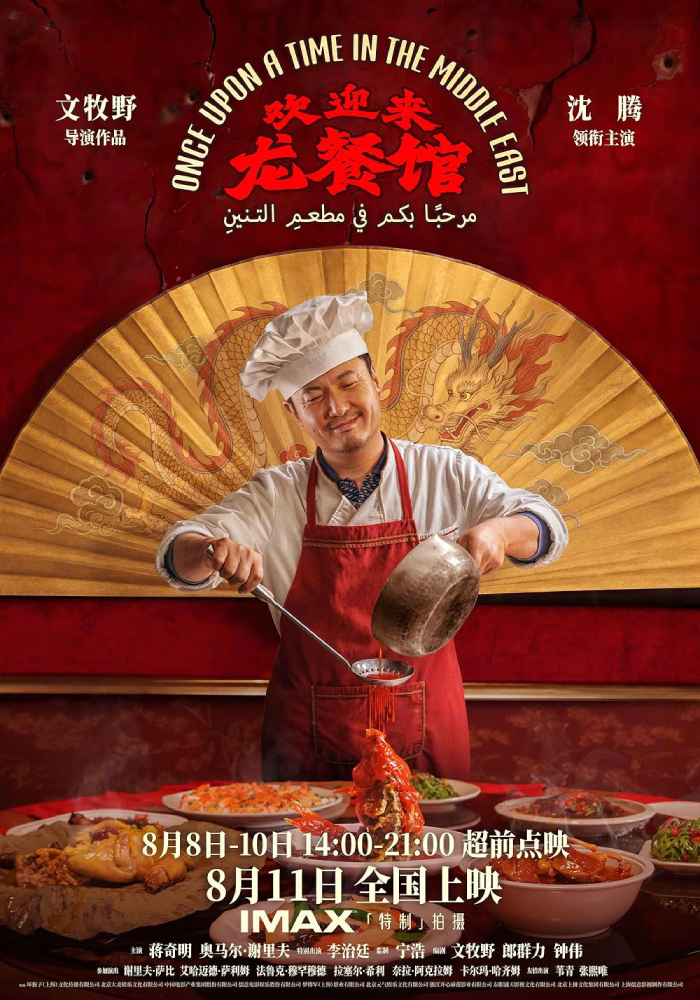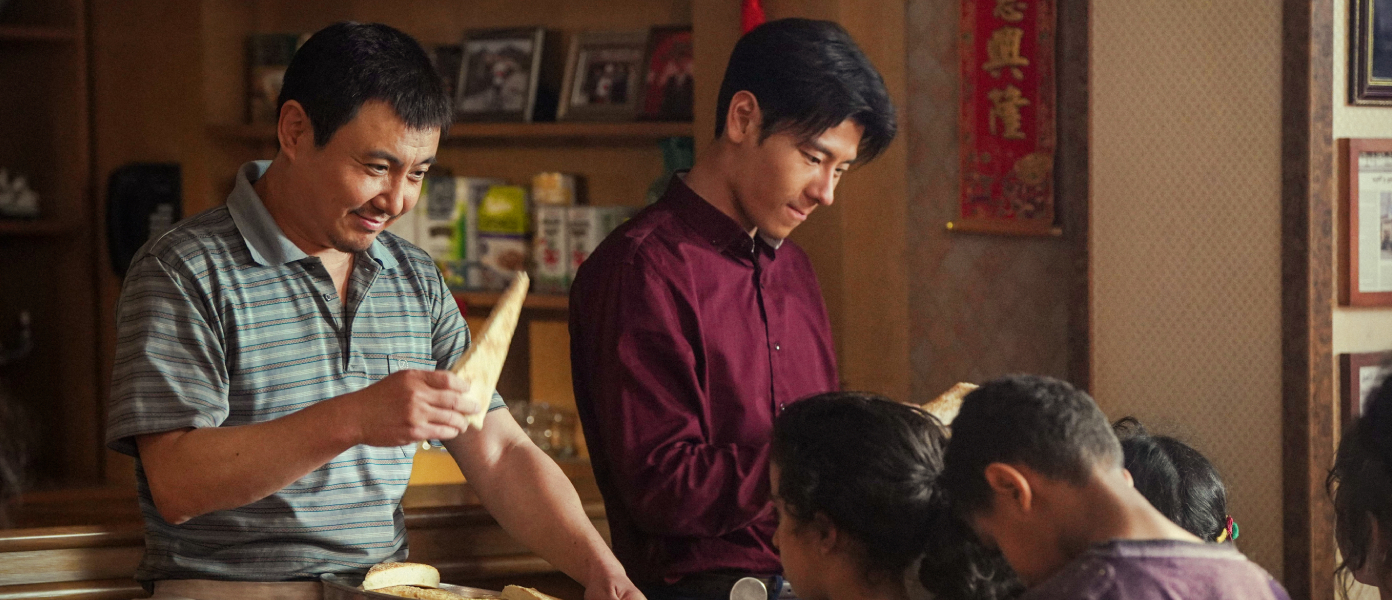

One of China’s biggest stars, Shen Teng, stars in an acclaimed international box-office sensation about a chef who turns a struggling restaurant into a refuge and risks everything to protect his community when war engulfs the city.
Shen Teng as Xu Fu stars in a heart-wrenching film about a father who is compelled to travel fifteen hours from home to live and work for two years in the town of Bahata because of debts incurred when his restaurant in China burned down. Bahata is a fictional city in a fictional Middle Eastern country, clearly modeled on Baghdad, Iraq. Xu plans to make fast money and then return to China flush, to a normal life. This is not an easy choice given that he must leave behind his daughter Xu Le (Zhang Xiwei) and mother (Wei Qing). Not surprisingly, things do not go as planned.
Xu has been tentatively selected as head chef of the Loong Chinese Restaurant in Bahata. His fellow countryman Junsheng (Jiang Qiming) is the floor manager. When Xu first arrives at the restaurant to meet with the owner, Zaid (Sherif Sobhy), an official of Bahata’s regime and owner of the Loong Restaurant, the place is nearly empty, and the two men’s conversation is tense. Zaid complains that the sample dishes are too spicy, too salty, and that the sauces are too thick because they have been reduced too much for local palates. Xu pushes back on the criticism of his authentic Chinese cuisine, speaking Mandarin, while Junsheng translates back to Arabic. Still, at the end of the meeting, Zaid is satisfied and hires Xu. Soon, the restaurant is crowded and popular; a line stretches out the door, and there aren’t enough tables, all because of Xu’s exquisite cooking, a nice thread that runs through the movie.
The setting feels authentic, with dusty urban streets and heavy pedestrian traffic. Sitting outside the restaurant before work, Xu attempts to learn basic local language phrases, as expats often do. Xu hears commotion inside the restaurant and catches some kids, war orphans, stealing food and running away. When Xu confronts them, Junsheng’s fiancée, Lina (Naira Al-Qasim), a teacher, admonishes the orphans not to steal again. At the same time, Xu and the children begin to form an unexpected bond.
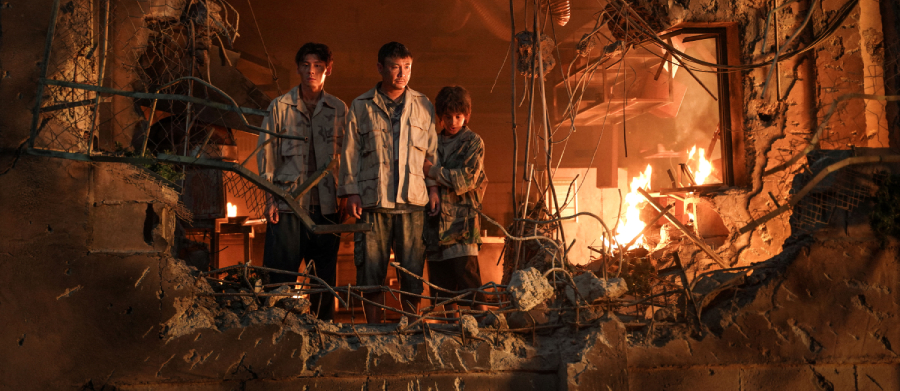
Very soon after Xu’s arrival, indiscriminate bombing wakes him and Junsheng in their apartment, still dark outside, shattering the windows. It’s a gripping visual that contrasts sharply with the sterilized look of war seen by Americans on television thousands of miles removed. One might almost get the impression from CNN or ABC News footage that locals in the Middle East are inured to such pandemonium, since it seems to happen all the time, which is an inane and superficial take on matters. People are people, and literally everyone, wherever they are, runs frantically through the streets trying to find safety. The cinematography exudes urgency, skillfully staging Xu and Junsheng scrambling amidst the crowds, fleeing haphazardly, even as others step on a dead body on the ground. The filmmaking’s immediacy and visceral nature are truly impressive. Despite the chaos, the two men change course and head back into the conflagration to the orphanage to collect Lina and the kids. They find relative safety in a packed bunker, where children shiver in the cold underneath the burning city.
Not far from the scene, an ancient television set blares, and Anglo foreign correspondents, with their starched voices, matter-of-factly report that this country has fallen. The new occupying army is from the U.S., and the time period is around 2003, a not-so-subtle nod to the invasion of Iraq. In a matter of days, the U.S. disbands the military and police, turning over the existing government to the inexperienced opposition party, a classic fumble in nation-building exercises, yet one that continues to be made even today. As any competent city manager will tell you, keeping the lights on and water running requires training and experience.
Xu and Junsheng help the orphans by obtaining and making food for them, though Xu intends to leave the Bahata and return home, given the dire situation. However, the owner comes up with an idea to salvage the business. They will cook and deliver food to the safety zone – essentially the equivalent of the Green Zone in Iraq under George W. Bush. Xu is reluctant to stay, but Zaid offers to double his salary. Instead, Xu wants a 50-50 share of the profits and the title of restaurant boss, to which Zaid agrees because he knows he’s still getting a good deal. Jungsheng isn’t happy with this new deal because Zaid promised him half ownership years ago. Xu tells Jungsheng he’s only staying two years, after which he will hand over his share of the restaurant, patching things back up.
Omar Sherif as Seif is the oldest orphan who becomes an apprentice at the Loong Restaurant. The other kids are tasked with serving and cleaning to pay for their food, clothes, and housing. Seif learns some Mandarin, and Xu eventually takes him under his wing and teaches him to cook masterfully.
To secure supplies from the black market, Xu agrees to cater the wedding of an influential leader. They prepare large, industrial quantities of food, including whole chickens and other ingredients fried in a huge wok-like basin the size of a modest fountain in an outdoor courtyard. The dish they are making is called iron-pot stew, a recipe from Northeast China.
One of the cute little orphan girls, named Susu (Karma Hasim), does some marketing during the event by handing out full-color business cards to guests, greatly raising awareness of the restaurant. Everyone is pleased, and Xu gets a resounding round of applause for his efforts. With the wedding reception successfully under his belt, Xu sits off by himself, eating from his own bowl and wistfully admiring the wallet photo of his mother and daughter back home.
With Zaid’s connections to the government Ministry of Water and Power, Loong’s gets preferential access to its critical supply chain items needed to operate the restaurant. Things seem to be going well until an American officer, who procures children’s lymphoma drug treatments at a price for Zaid’s daughter, starts charging extra. The U.S. officer, sitting in Zaid’s office, obtusely flicks his burning cigarette into Zaid’s metal lunch bowl, treating it as an ashtray. Other American servicemen boorishly show up at the restaurant after hours. When they see Xu’s bottle of Jim Beam, they lament that liquor is not generally available in-country. Ever the entrepreneurs, Xu and Junsheng persuade Zaid to issue a bulk import permit so they can sell to foreigners. Loong transforms into a restaurant by day, bar by night. I have to say that the restaurant scenes remind me of places I’ve been as an expat, like Afghanistan between 2003-2005 working for a non-governmental organization funded by the now-disbanded USAID, though the wanton rowdiness and public drinking by military personnel in an Islamic state is not realistic.
Even after Xu earns enough money to pay off his debts with the new revenue stream, he stays despite previous promises to his sad-eyed mother and despondent daughter. Later, Zaid’s house is terrorized by opposition party thugs – his wife and daughter are killed, setting him on a path to radicalization. Because Zaid becomes an alleged terrorist and owns part of Loong, the U.S. military arrests Xu, Junsheng, and Seif on suspicion of a car bombing that killed several soldiers the previous day. Though none of them are in fact complicit, who’s going to believe a couple of Chinese nationals?
Months pass at an American jail in Bahata before Xu, Junsheng, and Seif are finally exonerated. However, just before their planned release, a group of radicals led by warlord Ali (Ahmed Salim) attacks the U.S. prison and captures them. The orphans are also then taken to Ali’s compound in the desert and indoctrinated. Barely more than halfway through the movie, Xu spends all his savings plotting an escape, which only creates more complications. The twists and turns continue right up until the closing credits.
The film depicts a hard road for Xu, Junsheng, the orphans, and their collective legacy, but in war, as vividly depicted here, that’s how things actually work in the real world. It dismally notes that 473 million children worldwide live in conflict areas, constituting 19 percent of the global population of underage boys and girls.
At two hours and twenty minutes, “Once Upon A Time In the Middle East” feels epic in both scale and scope, a moving narrative that never flags for a moment, with solid production values. Released in 2026 in Arabic, with Mandarin and English subtitles, this Chinese movie has, to date, grossed over $300 million worldwide, with additional country rollouts planned soon. It looks at international relations from a viewpoint most Americans can’t see, or don’t want to, and that a vacation to Europe or Asia won’t provide. Directed and co-written by Wen Muye, the film offers a refreshing take on conflict by focusing on non-combatants and reminding audiences that individual motivations across the world stem from more than a single ideology or nationalistic perspective. It is timely, relevant, and poignant – something quite special.
In Theaters Friday, October 9th