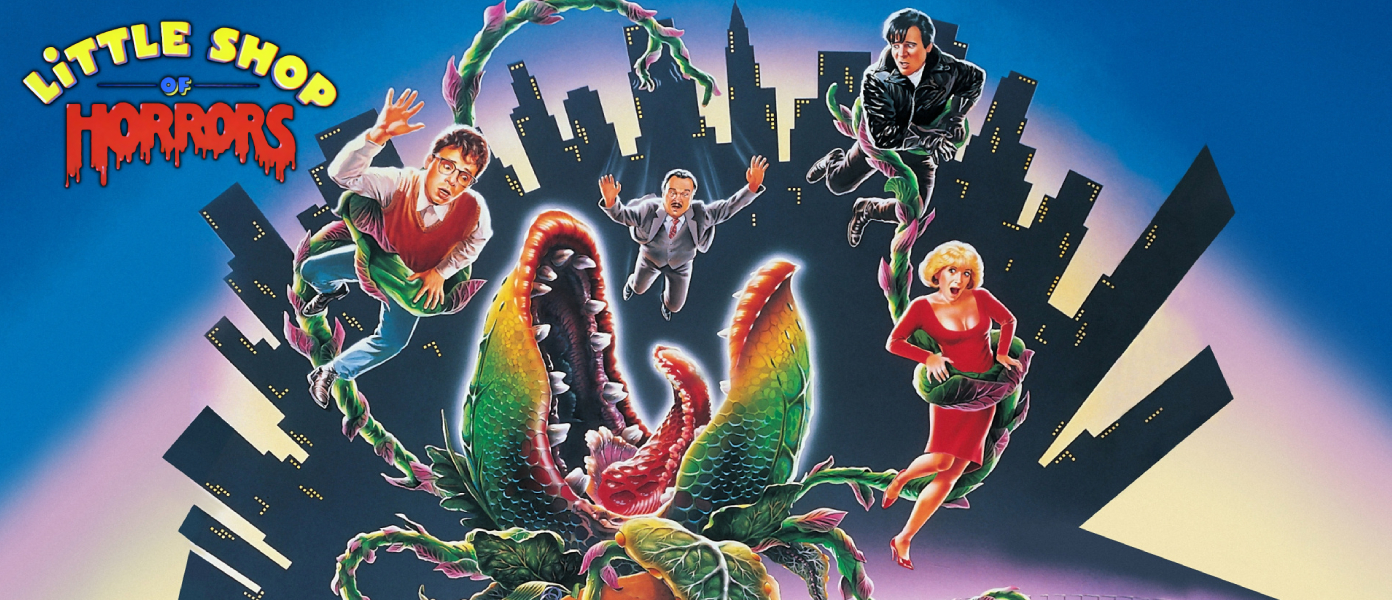

A nerdy florist finds his chance at success and romance with the help of a giant, man-eating plant that demands to be fed.
The musical comedy “Little Shop of Horrors” by Frank Oz is one of the rare films that feels carefully put together yet completely out of control. When it was released in 1986, it combined romance, horror, Motown music, and traditional showbiz style into a single strange and highly attractive package. Almost four decades later, its songs still hit home, its jokes still work, and its main monster remains astonishingly realistic.
Rick Moranis plays Seymour Krelborn, a shy worker in a failing flower shop on Skid Row. He works for the irritable Mr. Mushnik (Vincent Gardenia) and quietly loves his kind-hearted colleague, Audrey (Ellen Greene). Business is almost nonexistent until Seymour comes across a strange plant, which he names Audrey II. The plant’s exotic appeal soon draws in customers, wins attention, and brings about unexpected opportunities—yet keeping it healthy turns out to be much more complicated than Seymour had expected.
Moranis is excellent as Seymour; he gives the character awkwardness and anxiety without turning him into a caricature, and his soft singing voice matches Seymour’s vulnerability. Ellen Greene is just as impressive as Audrey, combining broad comic mannerisms with real warmth and sadness. Although she has a breathy voice and an exaggerated look, she longs for a better life but struggles to believe she deserves it. Moranis and Greene give the film its emotional core, which makes the ever-more-outlandish plot feel emotionally believable.
Steve Martin also plays Orin Scrivello, Audrey’s boyfriend, a dentist who rides a motorcycle. Martin brings a joyful menace to the role, creating a villain who is at once terrifying, ridiculous, and extremely entertaining. His musical number is one of the film’s funniest moments. Bill Murray too has a memorable appearance as a dental patient whose eagerness turns a normal visit into a wonderful comic exchange. John Candy and Jim Belushi provide further humor in minor roles without taking focus away from the main plot.
Alan Menken and Howard Ashman’s songs drive the movie; the score blends doo-wop, Motown, rock, soul, and classic Broadway, giving each song its own character without interrupting the story’s progress. The group of street urchins—Crystal, Ronette, and Chiffon, played by Tichina Arnold, Michelle Weeks, and Tisha Campbell—act as a kind of Greek chorus, commenting on what is happening in the film through their smooth harmonies and excellent attitude. They set the film’s playful fairy-tale pace from the beginning.
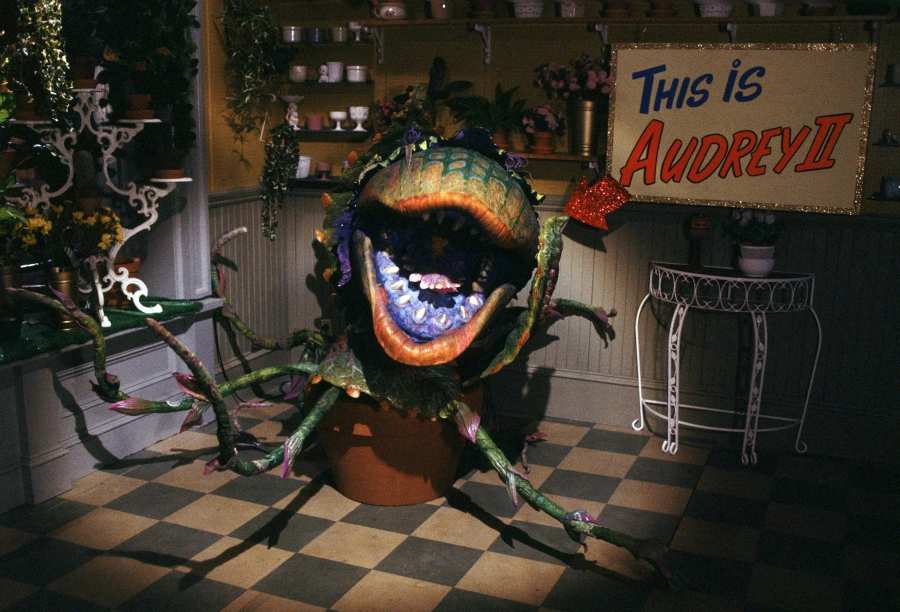
The production’s greatest success is Audrey II, whose voice is provided by Levi Stubbs of the Four Tops. Stubbs gives the vicious alien plant a powerful dose of Motown and soul energy, turning each line into a performance. His voice is at once seductive, funny, and threatening—all three qualities in the same sentence. Audrey II doesn’t just appear in the musical numbers; it takes charge.
The practical results are just as impressive. Instead of using a digital effect, the team built Audrey II as a large mechanical puppet with real weight, texture, and genuine physical presence. To match the plant’s enormous mouth movements to the music, actors like Moranis sometimes performed at a slower frame rate and half speed. When the filmed material was played back at the normal rate of 24 frames per second, the human performances coincided with the puppet’s lip movements with remarkable accuracy. Although the method required careful choreography, the final scenes appear to be spontaneous and smooth.
The film’s Oscar for Best Visual Effects nomination is an uncommon feat for a musical comedy, since science fiction films with large-scale spectacles were the norm at the time. That nomination was well deserved, since Audrey II feels more believable than many computer-generated creatures because the actors could interact with a real object on set.
The film has a stylized, gritty yet whimsical look typical of Skid Row. The crowded scenes, smoky streets, vivid colors, and theatrical lighting create an atmosphere that feels halfway between a run-down city area and a bizarre storybook. This tension matches the film’s nature exactly; it can be sweet one moment and sinister the next, but it always maintains its own particular comic tone.
“Little Shop of Horrors” succeeds because all its elements work as a unified whole—sharp dark humor, catchy songs by Menken and Ashman, expressive production design, clever puppetry, and a cast that fully embraces the absurdity. Moranis and Greene bring tenderness, Martin brings manic danger, and Stubbs ensures the monster has a voice large enough to shake the theatre.
It’s funny, pleasant to the ear, technically impressive, and just macabre enough; few musical comedies have aged as well as this one, and even fewer boast one of cinema’s greatest practical effects. Little Shop of Horrors is a wonderfully odd classic with real bite.
Now available on 4K Ultra HD™, Blu-ray™, and DVD
