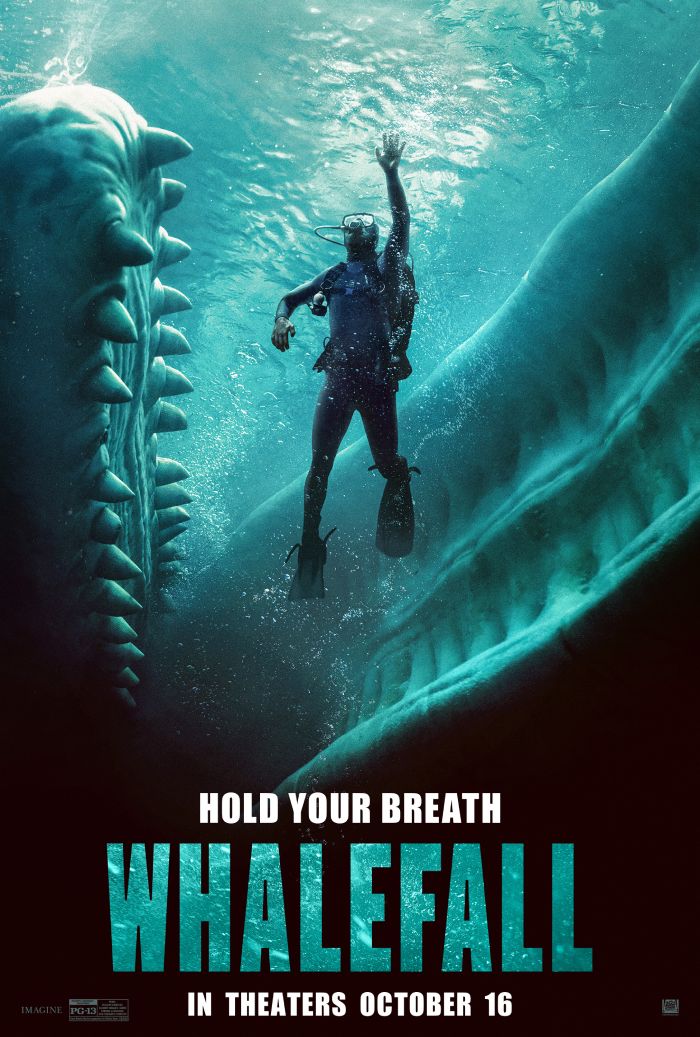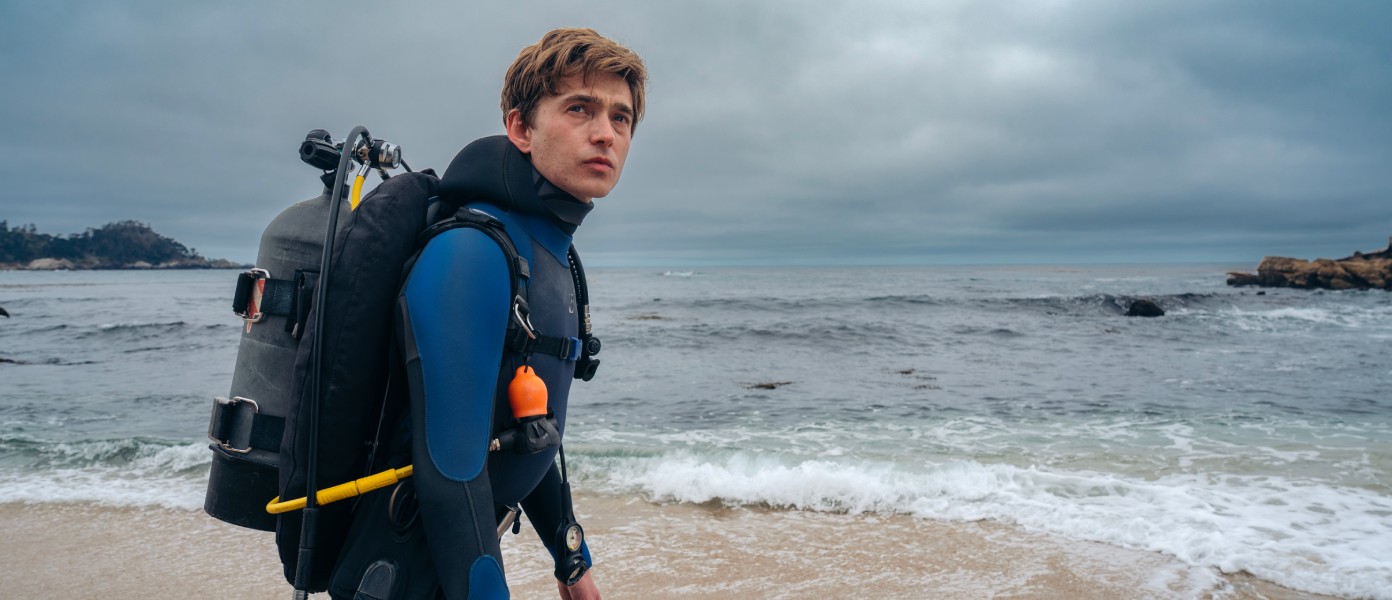

Follows a scuba diver who, while looking for his father’s remains, is swallowed by an 80-foot, 60-ton sperm whale and has just one hour to get out before his oxygen runs out.
Jay Gardiner (Austin Abrams) returns to his California coastal home after being away at college. Exactly one year earlier, his father, Mitt (Josh Brolin), after receiving a terminal cancer diagnosis, took his own life at sea. Although Jay’s relationship with Mitt was strained, he is determined to find his father’s remains and bring them home so he, his sisters, and his mother can find closure.
While submerged near an undersea canyon off Monastery Beach, Jay witnesses a giant squid being attacked by a sperm whale. In the ensuing chaos, Jay is swept up in the squid’s tentacles, pulled into the whale’s mouth, and down into its first stomach. His goggles and scuba fins are damaged, but his air tank and mouthpiece remain intact. With less than an hour of air left, he quickly realizes he cannot breathe the air inside the whale’s stomach because it contains no breathable oxygen; the chamber holds toxic gases like methane and potent digestive acids, so he has to keep his mouthpiece on at all times.
Refusing to die inside a whale, he tries to navigate the whale’s stomach. The whale’s powerful stomach muscles contract from time to time, threatening to crush him, but he manages to position a remaining fin as a brace against the contracting walls, leaving just enough space to move and breathe. Attempting to map out the digestive tract, Jay crawls deeper into the whale’s system. He crosses into a secondary chamber, intensely hot and filled with blistering stomach acids. During this grueling navigation, a squid beak gets painfully lodged in his hand. Realizing the path forward pinches down into an impassable, narrow tube, he is forced to crawl backward into the first stomach chamber to find another way out.
While trapped inside the whale’s stomach and under the influence of physical trauma, oxygen deprivation, and methane delirium, Jay mentally communicates with a voice that sounds like his late father. The conversation is a psychological and emotional reconciliation as he processes his unresolved grief, guilt over his father’s cancer and suicide, and their strained relationship. Mitt was a demanding, overbearing, and controlling master diver who made Jay feel emotionally suffocated and weighed down by his high expectations and harsh criticisms. Trapped in the dark, Jay has to recall and apply those exact technical lessons to troubleshoot his way out of the whale.

The first half of “Whalefall” is gripping and deeply unsettling. If you are claustrophobic, you’ll have a very difficult time watching this film. The same goes for people who have Thalassophobia or Megalophobia. When we first see the whale, we see it from Jay’s perspective as he lies on the edge of an underwater canyon wall, looking into the darkness below. We first see the squid ascend from the murky depths, but then the whale appears in all its frightening glory, and that image alone is enough to disturb viewers without any particular fear of the ocean or enormous creatures. Watching Jay get caught in the squid’s tentacles as it drags him through the water, and then seeing the whale swallow them whole, is genuinely frightening. Once the story moves inside the whale’s cramped stomach, the sense of claustrophobia becomes nearly overwhelming.
Technically, “Whalefall” is remarkable. The whale, the squid, and all the underwater scenes are rendered with exceptional detail, giving many scenes the realism of a high-end nature documentary. Austin Abrams, last seen in “Resident Evil,” delivers a commendable performance as a young man burdened by grief and guilt over his late father. Josh Brolin brings the intensity needed to make you despise him for what he puts young Jay through. Yet he also captures Mitt’s vulnerability as cancer ravages his body and gradually robs him of his ability to dive.
What didn’t work, for me, was the last act. While it seems Jay is giving up on life and accepting his fate, the conversation between him and his father feels overly contrived. The movie then segues into melodramatic territory, with a luscious score meant to provoke tears, but it had the opposite effect. Rather than deepening the emotion, the scene felt too determined to manufacture it, and I gradually lost interest. Brolin’s dialogue is also delivered with an exaggerated, ghostly echo that trails off at the end of nearly every line, making the exchange feel even less natural. I think if the film had focused solely on Jay’s attempt to escape, using the existing flashbacks but cutting the maudlin conversation between the two men, it would have worked even better. And that’s a shame, because the first half is so tense, frightening, and skillfully executed.
The first time I saw Austin Abrams on the big screen in “Weapons,” he was trying to escape a centuries-old, parasitic witch. Then, in “Resident Evil,” he was trying to escape hordes of zombies. And now in “Whalefall,” he’s trying to escape the intestines of a large sperm whale. Maybe in his next movie, he’ll star in a romantic comedy, not trying to escape anyone or anything.
In Theaters Friday, October 16th