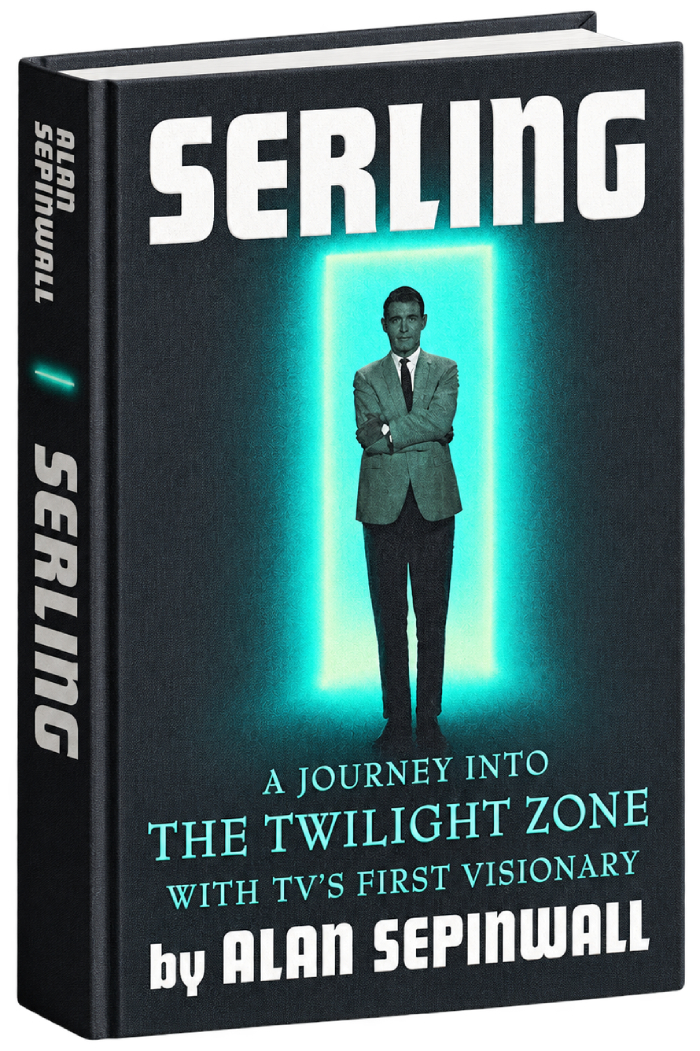

New York Times bestselling author and esteemed TV critic Alan Sepinwall delivers the definitive biography of Rod Serling, creator of “The Twilight Zone.” Serling’s pioneering work not only included entertaining millions and shaping television standards, but also being an outspoken advocate on a range of social justice issues.
Rod Serling has been a household name for over sixty years, largely because of the enduring success of “The Twilight Zone” (TZ), which he created, ran for five seasons from 1959-1964, and remains in syndication today. It made its debut near the end of a seminal period referred to as a Golden Age of Television, which featured high-culture, serious drama – a big step-up from earlier content in the medium, pejoratively known in some quarters as the vast wasteland.
Though Serling had written teleplays for years, the somewhat unexpected breakthrough of “Patterns,” which aired on the Kraft Television Theatre in January 1955, put him on the map and brought him “overnight” success. As author Alan Sepinwall notes early and often, Serling’s stories were heavily influenced by his own life experiences. In “Patterns,” Fred Staples (Richard Kiley) is hired by a ruthless corporate boss, Walter Ramsie (Everett Sloane), with the hidden agenda of forcing out old-timer Andy Sloane (Ed Begley). Ramsie regularly humiliates Sloane, though Staples still sees the seasoned hand as an asset. The pressure from Ramsie induces Sloane to have a fatal heart attack, causing Staples to resign. Ramsie persuades Staples to stay with the company so he can presumably effect change from the inside.
Many of the episodes penned by Serling – a lengthy list not only for “The Twilight Zone,” but also “Night Gallery,” “Playhouse 90” and others – are outlined in the book, lending context to the broader connections with his own experiences. While “Patterns” depicts the protagonist in the middle of his career, others of Serling’s stories draw from earlier periods of his life, including his infantry service in combat during World War II, and the death of his father while overseas – an event that seared into his psyche. Others delve into his desire to revisit his childhood as nostalgia and unfulfilled longing. But perhaps the most poignant narratives emanate from late-career insights, even before Serling had encountered most of them personally – such was the brilliance of his writing ability.
While the book covers virtually all phases of Serling’s career, the bulk of the narrative focuses on analysis of “The Twilight Zone” episodes and what went on behind the scenes. Nonetheless, the well-received “Night Gallery” series is covered, as well as his somewhat limited film successes – most notably co-scripting “Planet of the Apes,” adapted from French author Pierre Boulle’s 1963 novel, and “Seven Days in May,” adapted from the novel by Fletcher Knebel and Charles W. Bailey. On the downside, his series “The Loner,” starring Lloyd Bridges as a wandering former Union captain seeking a new life on the American frontier – which favored introspection and dialogue instead of loads of gunfights – never really connected with audiences. And while “Night Gallery” was surprisingly popular, Serling had relinquished the control he enjoyed with the TZ production, unintentionally ceding it to NBC and Jack Laird, and eventually grew disillusioned with the program.
The list of movie stars who agreed to appear in TZ is truly remarkable. In particular, talent agents initially said their clients didn’t do television. However, when co-producer Buck Houghton persuaded them to pass the script along to the film actors, the agents came back a few days later, remarking that their clients still don’t do TV, but they’ll do TZ.
Steven Spielberg, Guillermo del Toro, J.J. Abrams, Ben Stiller, Rian Johnson, Vince Gilligan, and Rob Mac, among many others, publicly and enthusiastically acknowledge the debt they owe to Serling. In fact, it’s remarkable how many current A-list writers, directors, and showrunners cite Serling as a major influence on their work. Sepinwall keenly notes that had Serling lived longer – he died in 1975 when he was only 50 – Hollywood heavyweights like Spielberg would have lined up for the opportunity to work with him, again or for the first time, in the 1980s.
One of the most notable “Twilight Zone” episodes, “It’s a Good Life,” appeared in the third season and was written by Serling, adapted from Jerome Bixby’s 1953 short story. It stars child actor Billy Mumy as six-year-old Anthony Fremont, imbued with superhuman-like mental abilities, which he uses to control nearly every aspect of life in the village of Peaksville – a hamlet separated from the rest of the universe. Charlie Brooker, creator of the “Black Mirror” series – arguably the closest modern cousin to the TZ – says the episode is about a tyrant that relates to what is going on now in politics. Ben Stiller goes further, indicating that he considers Trump an Anthony Fremont; Billy Mumy agrees – all taken together representing yet another example of the show’s cultural and political relevance decades after the episode aired in 1961.
Serling won six Emmy Awards over his career – he is sometimes described as the Aaron Sorkin of his day. He was television’s first showrunner, well before the term was formally coined in the late 1980s. Yet, despite the intellectual, social, emotional, and entertainment content he produced, the invariably self-effacing Serling failed to realize the ageless fascination TZ would generate. Because of that misperception, he sold his forty percent stake in the television phenomenon to CBS in 1966, just two years after the fifth and final season ended.
Sepinwall’s book provides an excellent, detailed account of both the highs and lows of Serling’s travails in the film and television industry, including attempts at Broadway productions. Indeed, perhaps the only way to get a fuller understanding of the peerless series is to get a copy of the “Twilight Zone Companion,” buy the DVDs now widely available, or catch episodes of TZ in reruns on a local broadcast channel. It’s not surprising that attempts to recreate the magic of TZ in one form or another have invariably fallen short of the original. The appeal of Rod Serling’s iconic and timeless “The Twilight Zone” seems to grow with each passing year, one of the myriad elements Sepinwall expertly documents for readers. Part biography, part movie and television chronicle, and part Rolling Stone-like interviews with celebrities, this new volume covers Serling’s life from many fresh perspectives.
Available in Bookstores October 13th by Grand Central Publishing