

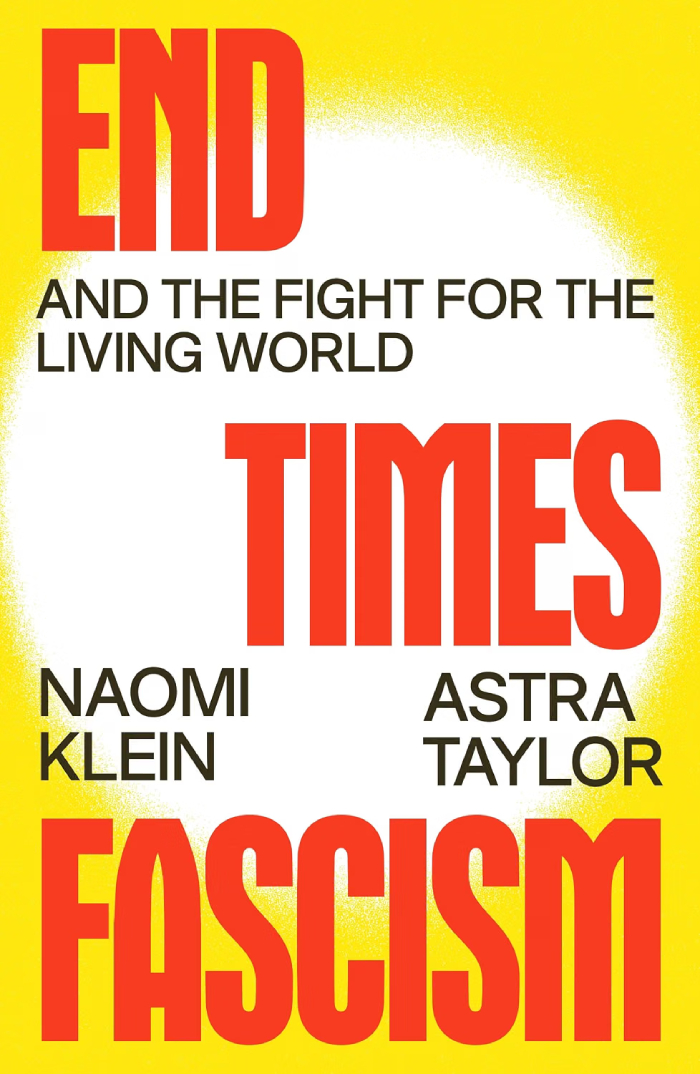
A scathing investigation into the apocalyptic thinking of the Christian nationalists, tech-bro reactionaries, and populist survivalists who increasingly define the contemporary right- and a recipe for how to fight them.
The book begins, appropriately enough, with the annual meeting in Davos – the town at the highest elevation in Europe – at the World Economic Forum, whose slogan suggests attendees are committed to improving the state of the world. That credo might just be subject to varying interpretations. The opening scene features two of the usual Trump administration suspects, Jared Kushner and Steve Witkoff – the at-large emissaries given broad license to canvass the globe, making lucrative, self-serving deals. In Davos, they set their sights on a real estate development dream called New Gaza: a radiant, luxurious city for some, but almost certainly not for the Palestinians who reside in the territory.
In the truest sense of Mark Twain’s adage that history may not repeat itself, but it often rhymes, the path to the end times will almost certainly not appear as regimented as it did in the 20th century. Venture capitalists and autonomous weapons will replace goose-stepping soldiers. Facial recognition software will make badges or other visible labels unnecessary. Ideological assimilation will do the rest.
The fascist goal is to steer the understandable anger and resentment of so many people away from the elites and toward the other: whether it’s the vulnerable, those of different races, or even our neighbors. The insidious nature of fascism is that it creeps along incrementally, following one successive crisis after another until anything resembling representative democracy disappears.
A year ago, it might have been possible to deny that such apocalyptic measures were underway credibly. Many folks still do, it’s true, even protesting with a straight face and righteous indignation. But hard evidence and facts indicate otherwise.
One leading indicator is the billionaires. Some of the steps they have taken – partly because only they can afford the cost – include Mark Zuckerberg’s $300 million underground shelter with a blast-proof door in Kauai, Jeff Bezos’ purchase of properties off the coast of Miami called Bunker Island, Anduril co-founder Trae Stephens recommending decommissioned missile silos as secure refuge, and Peter Thiel hiding out in Argentina (leaving readers to draw their own inferences about what parallels that suggests). Or then there’s Elon Musk’s obsession with colonizing some distant rock even less hospitable than West Texas as the remedy for escaping inevitable doom. Such activities, Klein and Taylor point out, show how terrified these men are of the world that, ironically, they largely helped create. Even more ironic is that all these contingency plans stem from failing to appreciate our home planet and its wonders, instead recklessly exploiting it for short-term profit and long-term cost.
While the warning is stark, the authors do not abandon all hope. For, as they write, though the forces of fascism spiral through history, latching onto accumulated power from the earlier republic, so too do the forces of shared unity and a thirst for fairness and equity. With humanity possessing the means in multiple ways to decimate entire populations and massive swaths of the environment, the stakes have never been higher. Either a fight to the death in the end times or, with any luck, a fight for life in the here and now.
The authors conclude that end times fascism is a darkly festive fatalism that celebrates harm in the absence of a former, romanticized supremacy. It is a mindset that helps explain why Fermi may have gotten his paradox correct – that is, perhaps the reason no life has been detected outside the confines of our world is that once a society reaches a certain level of technological advance, it is prone to self-destruction. Put another way, the current president of the United States has reportedly intoned more than once that if the country has all these nuclear weapons, why haven’t they been used? As Klein and Taylor pointedly ask, if terrible weapons and terrible people find one another, what happens next?
At this point, prescriptive remedies look unpromising. Though the authors propose mutual disarmament, the outlook for that seems unlikely in the extreme – nationalistic tendencies in virtually all countries far outweigh any ostensible desire for collective action, however beneficial for the species that choice may offer. More realistically, a cap on wealth could gain political traction. Thomas Piketty’s research has shown that since the late 1970s, economic returns from productivity gains have not been shared equitably between the working class and investors. The bulk of productivity gains over the past nearly fifty years have gone mostly to shareholders and executives. One need only look at the difference between the growth in worker pay versus the growth in corporate profits – lots of money is being made to be sure, as reflected in a skyrocketing stock market. But average Americans have been left out.
Unfortunately, given the absurd admiration Americans assign to wealth and status, that too could be a long shot. Nonetheless, there is still time to avert such a deterministic outcome – the dismally bleak scenarios that the writers outline – but only if we have the courage and tenacity to act.
Now available in Bookstores
 10k
10k 20k
20k 1.5k
1.5k 2.2k
2.2k