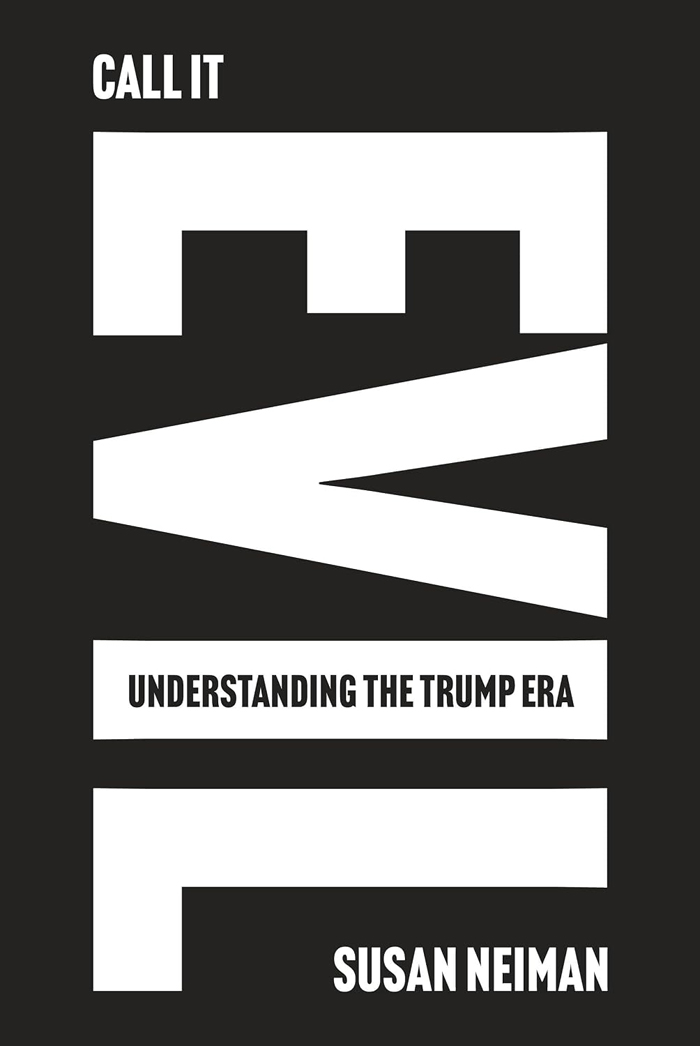

The eminent moral philosopher Susan Neiman shows how naming and confronting evil is essential for preserving democracy in an age of demagogues.
Susan Neiman brings her background as a professor of philosophy at Yale and Tel Aviv University to lay out a methodical case about how and why the Trump administration has largely gotten a pass for its morally bankrupt actions from 2017-2020 and especially from 2021 to the present, a work in progress that’s far from complete. In her introduction, Neiman lays out her premise unequivocally: denial of evil may be the worst form of evil, and self-interest has become the basis for reason and rationality, a development that would horrify philosophers across centuries. In one sense, it’s not hard to see why. Over-reliance on Adam Smith’s invisible hand is the sort of ideology economists have preached for years, as they parade widely cited academic papers, thinly disguised as theory and research, most of which fail to predict much of anything. The weatherman, at least, can claim to have advanced their art of forecast precision over time.
Neiman argues that believing nothing is evil leads us to infer that cruelty and corruption are ordinary, as if they are an acceptable or normal part of human nature. Referencing the influential philosopher Hannah Arendt’s work on the banality of evil, we face the subversion of social rights in favor of pure economics, which, ironically, fuels the rage driving antidemocratic forces today. As an economist, I find this conclusion disheartening but understandable. For all the respect afforded to the economics profession, its perspective on the real world suffers from abstract theory fundamentally divorced from the human condition. Economic models have become an odd mix of gross oversimplifications shrouded in a soup of complex, arcane mathematical equations.
Part of the problem stems from how we typically think about evil, something along the lines of, as Trump has said, the late great Hannibal Lecter. Aberrant behavior such as cannibalism, however, is exceedingly rare; hence our fascination with that kind of explicit evil. Far more commonly, evil manifests itself from twenty-thousand feet up, like starting wars for political gain or eviscerating social programs to lower taxes for the wealthy, a policy choice that harms the many while further enriching a tiny elite who need no help.
We tend to want to externalize evil, that is, to see it as outside the range of normal human conduct. Less dramatic forms of evil have become so common that they serve as background noise to daily events. Like a fungus on the surface that can lay waste to the world, evil is not grand or maleficent. Rather, it lacks depth and no demonic dimension, making it hard to recognize or counter.
One rationalization for committing evil is the trite but, unfortunately, true aphorism that someone else will do it if I don’t. Neiman indicates that evil is seldom committed by monsters. Instead, ordinary people commit it by abandoning integrity. As a chilling example, Neiman cites research from social psychologist Stanley Milgram, who conducted a now-famous experiment in which subjects were told they were examining the role of stress in learning. The test subjects, who thought they were administering electric shocks to learners who were actually actors, repeatedly applied punishment, despite screams and eventual silence (presumably from unconsciousness or death). The learners, after all, were on the other side of the wall. Nearly half of the subjects continued to administer the faux shocks based on bland assurances from the instructors. Milgram later concluded that “if a system of death camps were set up in the United States…one would be able to find sufficient personnel for those camps in any medium-sized American town,” or even perhaps at an ICE recruitment center.
The task Neiman sets before her is not easy. She writes that previous definitions of evil have been so broad they’re almost meaningless. Part of the charm for either Putin or Trump is that they don’t need to convince anyone they aren’t corrupt or evil. They merely need to convince people that everyone else is corrupt and evil, thus absolving their own odious appetites.
Ultimately, Neiman targets the ideological enablers of evil by refusing, for example, to take capitalism’s threats seriously. The notion that self-interest leads to the best of all possible outcomes, like the German Enlightenment philosopher Gottfried Leibniz, who invokes the goodness of God, is, to say the least, a heroic assumption. Going back to Adam Smith, the spiritual founder of free markets and capitalism, Neiman rightly notes that he considered “The Theory of Moral Sentiments” his most significant work and, at the time, his best-selling book. Though few now alive have actually read it, the masterpiece paints a far more robust portrait of economics and human motivation than does the more widely (and selectively) cited “Wealth of Nations.” “Moral Sentiments” weighs in forcefully on empathy and morality, themes modern-day economists largely ignore, and that are certainly absent from my own graduate-level studies. Economics has become an academic discipline that views a thief stealing your wallet as a transfer of wealth.
“Call It Evil” makes a strong case for social justice, most often pejoratively termed socialism. Maybe a better name would invoke the concept of cooperatives, which was a major achievement of homo sapiens on the journey to becoming the Earth’s dominant species, where they/we reside today. Competition is part of the story, but it too often gets overemphasized. Without cooperation, without rejecting zero-sum games that demand winners and losers in every instance, we are just another intelligent, remarkably clever savage species fighting nature and each other over scraps for dinner.
Now available in Bookstores