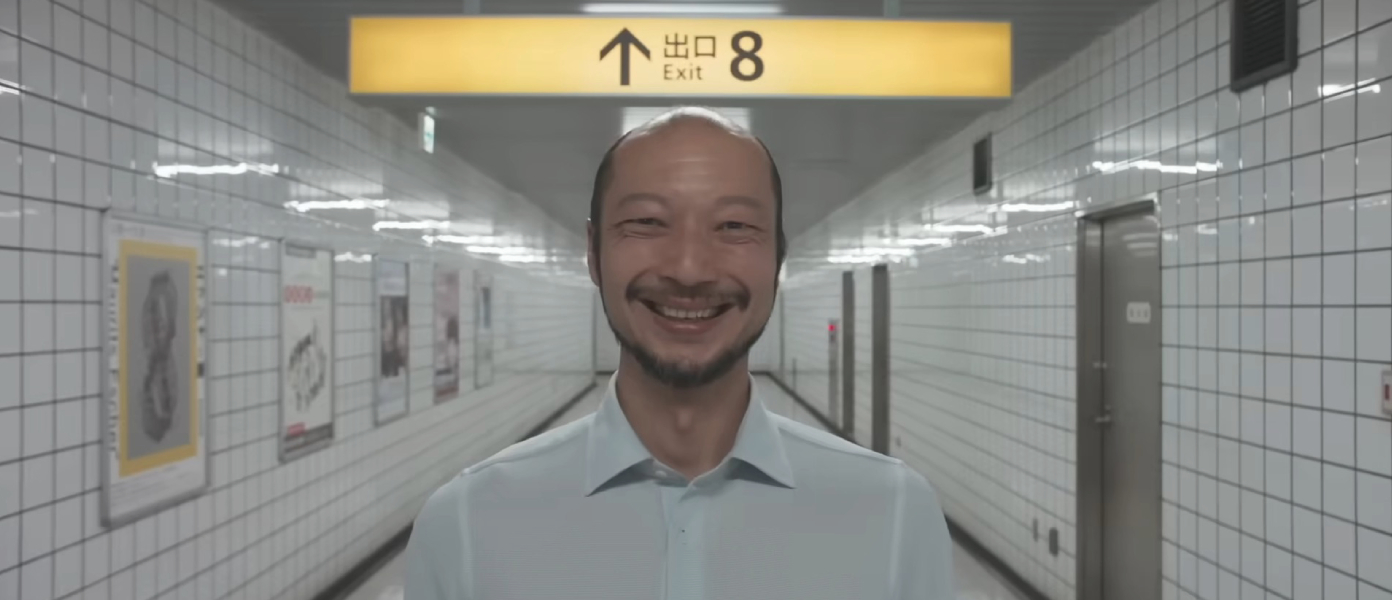

A man becomes increasingly desperate when he realizes he is trapped in a subway station and needs to complete a mission to get out.
Kazunari Ninomiya stars as the Lost Man, a commuter on a crowded subway packed with male office workers in dark suits coming or going to work. When he receives a call from his ex-girlfriend, she reveals that she is pregnant and offers him a choice about how to proceed. He expresses doubts regarding his worthiness as a prospective father, and as he exits the train, his path forward remains unclear, foreshadowing a series of dilemmas he must face. Navigating the tiled hallways toward the street, he finds himself in a loop that has no clear means of egress. The challenge manifests as a maze in which the Lost Man – as if in a computer game – must identify every anomaly to get out.
As the Lost Man observes and catalogs his surroundings, he repeatedly encounters the Walking Man (Yamato Kochi), who looks very much like a robot in early scenes. However, as the second act begins, the narrative shifts to the Walking Man’s perspective, where he too confronts his own plight in the seemingly endless loop, desperate to escape.
Naru Asanuma as the Boy initially plays an uncertain role in the drama, mostly like an appendage to the other two main characters. As the story progresses, the Boy’s relationship to the Lost Man becomes increasingly apparent. In the process, the Lost Man has the opportunity to not only examine his past but also the opportunity to alter his future for the better if he is up to the task.
While the premise is promising, the tale meanders a bit too much as it struggles to take flight. Still, “Exit 8” is not without merit, containing as it does references to the work of M.C. Escher – a.k.a. Maurits Escher as seen on the poster in the subway displaying a Mobius strip. Escher’s compelling, sort of psychedelic black and white drawings have given decades of college students and users of hallucinogens much to chew on in the wee hours of the morning. The artwork serves as an apt analogy for the movie’s setting, where reality has essentially been turned on its head.
Directed by Genki Kawamura, “Exit 8” offers a metaphor about salary or wage slaves who unexpectedly and mysteriously find the opportunity to examine the banality of their day-to-day existence. The movie is a mind-bending journey that will likely intrigue audiences at first, though even at 95 minutes, it may overstay its welcome. Daring in its low-budget style, “Exit 8” ultimately misses the mark. The film is a noble effort at creating an innovative speculative fiction starting point, but loses traction well before the closing credits roll.
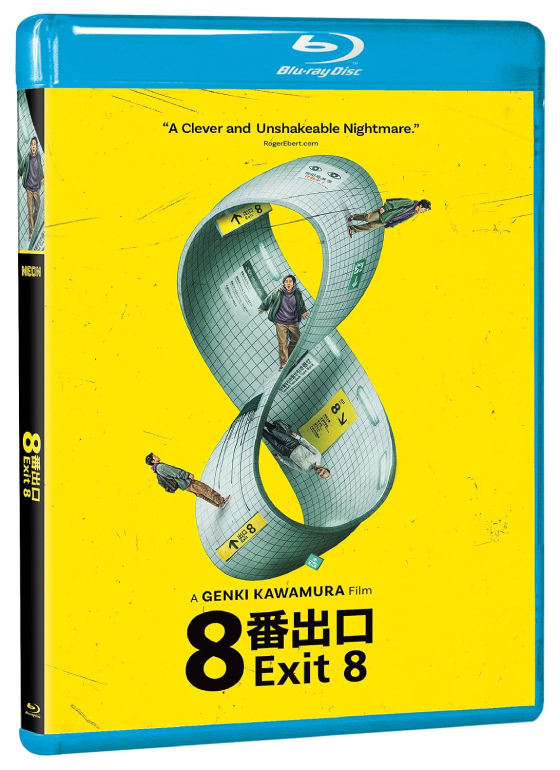
Available on Blu-ray™ August 4th
 10k
10k 20k
20k 1.5k
1.5k 2.2k
2.2k