

After an odd new medical student arrives on campus, a dedicated local and his girlfriend become involved in bizarre experiments involving the reanimation of dead tissue.
When “Re-Animator” debuted in the U.S. in October 1985, American moviegoers could immediately see it on the big screen. In contrast, my friends and I, living in Ireland, waited months before we could rent the VHS in mid-1986. This delay was typical due to the two countries’ starkly different film rating systems. In the States, an R rating means minors can attend if accompanied by an adult, but in Ireland during the ‘70s and ‘80s, the rules were much more rigid: no one under 18 was allowed into 18-rated films, regardless of who they were with. Because of this, horror fans like us mostly watched these movies at home on VHS, not in theaters, until we were old enough.
“Re-Animator” itself, loosely inspired by H. P. Lovecraft’s 1922 story ‘Herbert West–Re-animator,’ follows the exploits of Herbert West (Jeffrey Combs), a gifted but obsessive and ethically troubled medical student who arrives at Miskatonic University in Arkham, Massachusetts. There, he quickly finds himself at odds with Dr. Carl Hill (David Gale), an arrogant, predatory expert in brain surgery. West doesn’t hesitate to accuse Hill of stealing research from Dr. Hans Gruber, a Swiss mentor from his past whose suspicious death still lingers. Offended, Hill storms out, while West befriends another student, Dan Cain (Bruce Abbott), and moves into Dan’s house.
Dan’s fiancée, Megan Halsey (Barbara Crampton), is uneasy about West and warns Dan, though he brushes off her worries. Not long after, the pair catch West trying to bring Megan’s dead cat back to life with a mysterious glowing substance called Luminol. To their horror, the cat is revived—but returns as a grotesque, zombie-like creature.
Once Megan leaves, West persuades Dan to further help him test the serum. They sneak into the university morgue and inject it into a freshly deceased body, which reanimates violently and uncontrollably. The resulting chaos ends in the death of Megan’s father, Dean Halsey (Dean Halsey), at the hands of the reanimated corpse. West, undeterred, uses the serum on the Dean, but with the same disastrous results: he comes back, but as a mindless, violent zombie.
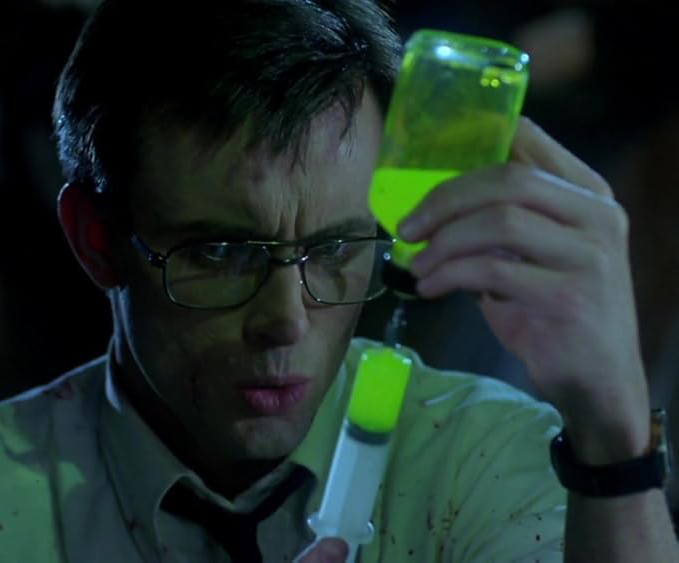 Dr. Hill takes over care of the now-undead Dean, performing a laser lobotomy and discovering the truth about his condition. Meanwhile, Hill discovers West’s laboratory and learns the secret of the serum. He tries to claim the breakthrough for himself, threatening West, who responds by killing Hill with a shovel, decapitating him. West then injects both Hill’s head and body with the serum. Hill’s head returns to life, and his body, now reanimated, knocks West out. Controlling his own headless body, Hill plots to abduct West and perform a lobotomy, but Dan and Megan intervene, resulting in a dramatic showdown.
The ‘80s and ‘90s were a golden age for practical effects in horror movies. Films like “Hellraiser,” “Candyman,” “The Thing,” “Event Horizon,” “The Fly,” and “Re-Animator” all relied on real, physical effects rather than digital ones, which didn’t exist yet. These techniques gave gory scenes—like a monster bursting out of a dog or a beheading—a palpable realism. While directors like Peter Jackson later blended traditional and digital effects with skill, such examples are rare. Though computer-generated imagery eventually became more affordable, it often lacks the weight and realism of old-school effects. Even if some practical effects look fake by today’s standards, their impact and inventiveness were unforgettable, especially for young viewers seeing them for the first time.
After so many years, watching “Re-Animator” again brought on a wave of nostalgia. To be honest, the acting hasn’t held up as well as the effects. Except for Jeffrey Combs, who is excellent as West, most of the performances come off as amateurish—Barbara Crampton’s role is particularly unconvincing. The movie leans more toward dark comedy than straight horror, which matches Lovecraft’s original intent to poke fun at ‘Mary Shelley’s Frankenstein.’ Director Stuart Gordon makes this influence clear. The same creative team reunited in 1986 for another Lovecraft adaptation, “From Beyond,” which, in my view, surpasses “Re-Animator.”
“Re-Animator” is very much a product of its era, and, surprisingly, it wasn’t classified as a “video nasty” by British censors in 1986, though it did face cuts for its home video release. The practical effects have stood the test of time, preserving a kind of authenticity that’s rare now. Despite its flaws, “Re-Animator” has become a cult classic, recognized for its creativity and impact on the horror genre. Even if it’s not everyone’s cup of tea, its legacy in horror history is firmly established.
The Deluxe Edition Box Set includes a 4K Ultra HD/Blu-ray™ combo, Newly Produced Bonus Features and Legacy Bonus Features, a 150-page hardcover book featuring interviews with Jeffrey Combs, Barbara Crampton, writer Dennis Paoli, and composer Richard Band, with essays by Scout Tafoya, Kate Rife, Will Sloan, Alex Kittle, and Ben Sachs, and preface by Brian Yuzna, and collector’s art cards.
Now available in four versions: an Ultimate Limited Edition Box Set,
a Deluxe Edition Box Set, a 4K Ultra HD™-HDR Standard Edition, and a Blu-ray™ Standard Edition

