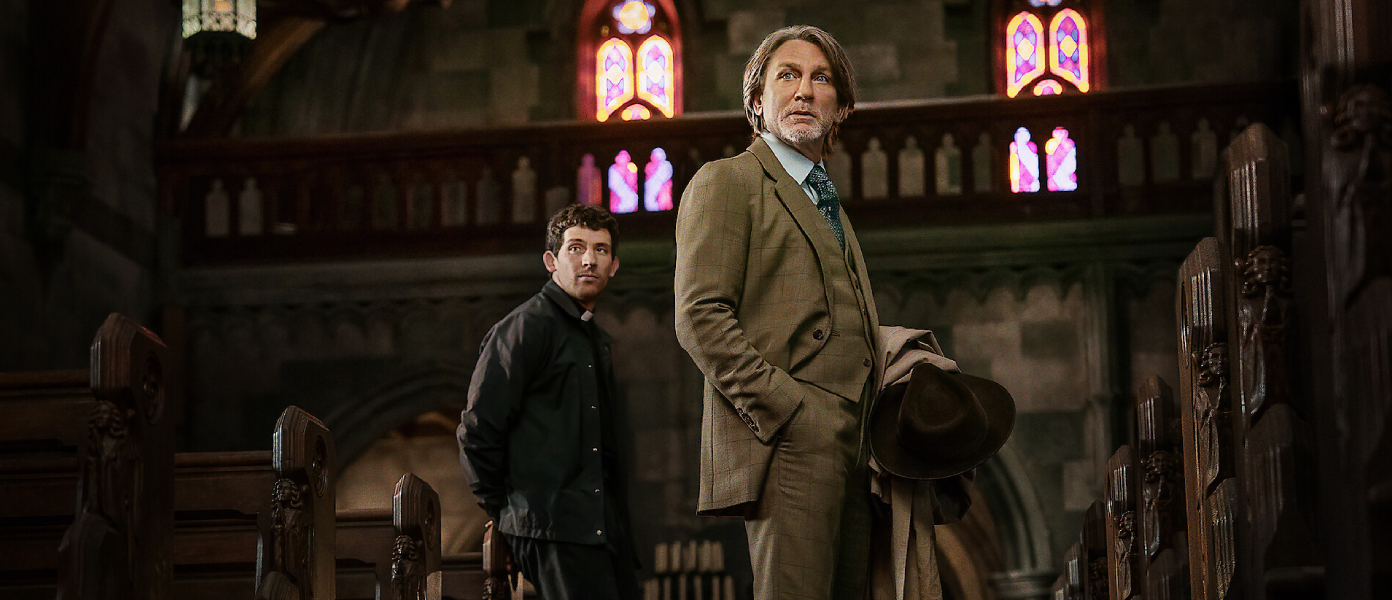

Detective Benoit Blanc teams up with an earnest young priest to investigate a perfectly impossible crime at a small-town church with a dark history.
After “Star Wars: Episode VIII – The Last Jedi,” I found myself deeply frustrated with Rian Johnson. The film sparked intense debate within the fan community, and, like many others, I was disappointed with his interpretation of such a beloved universe. Yet, my perspective began to change with the release of “Knives Out” in 2019. While my displeasure with “The Last Jedi” lingered, “Knives Out” offered a poignant reminder of Johnson’s undeniable talent as a director. No filmmaker produces a flawless resume; in my view, “The Last Jedi” fell short, but with the inception of the KNIVES OUT franchise, Johnson has consistently delivered thoroughly enjoyable mysteries.
With “Knives Out,” audiences were introduced to Daniel Craig’s Benoit Blanc, a captivating private detective marked by brilliance, a distinct Southern drawl, and a charmingly theatrical flair. In many ways, Blanc is reminiscent of Agatha Christie’s Hercule Poirot, yet his deeply empathetic demeanor and effortless conversational style set him apart. Following the critical and commercial success of “Knives Out,” Johnson returned with “Glass Onion: A Knives Out Mystery” in 2022. Now, with “Wake Up Dead Man: A Knives Out Mystery,” the latest installment, Blanc finds himself investigating a murder in a modest church located in upstate New York.
This new setting places Blanc at the center of a perplexing case: Monsignor Jefferson Wicks (Josh Brolin), a clergyman infamous for his rule by fear, has been murdered. Revered Jud Duplenticy (Josh O’Connor), a former boxer turned priest, lands as the town’s new parish leader following a contentious past. Despite his efforts, Duplenticy clashes with Wicks’ fiery preaching style—making him the primary suspect in the eyes of the tight-knit congregation. As the investigation unfolds, Blanc must navigate the tangled motives of the parish’s loyal members—each with reason enough to want Wicks gone. The question, of course, is who among them is truly responsible?
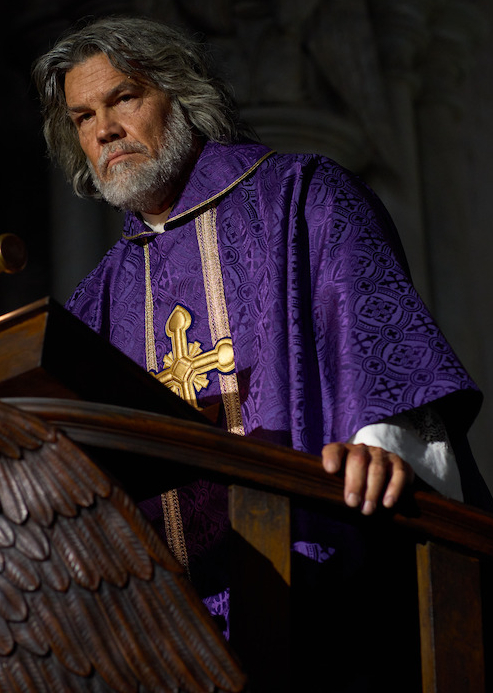 Johnson’s collaboration with cinematographer Steve Yedlin continues to bear fruit, with Yedlin framing the story through an atmospheric, near-horror lens. Though the film is firmly in the thriller genre, its locations and tone easily evoke the suspense of classic horror. Notably, while the narrative takes place in New York, filming primarily occurred in the English countryside—High Beach, Epping Forest, and areas in London—lending the film a haunting visual authenticity.
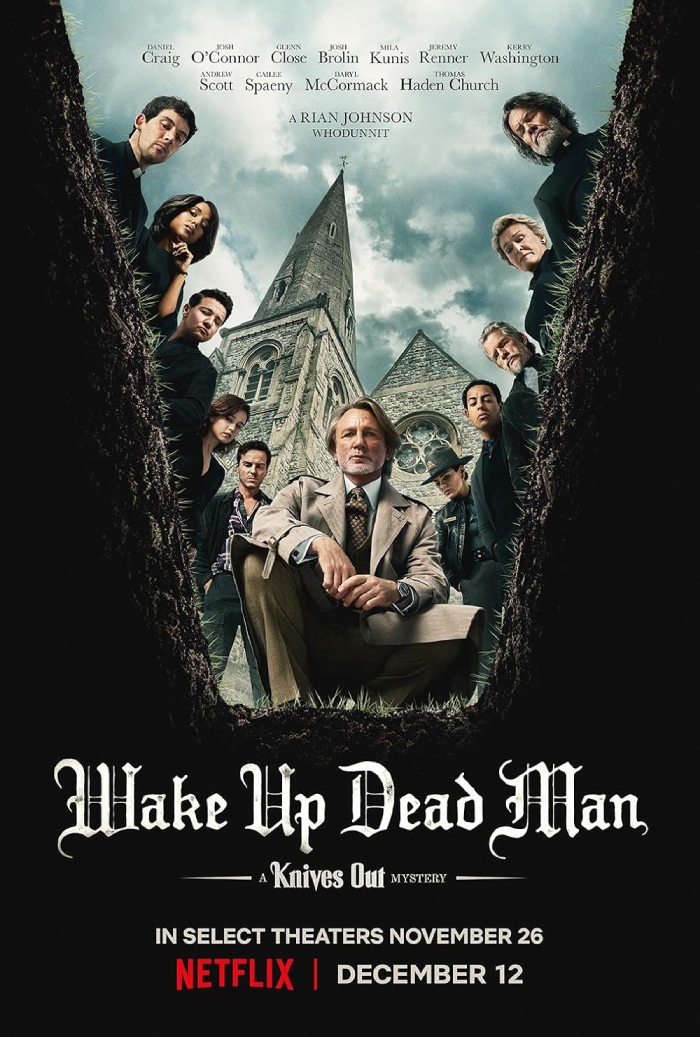
Characteristic of Johnson’s style, the film abounds with clever twists and unexpected revelations, much like its predecessors. Daniel Craig’s Benoit Blanc, inspired in part by Poirot, stands as a modern detective distinguished by his sharp intellect, unique voice, and methodical reasoning—traits that pay a respectful homage to, yet clearly evolve from, Christie’s iconic detective. As with earlier KNIVES OUT installments, “Wake Up Dead Man” features a sprawling ensemble cast. When the killer is finally revealed, the answer may not be as straightforward as anticipated—the possibility of multiple culprits remains ever-present. The performances of Craig, Brolin, and O’Connor are particularly notable, with the dynamic between Craig and O’Connor offering some of the film’s most compelling moments. Supporting contributions from Glenn Close, Mila Kunis, Kerry Washington, Andrew Scott, Cailee Spaeny, Thomas Haden Church, and Jeremy Renner enrich the ensemble, but the spotlight consistently returns to Craig and O’Connor.
While “Wake Up Dead Man” broadly follows the structural blueprint of the earlier films, this chapter addresses more serious thematic concerns. The narrative, rich in social commentary, explores how faith and power can be manipulated, focusing on a divisive figure who wields anger and fear to maintain control. The tale relies on dense plotting and considerable exposition, with characters often explaining critical developments rather than revealing them organically. This reliance on explanation can become cumbersome, yet eventually, the intricacies of the story and the depth of the characters prevail—the resolution, while complex, promises that justice will be served.
The film’s primary drawback is its considerable length. At close to two and a half hours, the pacing occasionally staggers; some scenes test the audience’s patience. Nevertheless, the ensemble cast’s strength, bolstered by distinctive character arcs, helps maintain engagement throughout. With Daniel Craig’s tenure as James Bond concluded, it is a pleasure to witness his continued collaboration with Johnson in future Benoit Blanc mysteries. Unlike adaptations of long-standing properties such as Bond, each KNIVES OUT entry promises new stories, unfettered by expectations, making every new installment genuinely unpredictable. In an age where so little remains a surprise, that level of novelty is truly rare.
Now playing in Select Theaters and streaming exclusively on Netflix, Friday, December 12th
 11k
11k 19.8k
19.8k 1.5k
1.5k 1.8k
1.8k