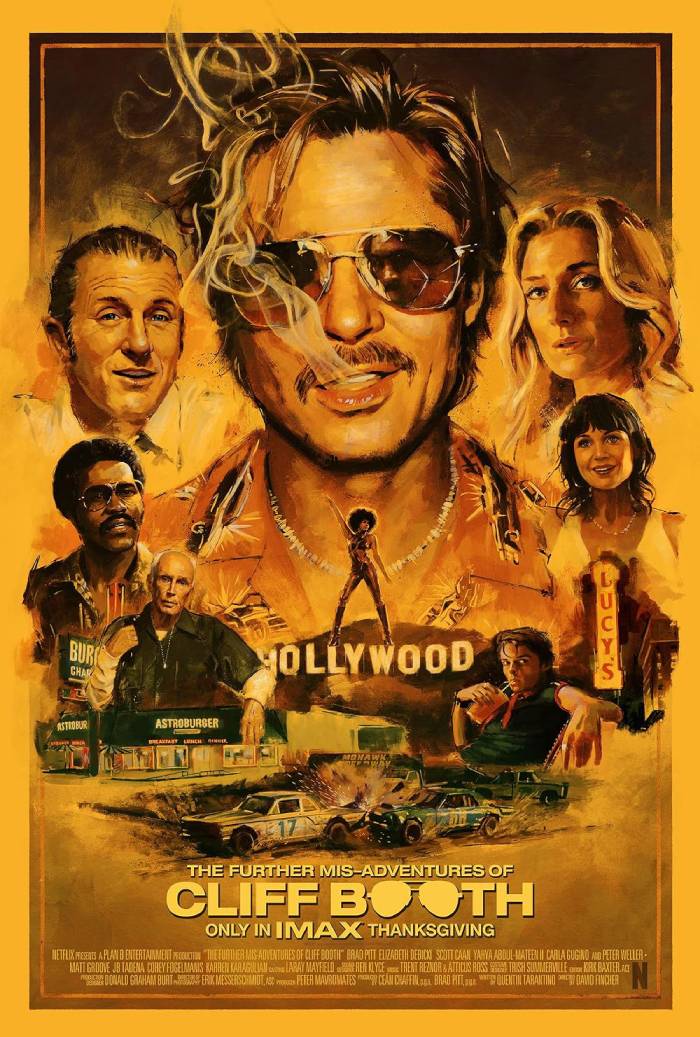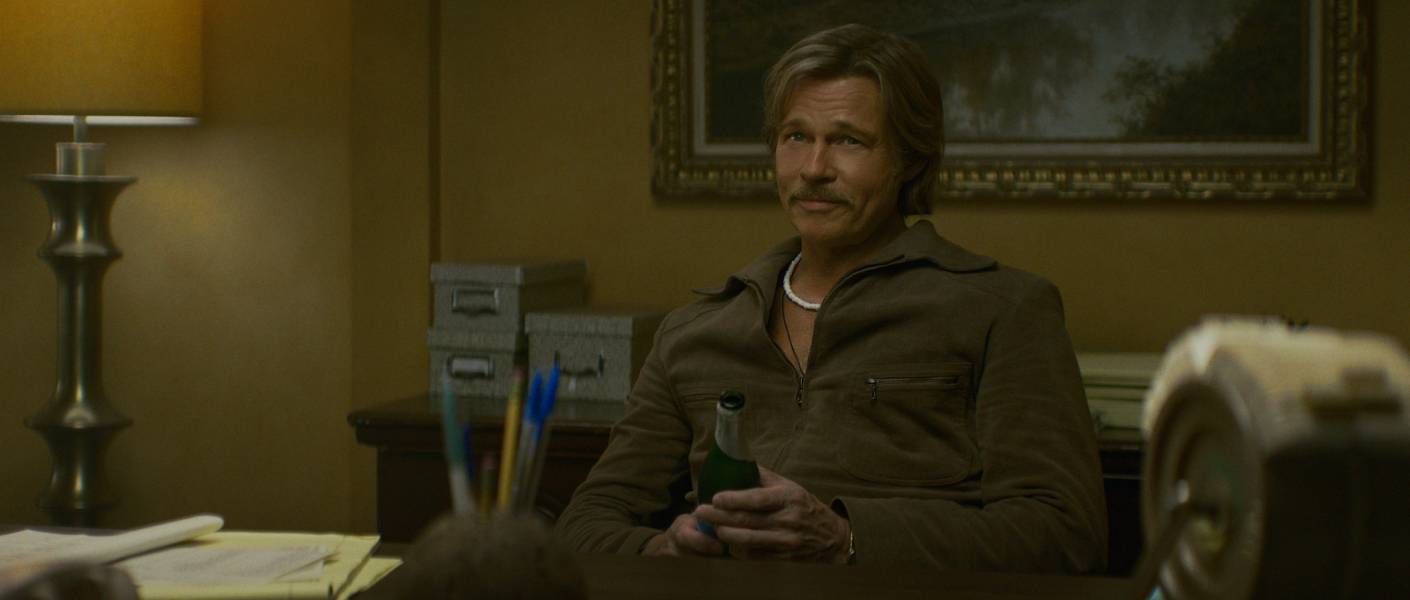

Set in 1977 Los Angeles—eight years after “Once Upon a Time in… Hollywood”—former stuntman Cliff Booth works as a Hollywood studio fixer handling extralegal problems for stars, studios, and industry insiders.
I find it fascinating that some of Tarantino’s most interesting works are films he didn’t direct: “True Romance,” “Natural Born Killers,” “From Dusk Till Dawn,” and now, “The Further Mis-Adventures of Cliff Booth.” I like him as a director; I just think he is overrated. My favorite movie of his is still his first, “Reservoir Dogs.” He has become increasingly selective about directing, often suggesting that each new project may be his last before retirement. For that reason alone, I am glad David Fincher took over the directing reins on this film. While Tarantino’s influence remains unmistakable, the movie possesses Fincher’s distinct visual and psychological sensibility.
When I first saw “Once Upon a Time in… Hollywood,” I was unimpressed. On first viewing, I thought it was typical, overrated Tarantino, but on second viewing, Brad Pitt’s performance won me over. While DiCaprio delivered a capable performance, and Margot Robbie was enjoyable, it was Pitt’s performance as Cliff Booth, the stuntman who gave Bruce Lee a run for his money, and was rumored by people in the film industry to have killed his wife in a “tragic accident,” that stood out the most. So much so that the Academy bestowed upon him the Oscar for Best Supporting Actor. While DiCaprio was the movie’s central character, Pitt stole the show.
“The Further Mis-Adventures of Cliff Booth” is set in 1977, eight years after the events of “Once Upon a Time in… Hollywood.” This time around, Cliff lives in a much tougher, more changed LA. His days as a stunt driver are over, and he’s taken on a variety of odd jobs as a bartender and a film projectionist. He is also an off-the-books Hollywood studio fixer. His work in that capacity involves getting involved in all sorts of extralegal activities—murder, blackmail, theft, extortion—which inevitably puts him in the middle of secrets and betrayals, testing his survival and his loyalties.
When he is introduced by Karen Crosby (Elizabeth Debicki), a high-profile talent agent, to Charlie Peters (Scott Caan), a popular television star and client of Karen’s, Cliff assumes it is to be a part of one of Charlie’s upcoming TV projects, but he quickly learns that that is not the case. Charlie tells Cliff he knows he’s a fixer and has a problem he needs help with. While in Asia with the notoriously violent Verdusco brothers, whose boss is trying to woo him to star in his own TV show, he admits to the brothers that he had a huge fight with his wife, Toni (Carla Gugino), and wished she were dead. The brothers take it literally and offer to kill her for $200,000. Charlie agrees, but when he returns to the US, he and Toni make up, and he has a change of heart; however, the brothers have not. Now he needs Cliff to intervene and stop the brothers before Toni ends up dead, a task that is easier said than done.
The one thing I love about Pitt’s character is that no matter what dangerous situation he finds himself in, he always keeps an effortless, easygoing demeanor—though it masks a ruthless, violent side. While there is less action this time around, the movie focuses more on Cliff and his relationship with Karen, as well as his prior relationship with Toni, which they deliberately hide from Charlie. While we never get to see DiCaprio’s Rick Dalton, he is mentioned several times, most notably by Cliff, who says he moved to Australia, where he is starring in a hit TV show called “Dingo Dan.” There were talks of DiCaprio making a cameo, but they fell through, and I’m glad because it kept the attention squarely on Cliff and his latest exploits.
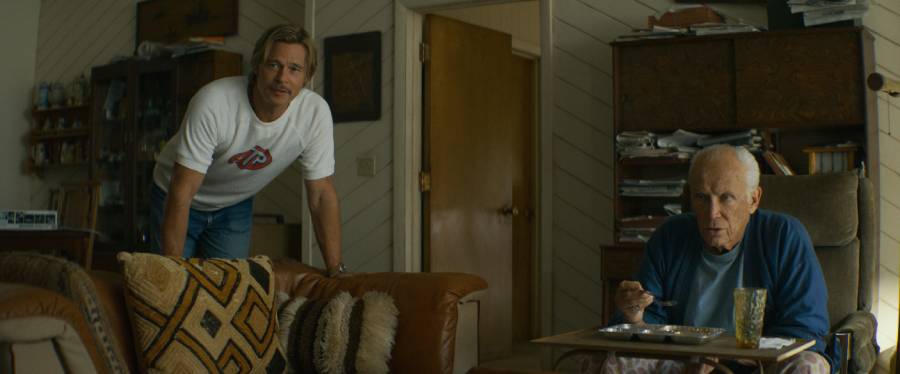
While the film has Tarantino’s fingerprints all over it, it also feels very much like a David Fincher movie. One of his defining directing characteristics is that he seldom uses handheld cinematography, and that is very much, and thankfully so, the case here. His precise camera placement and smooth tracking movements are deliberately choreographed to help guide viewer focus and mirror character dynamics. His signature dark, moody lighting and desaturated tones are also on full display.
One of the film’s most affecting elements is Cliff’s relationship with his father, Gus (Peter Weller), whom he lives with. The dynamic between the two men is warm, laid-back, and gentle. Cliff looks after Gus and spends his free time with him at their waterfront apartment in Marina del Rey. Their bond is one of the warmest, most relatable parts of the movie, contrasting with Cliff’s rougher jobs and the movie’s darker crime elements.
It’s also nice to see Cliff develop a romantic relationship with Karen. I was glad that his wife’s death, which was stated in its predecessor, is never mentioned here, because it gives Cliff a chance at a new love life, without forcing the narrative to dwell continually on his past. In the few scenes that he and Toni share, their playful banter and natural chemistry make it easy to understand what initially brought them together all those years ago.
In the end, “The Further Mis-Adventures of Cliff Booth” expands Cliff’s narrative, but it also feels like the second part of a three-part play. Its violent ending leaves the door wide open for a continuation, and I really hope they do, because Cliff is an intriguing, multifaceted character. And since the first film took place in the 1960s, and this one in the 1970s, its only logical conclusion would be to finish up in the 1980s. I would recommend this over “Once Upon a Time in… Hollywood,” mainly because of Pitt’s effortless cool, dry humor, and quiet melancholy. Here’s hoping we get to see Cliff Booth again soon in another misadventure.
Releasing in IMAX Theaters globally Wednesday, November 25th,
and on Netflix Wednesday, December 23rd