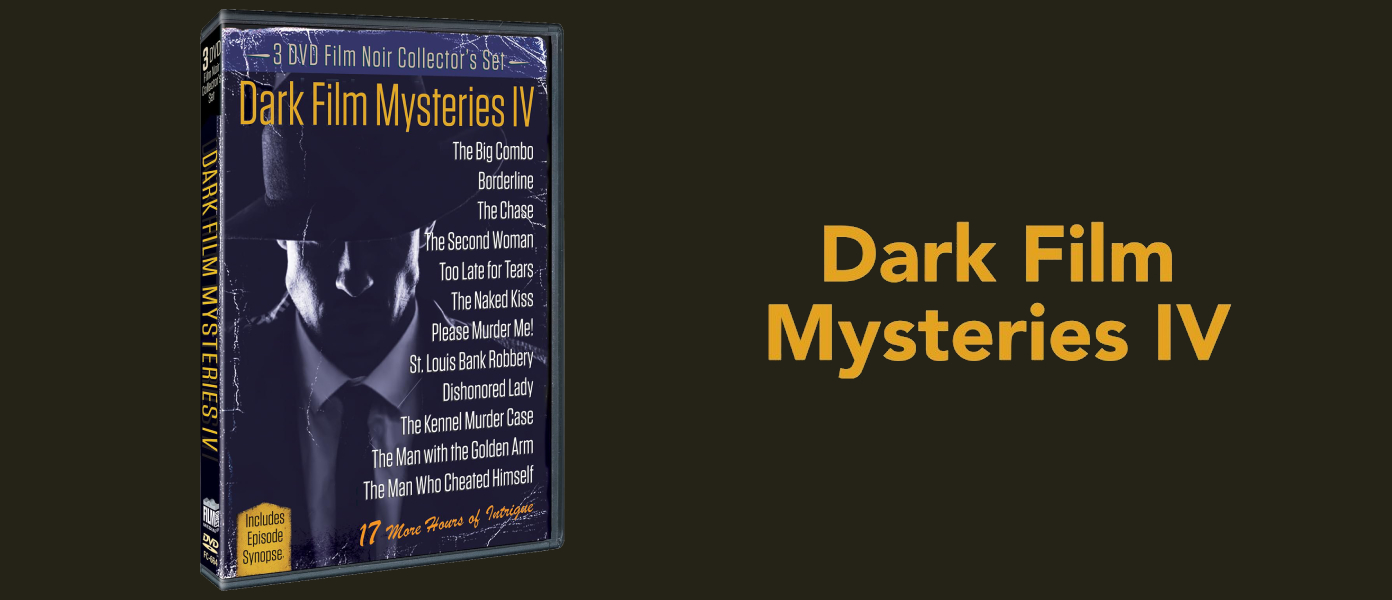

“Dark Film Mysteries IV” continues this successful noir-based series with an additional 12 films and a robust 17 hours of stories that include many of the most memorable actors of the genre, including Lizabeth Scott, Raymond Burr, Lee J. Cobb, Hedy Lamarr, Peter Lorre and Fred MacMurray, along with notables Frank Sinatra and Steve McQueen.
For film buffs who can’t get enough of the timeless film noir genre comes “Dark Film Mysteries IV,” a delightful compilation of directors, stars and writers. Twelve movies in all, the set spans the period from 1933 to 1964.
Probably best to discuss in order: the first entry is “The Big Combo” (recently reviewed on IFC), starring Cornell Wilde and his then-wife, Jean Wallace, as the girlfriend of Mr. Brown (Richard Conte), a smooth gangster notorious for his ability to evade conviction for numerous organized crimes. Notable appearances include Lee Van Cleef and Earl Holliman as Mr. Brown’s henchmen – the two come as near to portraying a gay couple as censors would allow in 1955. “The Big Combo” marks a fine conclusion to what is generally considered the close of the film noir era that began in 1941 with John Huston’s “The Maltese Falcon.”
Next comes “Borderline” starring Fred MacMurray before his days in the television show “My Three Sons” and after his magnificent against-type performance in “Double Indemnity,” famously directed by Billy Wilder. Also starring is Claire Trevor as an undercover police detective attempting to infiltrate a smuggling ring run by Raymond Burr. Released in 1950, “Borderline” showcases strong chemistry between MacMurray and Trevor, who are conflicted in their roles, seemingly on opposite sides of the law.
“The Chase” from 1946 stars Robert Cummings as a down-and-out former Navy man who gets an unexpected job offer as a chauffeur for Steve Cochran, a Miami gangster. Cochran’s wife, played by Michéle Morgan, finds herself on a short leash because of what she knows. Cummings and Morgan scheme to escape to Havana in a pre-Castro Cuba, but run into more than a few snags along the way. Co-written by Philip Yordan, who also penned “The Big Combo,” “The Chase” serves up plenty of intrigue and tension.
Robert Young stars in “The Second Woman,” the story of a wealthy architect haunted by the untimely death of his fiancée, for which he may or may not be responsible. Betsy Drake takes on the role of Young’s love interest, as she helps him navigate his guilt and seemingly erratic behavior. Notable appearances by John Sutton, Henry O’Neill, and Morris Carnovsky round out the production.
“Too Late for Tears” tells the tale of a married couple, played by Lizbeth Scott and Arthur Kennedy, who find themselves the unexpected beneficiaries of a suitcase full of cash that a man in another vehicle tossed into the backseat of their convertible. They wrestle with the prospect of what to do next, though the intended recipient (Dan Duryea) hounds Scott relentlessly for the money. Kennedy’s sister (Kristine Miller) lives across the hall and is fiercely protective of her brother, who mysteriously disappears. Don DeFore, who later co-starred in the long-running television series “Hazel,” brings events to a dark conclusion after femme fatale Scott flees to Mexico with the life-changing windfall.
Stepping outside the typically acknowledged film noir window – released in 1964 and as such should probably be classified as neo-noir – comes “The Naked Kiss,” the story of a prostitute played by Constance Towers seeking a fresh start in a new town. A local policeman (Anthony Eisley) samples the wares but then steers Towers to another part of town across the river. Instead, she takes a job as a nurse caring for disabled children, where she establishes a positive and solid reputation among the staff and with her landlady. She meets and falls in love with Michael Dante, a wealthy patriarch of the community who harbors a sordid secret that ensnares Towers once she learns of it, though the denouement turns out not as bleak as one might expect.
Ahead of “Murder She Wrote,” Angela Lansbury takes on the part of a wealthy and calculating woman accused of murder. Raymond Burr, in a very Perry Mason-like role, comes to Lansbury’s defense only to find out that she has been less than forthcoming. This leaves Burr in a quandary, which he resolves much as one might expect, given his later legendary television career, by asking the eternal question, “Isn’t it true…?”
“The Great St. Louis Bank Robbery” stars Steve McQueen as an accomplice to a planned bank heist. Released in 1959, McQueen’s role is far different from his work as a suave action hero for which he is best known. In this film, McQueen wants only to drive the other gang members to and from the bank, but is coerced into taking on a bigger part in the caper. Based on a true story, “The Great St. Louis Bank Robbery” moves along methodically in a similar fashion to the superb “The Asphalt Jungle,” directed by John Huston and released in 1950.
Hedy Lamarr steals the show in 1947’s “Dishonored Lady as a talented magazine art editor who gets fed up with the grind and practically disappears from sight. In her new identity, she meets a research doctor (Dennis O’Keefe) and eventually falls in love, though she cannot escape from her past indiscretions. Morris Carnovsky, as a psychiatrist, attempts to guide Lamarr through her travails and essentially serves as her advocate throughout, even after she is wrongly accused of murder.
Harking back to 1933 and not really in the noir category, William Powell plays Philo Vance, a prelude to his popular “Thin Man” detective films based on the stories by Dashiell Hammett. In Sherlock Holmes fashion, Powell leads the law enforcement officials around by the nose before allowing them to take credit for solving the crime—in this case, two murders and one apparently attempted—good fun, with the erudite and insightful Powell never missing a trick.
Taking a darker and grittier turn, Frank Sinatra stars in “The Man with the Golden Arm,” with the title serving as a double entendre for playing poker and enduring a heroin addiction. Recently released from rehab, Sinatra has his sights set on joining a swing band as a drummer. Darren McGavin has other ideas, constantly tempting Sinatra back into his old ways. Eleanor Parker, Sinatra’s wife, is confined to a wheelchair and eagerly employs emotional blackmail to hold on to her man. Sinatra’s other love interest, Kim Novak, works at strip joints but has a special place in her heart for the would-be musician. Directed by the somewhat infamous Otto Preminger, the film doesn’t pull many punches and may surprise viewers to learn that, given its raw depiction of drug abuse, it was released way back in 1955.
Finally, “The Man Who Cheated Himself” stars Lee J. Cobb as a seasoned police detective in love with Jane Wyatt, before her role as Robert Young’s wife in the “Father Knows Best” television series. John Dall, perhaps best-known for his parts in “Spartacus” and “Gun Crazy,” plays Cobb’s brother, a freshly minted detective with a keen eye and insightful intuition. When Wyatt accidentally, or not, shoots her husband with his own gun – as he was planning to kill her – Cobb intercedes to cover up the crime and moves the body, dumping it at the airport. Dall slowly starts to put the pieces of the puzzle together, which he nearly regrets.
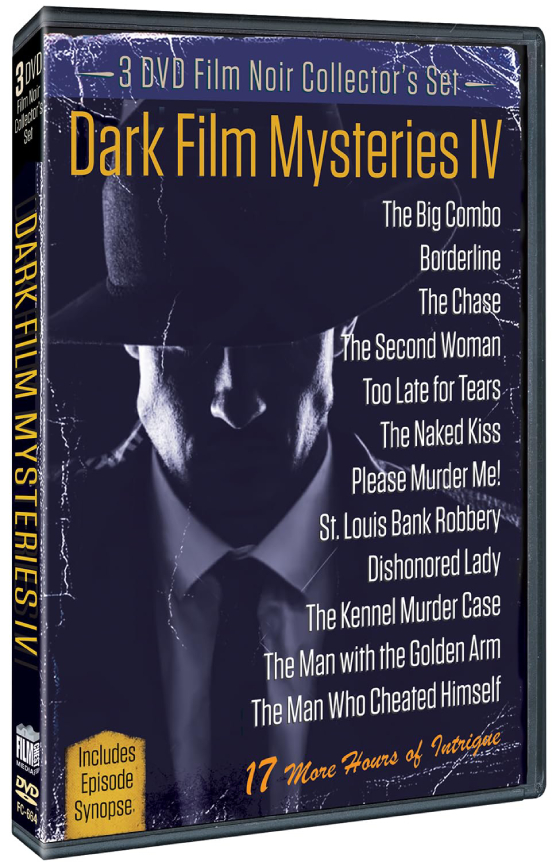
“Dark Mysteries IV” represents a fine collection of noir and near-noir that will certainly please aficionados. The 3-DVD set provides over 1,000 minutes (17 hours) of rewarding screen time, full of moody, mysterious content.
Now available on DVD
 10k
10k 20k
20k 1.5k
1.5k 2.2k
2.2k