
*Editor’s Note: Excerpts of this review could be perceived as expressions of personal views on matters of current public debate and consideration. The views and opinions expressed herein are those of the author and do not necessarily reflect the official policy or position of Irish Film Critic.
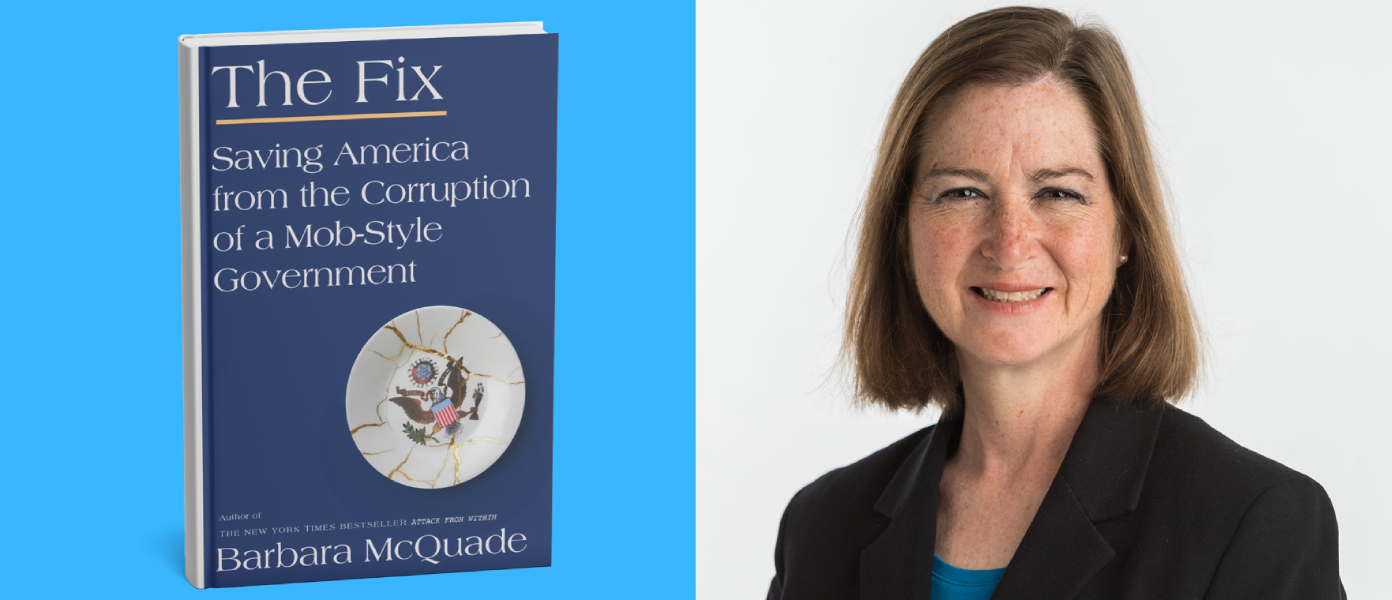
In ‘The Fix,’ Barbara McQuade draws on her decades of experience as a federal prosecutor to reveal how systems of organized crime and political opportunism exploit the levers of power—using corruption, cruelty, and chaos as tools to dominate institutions and eliminate accountability.
From the perspective of a former United States attorney in Detroit, Barbara McQuade begins ‘The Fix’ by providing some relevant background on Donald Trump’s early business dealings back when Roy Cohn was still around, and then recaps the series of key events that took place during his first and second terms. She delivers specific details on the actions that the current administration has taken in its attempt to exact revenge for perceived wrongs. She points out how power, corruption, cruelty, and chaos all constitute elements of the playbook.
The analogies to the way mob bosses operate ring all too chillingly true. In Chapter One, she begins with a retelling of the opening scene from “The Godfather,” where Vito Corleone meets with a funeral home director on the day of his daughter’s wedding because he must attend to business. When Don Corleone agrees to grant the funeral director’s wish, he does so with the caveat that, “Someday, and that day may never come, I’ll call upon you to do a service for me.” This type of transactional relationship rhymes with descriptions of interactions surrounding the present administration.
In 2016, Chris Hayes said that functioning democracies rely more on norms than laws. Similarly, ‘How Democracies Die’ by Steven Levitsky and David Ziblatt discusses unwritten democratic norms such as mutual tolerance and forbearance. That sentiment is now being tested in ways inconceivable a decade ago. Melania Trump has said that, “When you attack Donald, he will punch back ten times harder” – an uneasy prospect for folks on the other side of that equation. Notwithstanding, whether we rely on either laws or norms, both have been unceremoniously discarded as of late.
In such a fast-moving environment, authors like McQuade can only tell part of the story, as it evolves from day to day – literally. Recently, and after the book was published, for example, when cyber hackers infiltrated the Minnesota water supply, U.S. intelligence believed that Iran was potentially responsible. Instead, Trump insisted that the state’s governor was to blame. A couple of days later, Trump railed against U.S. Attorney for the District of Columbia Jeanine Pirro about dismissing charges against former Olympic canoeist David Hearn, who allegedly damaged the Lincoln Memorial Reflecting Pool despite compelling evidence to the contrary. It has come to the point where statements emanating from the White House regularly depart from any semblance of reality.
McQuade frequently references how Machiavelli – a proponent of deception, ruthlessness, and cruelty – figures prominently in the modus operandi of the current administration. One might legitimately wonder if the goal is to persuade Americans to tune out the political system in sheer disgust as a means to gain control without a whole lot of people caring too much.
‘The Fix’ presents a clear picture of what’s been going on in government lately. Based on executive orders and legislative actions, the emphasis has been on favorable tax treatment for the already wealthy, selective border closures (South Africans and Scandinavians excepted), massive increases in defense spending, removal of regulatory agency personnel, and eviscerating social programs. The outward façade consists of gold decor, money, and monuments, but the showmanship is just a distraction, a magician’s feint.
In so many ways, the traditional rules have gone out the window – the gloves have come off. As yet another example, DOGE (Department of Government Efficiency, spearheaded by Elon Musk) actions caused the U.S. to unilaterally give up significant soft power with the shuttering of USAID – a set of programs that provided food, medical assistance, disaster relief, and governance support to prospective U.S. allies. International influence once based on goodwill has been scrapped, with people across the world dying in the process.
For whatever reason – whether fear of getting “primaried” or the desire to maintain control of the policy agenda – the Congressional Republican majority largely refuses to abridge the powers of the presidency. Perhaps and more ominously, given that several legislators – especially in the Senate – have said they voted on Trump’s behalf simply because they feared for their personal safety, the coercion is working. Regardless, that leaves only the courts as comparatively impartial arbiters.
McQuade offers a host of recommendations in the final three chapters – most of them long-term in nature – for returning some semblance of normalcy to governance in the United States. Chapter 12, entitled Building Guardrails, discusses ways to stem the abuse of power, implement standards for government officials, ensure that the Department of Justice regains its independence, apply ethics laws to the president and vice-president, strengthen the courts and election laws, reform campaign finance, impose term limits, and eliminate gerrymandering. Needless to say, this would be a tall order from a legislative standpoint.
Chapter 13, entitled Vision for the Future, calls for a progressive income tax and increasing union membership, home ownership, and consumer protections. Further, immigration policies should recognize the complexity of the issue and serve to instill unity as a country. The U.S. has a long history of welcoming immigrants, but that obviously changed starting in 2017.
And finally, in Chapter 14 entitled Civic Awakening, McQuade outlines tools such as litigation, collective action, education, communication, resistance, satire, nullification by juries about unjust prosecutions, joining campaigns, voting, employing leadership instead of power, and active citizenship – once more serving up a full plate for those disposed to take action.
McQuade indicates that history can be instructive regarding seemingly hopeless imbalances. The advent of Mothers Against Drunk Driving – a response to intoxicated arrestees typically receiving a slap on the wrist – changed the way people view the offense. She later summarizes how the Progressive Era addressed rampant societal and income inequity. Then she goes on to lay out additional case studies demonstrating where and how citizens affected change in the past.
For folks not necessarily paying attention, recent developments may fail to hit very close to home. To understand what’s really happening across the country, one should focus on policies and their real-life outcomes, as opposed to the contradictory, confusing rhetoric served up almost daily from the administration. ‘The Fix’ offers a good primer for individuals interested in how to mobilize and push back against the insidious autocracy creeping into the system. It’s far from certain how events will play out through the November elections later this year, but McQuade’s insight provides a window into where things are likely headed.
Now available in Bookstores
 10k
10k 20k
20k 1.5k
1.5k 2.2k
2.2k