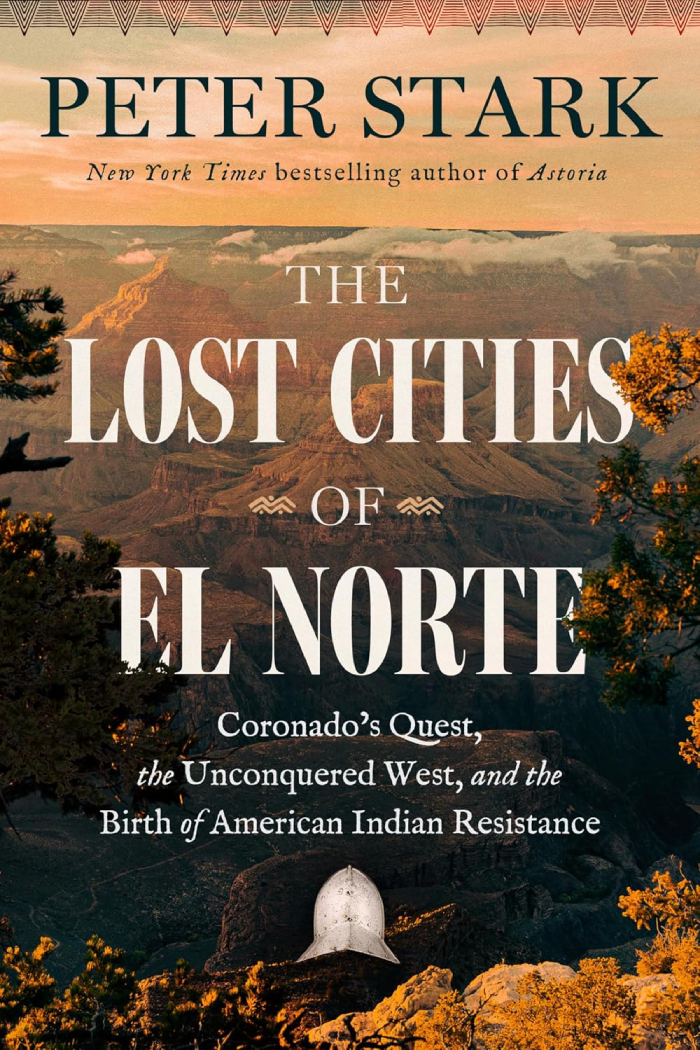

By the bestselling author of Astoria, a thrilling and masterfully crafted narrative of the Conquistador Francisco Coronado’s expedition across 2,500 miles of the vast, uncharted North American interior—“El Norte Misterioso” —where he was turned back by fierce indigenous resistance that would thwart white rule for the next three hundred years.
Among the many fascinating elements contained in this excellent book is the revelation – likely not fully appreciated by most modern day readers – that after Coronado’s ill-fated expedition into what is now the Southwestern United States, and specifically the Great Plains, the region remained largely unoccupied by Europeans for another three-hundred years. Even as recently as 1820, U.S. Army Major Stephen H. Long described the vast area as the Great American Desert – such was its perceived inhospitable nature. As a result, the dispossession of Native American lands in what is now the United States was dominated not by the Spanish but rather by English settlers, centuries after Coronado’s trek into the unknown.
This engaging narrative by Peter Stark lends detail to the exploits of one of the more enigmatic conquistadors – as well as others such as Hernán Cortéz – all of whom most people will remember, if only vaguely, from middle or high school world history classes. The oft-told legends tend to allude to how the Spanish explored the New World, only periodically inflicting violence on the native peoples. The reality, however, looked quite different, as the author ably chronicles.
Jared Diamond offers an interesting perspective in his Pulitzer Prize-winning masterpiece ‘Guns, Germs, and Steel: The Fate of Human Societies’ when he elucidates how Cortéz subdued the formidable Aztec Empire with a comparatively small handful of soldiers under his command. Early conquests by Spanish conquistadors probably contributed to the hubris Coronado displayed, but especially to that of his captains.
It’s hard to know where to begin when reviewing such a fine recounting of history from an outlook not widely appreciated. Certainly the final outcome of European conquests of North America remains manifest for all to see today. However, the current reality could have taken an entirely different turn had Coronado’s expedition persevered just a bit longer before abruptly turning back for home.
It’s worth noting that the Spanish were largely the only European power that held sway in the New World for a century after Columbus made landfall in 1492. For the whole of the sixteenth century, Spain colonized or – in the case of Coronado – attempted to colonize various regions in what is now North and South America. It wasn’t until the French founded Port Royal in Nova Scotia in 1604, and then shortly afterward the British founded Jamestown in 1607, that other major European powers got in on the act.
Had Coronado’s expedition found more success, the Spaniards might have colonized the central plains of North America with its rich, fertile soils and extensive waterways. Instead, Coronado abandoned his northeastward push that first traversed the desolate lands of Northern Mexico and Southern Arizona, and then turned eastward across the Texas panhandle, reaching as far as modern-day Kansas.
As mentioned earlier, the Spanish had seen remarkable success as conquerors, first with Hernán Cortés over the Aztecs in Central Mexico in 1521 and then with Francisco Pizarro in 1532 in Peru. Despite securing significant quantities of gold from the natives for the Spanish Crown, both conquistadors’ reputations were tarnished as a consequence of their barbarous actions. Though older than Coronado, Cortéz frequently reappears in the narrative – the two men lived practically across the street from each other in the former Aztec capital of Tenochtitlan, now known as Mexico City.
Coronado and his army of devoted followers hoped to follow suit, seeking cities of gold in the Mysterious North and ultimately traversing 2,500 miles in that endeavor. In addition to their search for gold, Coronado was accompanied by a contingent of Spanish friars whose mission it was to convert as many of the heathen hordes as possible to Catholicism, a goal that was clearly secondary. For a variety of reasons, things went badly for Coronado, not least because the officers treated the Native Americans so callously. The lack of local goodwill over repeated interactions between the Spanish and the indigenous peoples resulted in outright revolt. Further, the Puebloan population in Northern New Mexico employed different rules of warfare than the Europeans were used to – consisting essentially of head-on attacks and castle sieges, techniques developed over the centuries on the other side of the Atlantic. The Puebloans instead retreated and waited, looking for weakness in Spanish tactics, then capitalized when the right opportunity to strike presented itself.
Not only is ‘The Lost Cities of El Norte’ a fresh take on history, but the prose often glides by like a novel, so intimately are the characters drawn and the settings described. The picture that Stark paints, for example, when Coronado’s men encounter the Grand Canyon – with its seemingly bottomless depth and endless width that made human passage virtually impossible – is literally breathtaking. Other wonders of the New World are similarly portrayed, leaving readers captivated as though seeing them for the first time, as the Spanish did.
The book serves up a lengthy cast of characters too numerous to mention here. Happily, Stark provides a paragraph on each at the beginning, with another summary at the end detailing what became of the key players. As the subtitle indicates, the volume covers three key themes. Overarching is Coronado’s quest, or course, but more generally, it explores the unconquered West and, perhaps most fascinating, the birth of American Indian resistance, which departs from many historical accounts by other authors. In a book like this with the destination largely known, the journey is the adventure, the fun, as it were. And boy does it deliver.
Now available in Bookstores