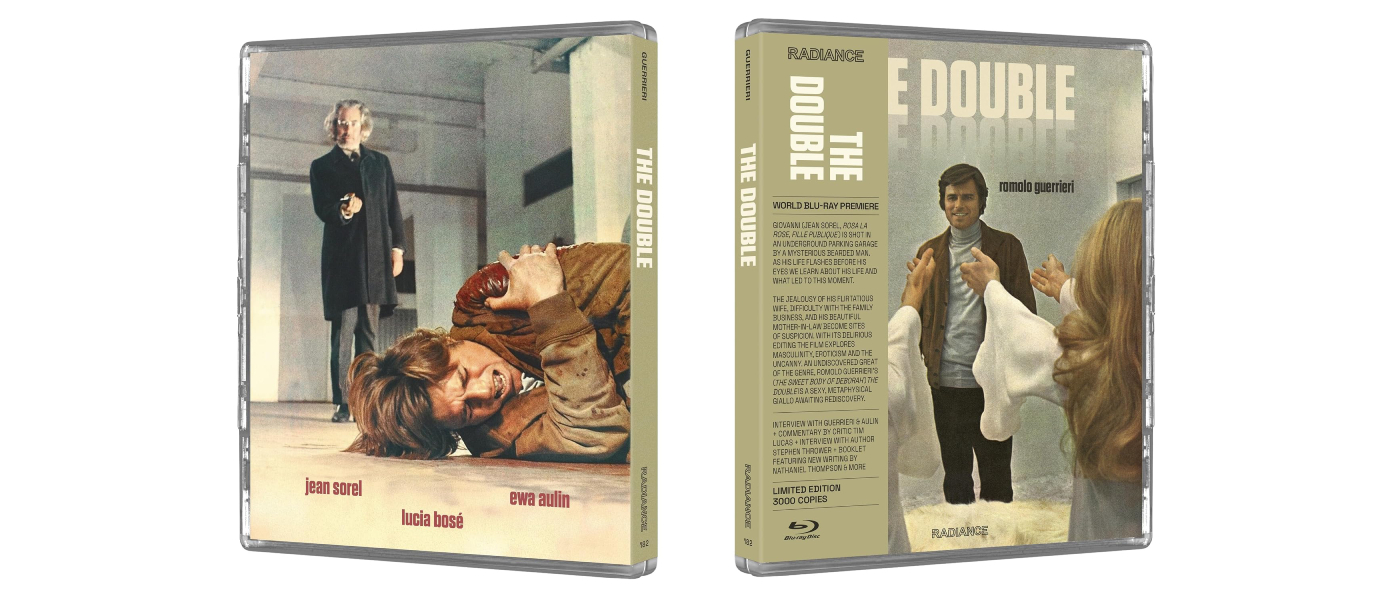

As he lies dying of a gunshot wound, an architect recollects the events that led to his demise, including adulterous liaisons and jealous envy.
After pulling into his apartment’s parking garage, Giovanni (Jean Sorel) is shot by a mysterious man (Antonio Pierfederici). As he lies wounded, Giovanni’s life begins to flash before his eyes, unveiling the events that led to the shooting.
Told out of sequence, the 1971 film “La Controfigura” (“The Double”), directed by Romolo Guerrieri based on a novel by Libero Bigiaretti, deliberately disorients the viewer as it weaves together Giovanni’s memories, fantasies, and experiences. The film’s opening segments particularly cause the viewer to question what is actually occurring. While the film is confusing, it’s not to the point of alienation.
While on vacation with his young wife, Lucia (Ewa Aulin), Giovanni grows increasingly jealous as she flirts with another man, Eddie (Sergio Doria). When his mother-in-law, Nora (Lucia Bosè), joins them on their holiday, it becomes clear that his primary attraction is really for her. Giovanni struggles with his jealousy and sexual desires as the film goes on.
As the circumstances around the shooting are revealed, Giovanni becomes a thoroughly despicable character. He imagines murdering Eddie — multiple times — in retaliation for his wife’s affection and grows increasingly agitated when Nora seems interested in Eddie as well. His jealousy and lecherous behavior ultimately lead to a disastrous decision.
The film features a dreamy score from Armando Trovajoli that’s both sensual and jarring. Carlo Carlini’s cinematography beautifully complements the score, giving the film a dreamlike and ethereal quality. As Guerrieri wraps things up, the storytelling becomes more linear while withholding full context, leaving the reveal for the film’s final moments. Although the revelation brings things into focus, the ending feels abrupt. Still, the longer I reflected on the film and dived into the disc’s special features, the more its score, cinematography, and storytelling structure came together to form a cohesive whole.
Radiance Films releases “The Double” on Blu-ray Disc with a 4K restoration from the original negative. The film looks fantastic. The imagery is detailed and filmic, with no noticeable anomalies or distracting damage. The disc allows viewers to choose between Italian and English mono tracks. I viewed it with the Italian track. It has an underlying hiss but otherwise presents dialogue, music, and effects clearly.
Extras include an audio commentary from Tim Lucas, a newly edited archival interview with Guerrieri and Aulin, an appreciation by Stephen Thrower, and an image gallery. I sampled approximately 15 to 20 minutes of Lucas’s commentary; what I heard offered substantial background on the film and its filmmakers. In the archival interview, Guerrieri and Aulin share their memories of working on the film. Stephen Thrower’s appreciation is thorough, placing the film in a wider context.
While the box art describes the film as a giallo, it differs considerably from many of the genre’s more familiar examples. Despite its initially confusing narrative, the film remains engaging and ultimately proves rewarding. Unavailable on home video since the VHS era, “The Double” now arrives in an impressive package from Radiance Films. Fans of Italian cinema will find much to appreciate here.
Now available on Limited Edition Blu-ray™ from RADIANCE FILMS
 10k
10k 20k
20k 1.5k
1.5k 2.2k
2.2k