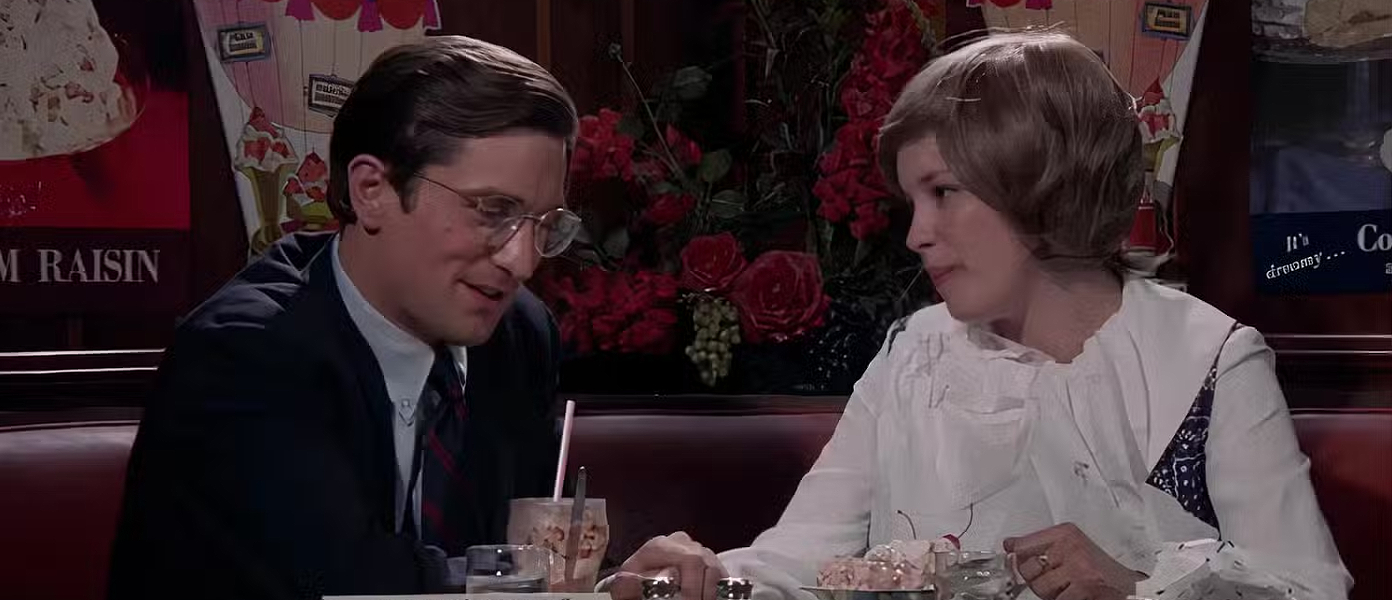

A man rents a dilapidated apartment to film people living in the opposite building in sexual situations, with help from a pornographer. When that fails, he joins a social experiment to teach white Americans how it feels to be black.
Brian De Palma is best known for his work in the gangster and thriller genres. Films such as “Scarface,” “Carlito’s Way,” “Carrie,” “Body Double,” and “Dressed to Kill” frequently feature elaborate set pieces that steadily ramp up the tension. “Hi, Mom!” is an early work from the director, and while it contains some of the themes and stylistic flourishes that would define his later career, it is quite a different beast.
Robert De Niro stars as Jon Rubin, reprising his role from De Palma’s earlier film “Greetings.” Recently returned from Vietnam, Rubin arrives in New York City seeking work in the adult film industry, beginning with a plan to film his neighbors without their knowledge. When that venture fails, he careens in different directions. The film’s most famous sequence, “Be Black, Baby,” features a militant Black theater group that aims to give a white audience the Black experience.
Watching “Hi, Mom!” today, some of its satirical edge has shifted. Its voyeurism angle, for instance, no longer feels far removed from modern life. In an age of security cameras, smartphones, livestreams, and self-documentation, someone’s personal life being exploited on a screen is, unfortunately, no longer rare. The film’s other targets — media exploitation, radical theater, racial guilt, and performative social awareness — remain potent, though they may feel less shocking simply because they’ve become so familiar.
The film ultimately plays like a series of sketches, all connected through De Niro’s Rubin. It can feel disjointed, especially when the focus abruptly shifts to other characters, but that looseness also works in its own way. “Hi, Mom!” is messy and confrontational, offering modern-day viewers an exaggerated but revealing snapshot of early 1970s America.
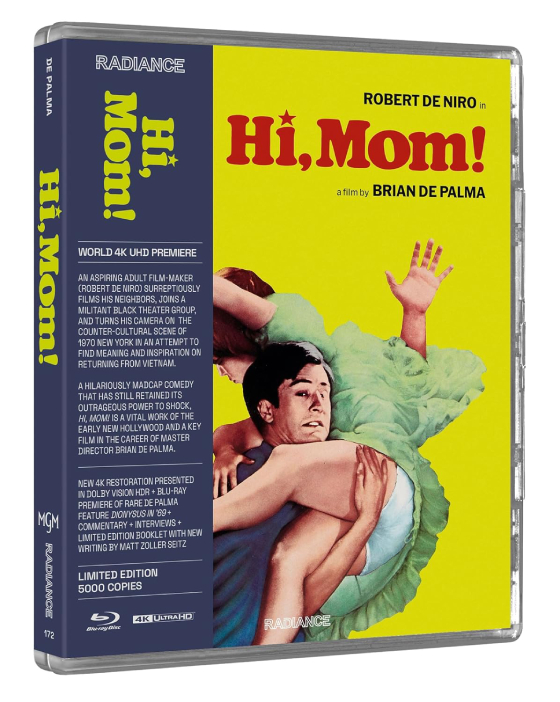
“Hi, Mom!” arrives on 4K Ultra HD™ and Blu-ray™ by Radiance Films. The feature, previously available on Blu-ray™ as part of an Arrow Video box set, arrives here with a new scan from the original 35mm camera negative. The results look strong on the 4K disc, offering an excellent presentation of this 50-plus-year-old film. At times, the image can appear quite dark, but I have never noticed any problems as a result. The mono audio presents the dialogue and effects cleanly and clearly.
Radiance packs this set with plenty of extra features for viewers to explore. There’s a commentary by Travis Woods available on both the 4K disc and Blu-ray™. The remaining features can be found on the Blu-ray™. Among these are a pair of interviews (one featuring Ellen Jones and another, originally recorded for the Arrow box set, featuring Charles Hirsch), the film’s trailer, and “Son of Greetings,” which includes behind-the-scenes footage from the film’s production. The limited edition also includes a booklet with writing from Matt Zoller Seitz.
Perhaps the most interesting extra is the inclusion of the experimental theater piece “Dionysus in 69.” Filmed using De Palma’s split-screen technique to capture both the performers and the audience, the piece helps illuminate one of the inspirations for the “Be Black, Baby” sequence. It is avant-garde and left me baffled, but it is an intriguing watch, especially in the way it blurs the line between actor and audience while adding context to the main feature.
It may not be my favorite De Palma film, but “Hi, Mom!” remains an important part of the filmmaker’s work. It introduces themes he would explore more fully in later movies while also serving as a time capsule of the early 1970s. Radiance Films’ release is thoroughly assembled, offering both a strong presentation of the film and useful insight into De Palma’s early career.
Now available on Limited Edition 4K Ultra HD™ and Blu-ray™
 10k
10k 20k
20k 1.5k
1.5k 2.2k
2.2k