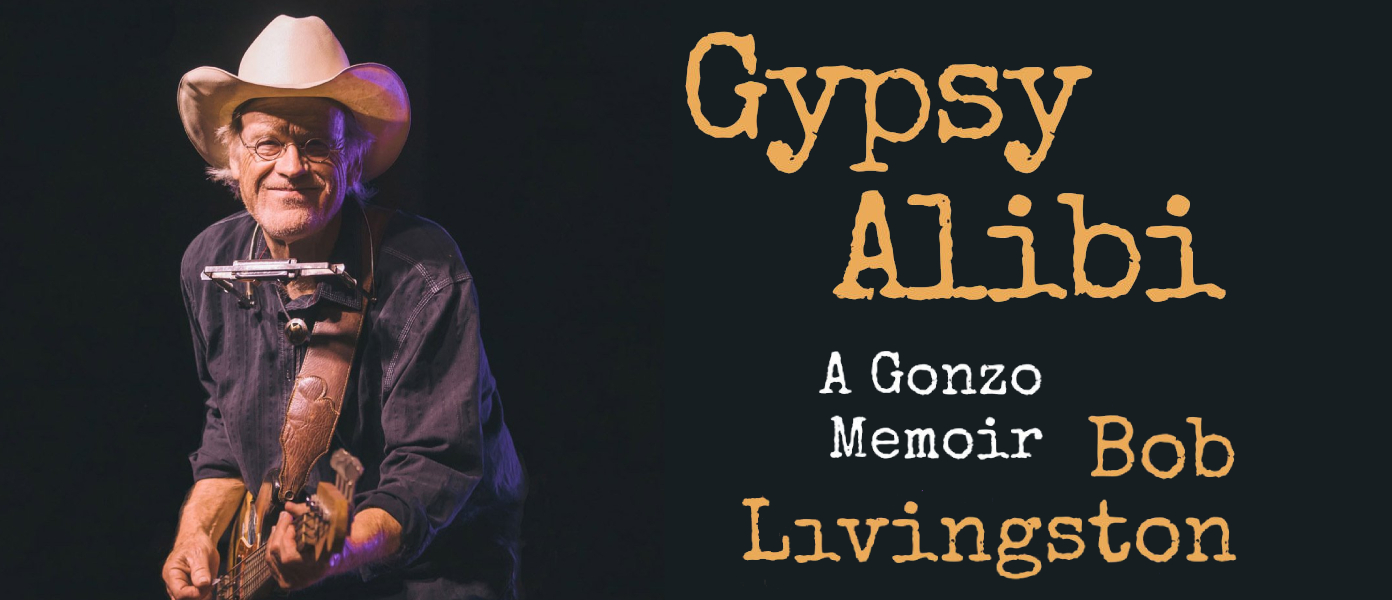

Born in San Antonio and raised in Lubbock, Bob Livingston drank from the same West Texas water as musicians like Terry Allen, Joe Ely, Lloyd Maines, and others who were surfing the wake of Buddy Holly, Sonny Curtis, and the Crickets. Livingston made his way to Austin and installed himself among the progenitors of the Cosmic Cowboy movement, who played outlaw country music and broke the rules that didn’t suit them.
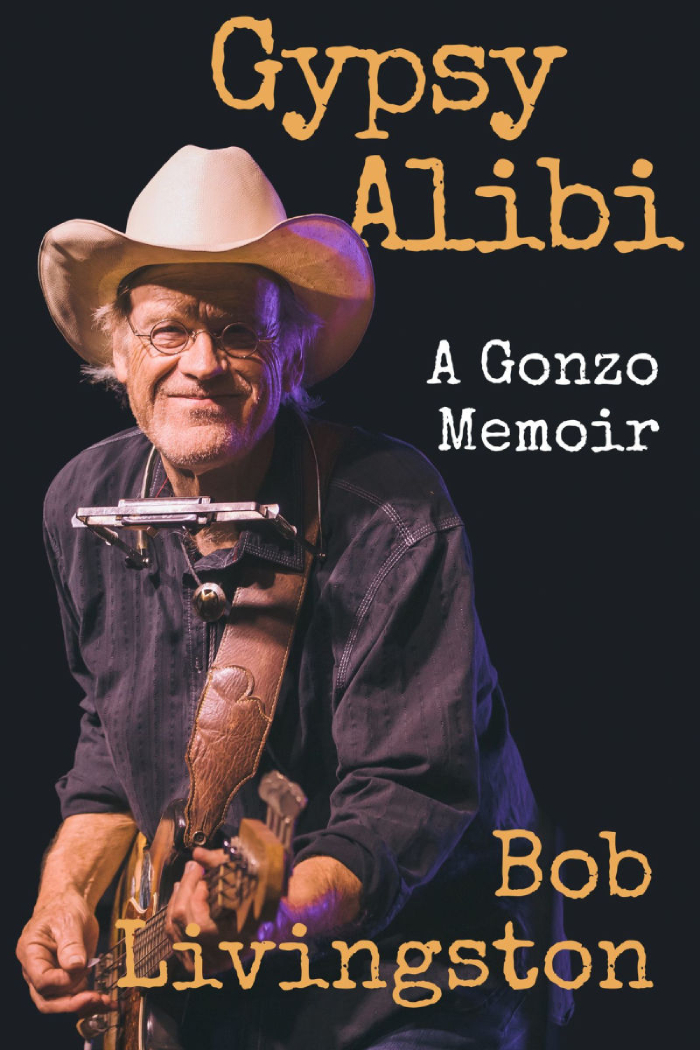
Bob Livingston has been around the block – to say the least – and knows his way around progressive country music going way back. It’s a genre that boasts many names, with its main features being rawness, improvisation, and authenticity, as well as a decided disdain for the over-polished, over-orchestrated, and overly saccharine sound of Nashville country. His recently released book, ‘Gypsy Alibi: A Gonzo Memoir,’ does a fine job chronicling the spirit of the Outlaw Country music scene in the 1960s and 70s.
Livingston played bass for Michael Martin Murphy during the days of “Geronimo’s Cadillac” and “Cosmic Cowboy” hits. Later, he served as a founding member of the Lost Gonzo Band led by Jerry Jeff Walker. Livingston was knee-deep in the making of the legendary progressive country album “¡Viva Terlingua!,” which featured memorable hit songs such as “Up Against the Wall Redneck Mothers,” “Getting’ By,” “Sangria Wine,” “Backslider’s Wine,” and most famously, “London Homesick Blues,” by Gary P. Nunn. The long-running PBS program Austin City Limits later adopted Nunn’s tune for the opening and closing credits.
“¡Viva Terlingua!,” recorded live in Luckenbach, Texas, in August 1973 and released three months later, was a huge success and proved a harbinger of things to come. Some poker buddies turned me onto the LP the year before I transferred to the University of Texas at Austin in 1975. On my first night in town, the Jester Hall resident assistants took us all down to Scholz’s Garten, where Willie Nelson’s just-released “Blue Eyes Crying in the Rain” played repeatedly on the jukebox. While not heavily emphasized in “Gypsy Alibi”, it’s worth noting the circumstances surrounding Willie Nelson’s return to Texas. Though he had found success in Nashville as a songwriter, he never really got traction as a performer. Back in liberal Austin, his more casual image of long hair, beard, blue jeans, and t-shirts served to draw both hippies and goat-ropers to packed venues that appreciated the country music rebel.
Livingston’s exploits include tours of India and Pakistan for the State Department, as well as other countries throughout the world. His time on the road covered most of Texas and many stops in the desert southwest, and eventually, the rest of the United States. “Gypsy Alibi” will strike a familiar, congenial tone for readers, as if the luminaries of the Texas country music world feel like old friends, albeit not without a few spats along the way.
Many recognizable names come into Livingston’s orbit, including John Prine, Steve Fromholz, B.W. Stevenson, Joe Ely, Ray Wylie Hubbard, Rusty Wier, and Butch Hancock, among many others. I saw B.W. Stevenson perform several times in Austin, including at Castle Creek, before he died unexpectedly at the age of 38. Famous old Austin haunts such as Mother Earth, Castle Creek, Armadillo World Headquarters, Soap Creek Saloon, and the Paramount Theater pepper the narrative and will ring familiar to readers, though many are, sadly, no longer around. Gruene Hall in New Braunfels also figures in as a favorite venue for Livingston.
Livingston outlines the controversy surrounding the release of “¡Viva Terlingua Nuevo!,” a tribute LP to “¡Viva Terlingua!,” which didn’t sit well with Jerry Jeff Walker, despite his prior blessing of the effort. Walker claimed trademark infringement, apparently because the album re-recorded the “¡Viva Terlingua!” songs, though with younger, up-and-coming artists. It was eventually renamed “Luckenbach Compadres.”
The book evokes many of the themes addressed with other fine works such as “Waylon, Willie and the Boys: How Nashville Outsiders Changed Country Music Forever” by Brian Fairbanks,” “The Improbable Rise of Redneck Rock” by Jan Reid, “Weird City” by Joshua Long, “ and “Austin to ATX” by Joe Nick Patoski.
Not incidentally, Livingston’s “Gypsy Alibi” won Album of the Year at the Texas Music Festival Awards in 2011. “Gypsy Alibi” offers a welcome view of the progressive country movement that centered around Austin, Texas – a celebration of Texas country music, Outlaw Country, Redneck Rock, progressive country, or whatever you want to call it. The fresh approach, tailored to and unique to the Lone Star State, was a refreshing change of pace from the sterility of Nashville country. During that golden age, Austin felt like the center of the universe. Filled with photos taken by band members and friends, “Gypsy Alibi” very effectively captures the spirit of the times that still lives on.
Now available in Bookstores
 10k
10k 20k
20k 1.5k
1.5k 2.2k
2.2k
Thanks for the super review!