

A Jewish prince is betrayed and sent into slavery by a Roman friend in 1st-century Jerusalem, but it’s not long before he regains his freedom and comes back for revenge.
Filmed in glorious Ultra Panavision 70, “Ben-Hur,” released in 1959, remains perhaps the finest effort of the great director William Wyler during Hollywood’s golden age, when the motion picture industry was forced to up its game in the aftermath of the widespread introduction of television into American homes after World War II. Prior to 1945, with only radio and newspapers available, most Americans consumed their entertainment and news in movie theaters two or three times a week. Once television came along, it often took widescreen, full color epics with big stars to bring folks to the cinema. Such is the backdrop for this carefully crafted story, displayed in the expansive 65mm format, and featuring excellent casting and strong character development – all of which come together as few films ever do.
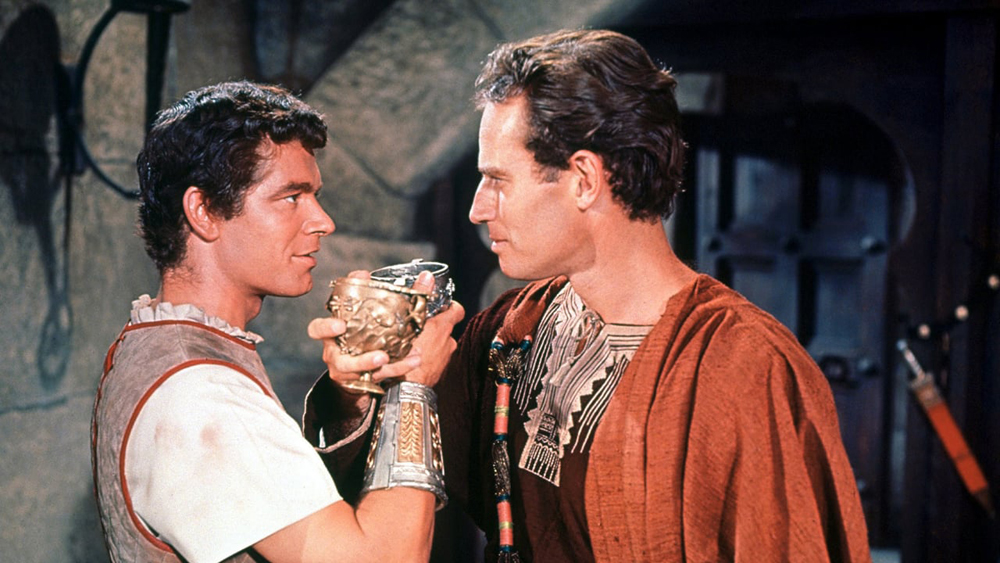
Charlton Heston commands virtually every scene as Judah Ben-Hur, a Jewish aristocrat in Judea. Ben-Hur’s childhood friend Messala (Stephen Boyd) has just returned to Jerusalem from Rome as second in command to the new governor. However, tensions between the conquered province and the Roman Empire soon create a severe rift between Judah and Messala, who has been tasked by the Emperor Tiberius (George Relph) to restore order and increase tax collections in the rebellious region.
Sam Jaffe as Simonides, Ben-Hur’s chief steward, appears after a year away working trade routes and bearing good news of a prosperous journey. Simonides’ beautiful daughter, Esther, played by Haya Harareet, accompanies him, and Judah is clearly enamored with her. Despite her recent betrothal, they embrace and kiss passionately under the night sky.
When the new Judean governor Gratus (Mino Doru) arrives on horseback with pomp and circumstance along the parade route, a loose tile falls from the roof of the Hur estate. The accident injures the governor, prompting Roman soldiers to arrest Judah, his mother Miriam (Martha Scott), his sister Tirzah (Cathy O’Donnell), and, later, Simonides. Messala releases the servants but refuses to intervene on Judah’s behalf. When Judah attempts to escape after learning that he will be sent to Tyrus as a galley slave, he confronts Messala, who reveals his cruel decision. Because Judah refuses to betray his fellow Jews as an informant, Messala plots a different way to use his old friend. By sentencing Judah to a lifetime of servitude on a Roman warship, he hopes to set an example that will keep the populace in line with the new Roman administration in Judea.
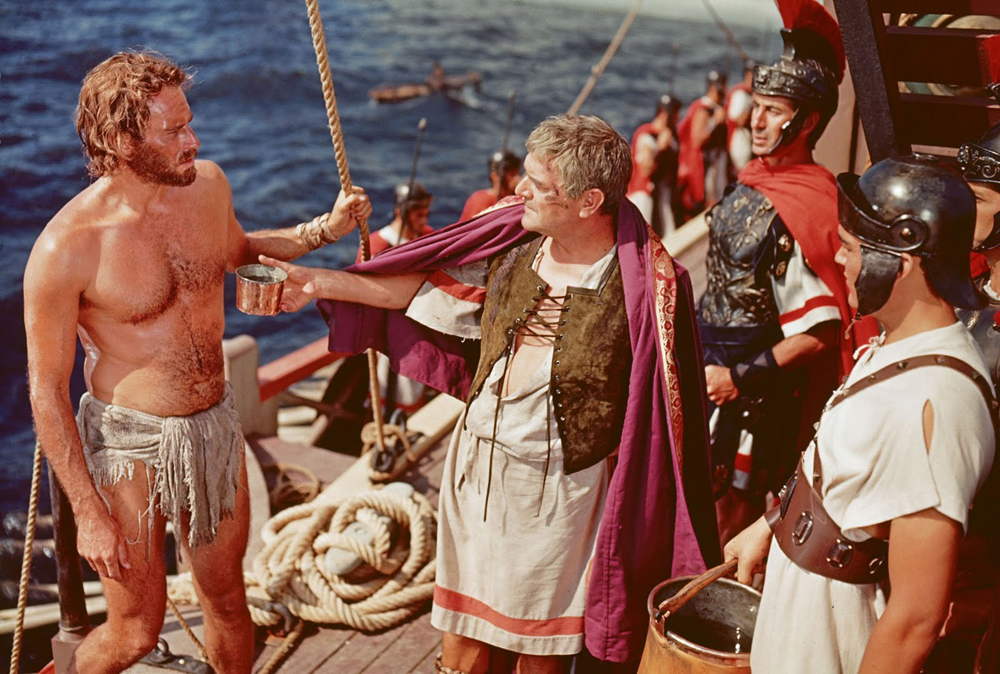
Judah barely endures the long desert march in chains to Tyrus, nearly dying of thirst in the process. In one of many moving scenes, a mysterious man offers Judah water despite a soldier’s orders to the contrary. As Judah drinks the water, the lead Roman confronts the stranger seen only from behind, but it’s clearly Jesus of Nazareth. When the young carpenter stands to face the sadistic sergeant, guilt washes over the man’s weathered face – as if Jesus had seen into his soul with a firm reprimand. The soldier turns away slowly in shame, looking back only once before resuming his normal duties.
Three years into Judah’s servitude on Roman ships, a new commander, Quintus Arrius (Jack Hawkins), takes over. He puts the rowers through their paces to see how far he can push them in an actual battle. Despite relentless lashings by the guards, many of the men succumb to the physical exertion, though not Judah, who remains convinced that God has kept him alive all this time for a reason.
Later, Quintus summons Judah to his cabin and offers him the chance to drive the consul’s chariot horses in Rome. Quintus is a troubled man, as later revealed, because of the death of his son. Judah senses that the old man has lost whatever faith in the eternal that the consul once had. When Judah asks what drove his faith from him, Quintus angrily sends him away.
As the Roman fleet prepares for battle, Quintus inexplicably orders Judah unchained from the galleys. When the ship is rammed, Judah frees many of the rowers and then climbs to the top deck to survey the situation. Enemy combatants force Quintus overboard, clad in his heavy armor, and Judah dives into the fiery sea to rescue the helpless man who would otherwise have drowned.
Together, the Roman commander and the slave float on a large piece of driftwood for a time in the Mediterranean. The prospect of disgrace causes Quintus to attempt suicide, but Judah intervenes until a Roman ship eventually approaches. What appeared to be certain defeat turns out to be an unexpected and decisive victory for Quintus, who, in a form of gratitude, takes Judah under his wing. Even so, as Judah passes the galley below deck in the rescue ship, he can’t help but pause to watch a large group of slave rowers, consigned to their own appalling fate – a reminder of man’s inhumanity to man. The yearning for a long-awaited messiah is made clear.
Of interest to many viewers, even though the bulk of the story is fiction, is the appearance of Pontius Pilate (Frank Thring) in two locales. The first takes place in Rome, in a conversation he has with Quintus Arrius, bemoaning his posting to Judea instead of his preference for Alexandria. His second appearance is in Judea, where he interacts with Judah twice. The intermingling of real and imagined characters in the genre of historical fiction works at its best in these types of scenarios. To the credit of Lew Wallace, author of the book “Ben-Hur: A Tale of the Christ,” Pilate is not portrayed as one-dimensional as his stereotype often suggests, but rather as a more complex figure with conflicted motivations.
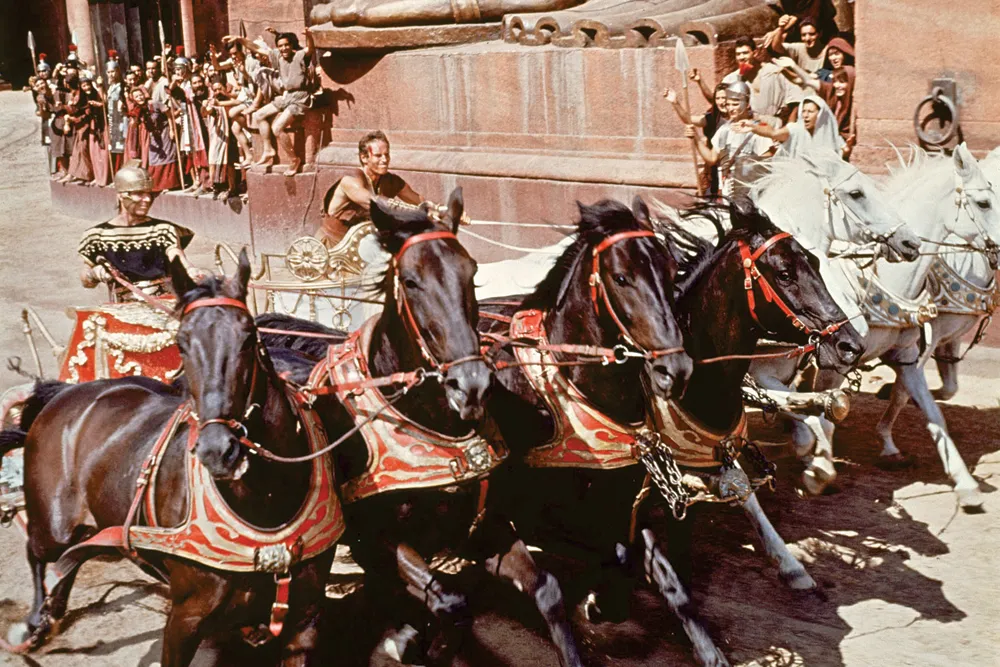
During the following months, Judah becomes a champion charioteer in the Roman circus, is adopted by Quintus, and becomes heir to his property. Still, all the while, Judah is tortured by the thought of his mother and sister confined in a squalid Roman prison. Judah tells Quintus he must leave Rome for Judea to set matters straight. Along the way in a desert oasis, he meets Balthazar (Finlay Currie), who also provides the film’s brief voice narration in the opening scenes. Balthazar introduces Judah to Sheik Ilderim (Hugh Griffith), who maintains four magnificent white horses that he hopes to race against Messala in Judea. Although impressed and intrigued, Judah can do little more than provide advice on training the steeds because of his desperate need to return to Jerusalem, most likely to kill Messala. Balthazar senses this and offers counsel to Judah in the form of the Messiah’s message of forgiveness – a credible lesson since Balthazar was one of the three wise men who encountered Jesus at His birth over thirty years previous.
Arriving at his estate in Jerusalem, Judah finds the palatial residence abandoned and neglected. Simonides still lives there, but can no longer walk as a result of Roman torture during his imprisonment in the dungeons. As Judah re-enters the courtyard after so many years, he encounters Esther in another emotional moment. She cannot believe his return from the slave galleys and weeps with joy.
Very shortly thereafter, Judah seeks out Messala and offers him the chance to atone for the previous injustice by freeing his mother and sister. When Messala tries to comply, he learns that the two women have contracted leprosy – a fate perceived as worse than death. They are banished to the Valley of the Lepers. Massala lies to Judah by letting him infer that his mother and sister died in prison. Esther knows the truth about their condition and lies too, but is sworn to secrecy by Miriam.
Thus sets the stage for Judah’s retribution against Messala in the great chariot race that “Ben-Hur” is best known for. It provides crowd-pleasing action but surprisingly little satisfaction for a vengeful, grieving Judah. In his death throes, Messala somewhat gleefully reveals what actually happened to Judah’s mother and sister, which horrifies him.
“Ben-Hur’s” final act surrounds the crucifixion of Christ, which allows Judah to return the compassion he had once received himself in the desert years before. The themes of redemption and salvation infuse the narrative in a measured, non-preachy fashion, constituting a delicate balance expertly navigated by Wyler’s incomparable direction. Every scene, every frame is a testament to his three Academy Awards for Best Director, ample proof of his enormous and widely acknowledged talent over many years of making motion pictures.
A true masterpiece, “Ben-Hur” has lost none of its relevance and moving sentiment over the decades. Even with a three-and-a-half-hour runtime, the film never flags for a moment. As Roger Ebert often said, no good movie is too long – which certainly applies here – and no bad movie is short enough. Winner of 11 Academy Awards, including Best Picture, “Ben-Hur” amply rewards repeated viewings, with the recently released 4K UltraHD version’s vivid colors and brilliant resolution both equally exceptional.
Now available on 4K Ultra HD™ and 4K Ultra HD SteelBook™

 10k
10k 20k
20k 1.5k
1.5k 2.2k
2.2k