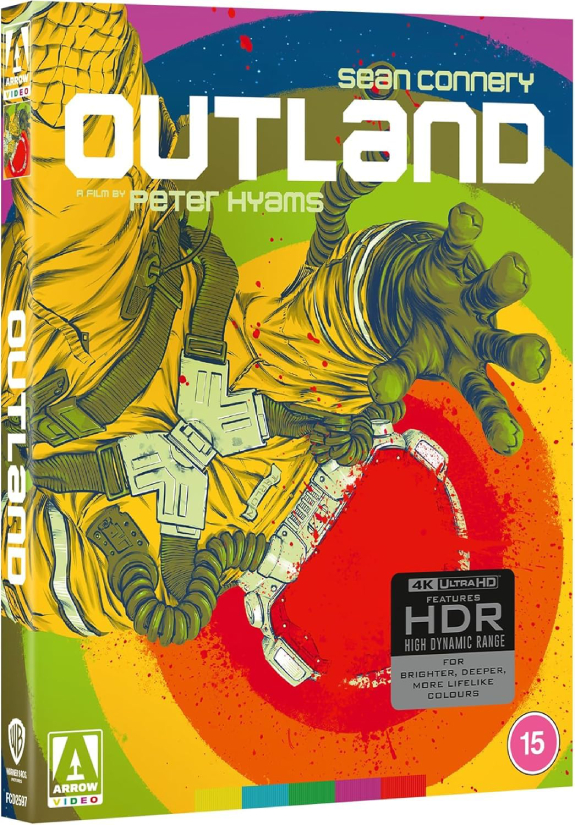

A federal marshal newly stationed at a mining colony on the Jupiter moon of Io notices a series of unusual deaths. Against the advice of everyone, he digs deeper to find the cause and finds himself marked for death.
Sean Connery’s 1981 film “Outland” didn’t perform well at the box office, but it later gained cult status on home video. By this stage in Connery’s career, he had already broken free from his Bond persona and tried his hand at many types of roles. “Outland” marked his debut in a straightforward, high-concept science fiction film. Although Connery had ventured into genre-blending fare like the infamous “Zardoz” and would later join the HIGHLANDER series, those projects mixed sci-fi with fantasy and adventure. “Outland,” in contrast, was his first and only foray into classic, unembellished sci-fi—making it a notable entry in the field.
Set in a not-too-distant future, “Outland” follows Connery as Federal Marshal William O’Niel, newly assigned to Con-Am 27, a remote mining base on Jupiter’s moon Io. The outpost is an unforgiving place, where workers battle extreme psychological stress and survive in an environment hostile to life, with no natural air. Spacesuits are always required, and oxygen is in short supply, creating an ever-present sense of anxiety and confinement. O’Niel’s family—his wife Carol (Kika Markham) and son Paul (Nicholas Barnes)—come with him initially, but Carol quickly finds the brutal living conditions intolerable, taking Paul back to a nearby space station and urging O’Niel to join them. Choosing duty over family, he remains behind.
Soon, O’Niel begins to notice a disturbing increase in miners suffering violent mental breaks, some even exposing themselves to the moon’s vacuum in fatal desperation. In a tense scene, one miner takes a prostitute hostage, forcing O’Niel to step in. Joined by Dr. Marian Lazarus (Frances Sternhagen), he begins investigating the troubling events. They discover that the miners are being dosed with polydichloric euthimal, a dangerous stimulant that allows them to work for inhumanely long hours but with devastating psychological side effects.
Their investigation leads them to General Manager Mark Sheppard (Peter Boyle), who runs a covert drug operation and credits his “management” for the outpost’s productivity. O’Niel disrupts the scheme by intercepting and destroying a new shipment, which puts a target on his back. Sheppard issues veiled threats, and O’Niel intercepts messages that assassins are on their way to eliminate him. Isolated and with his co-workers unwilling to help, O’Niel only has Dr. Lazarus in his corner as he attempts to prepare for the killers’ arrival, using the limited time before the next shuttle docking to set his traps.
Released two years after “Alien,” “Outland” shares that film’s stifling atmosphere and sense of constant danger. Jerry Goldsmith, who scored “Alien,” delivers another tense and moody soundtrack, while cinematographer Stephen Goldblatt amplifies the suspense with creative lighting and wide-screen visuals reminiscent of Ridley Scott’s style. There are no monsters in the shadows, but director Peter Hyams makes sure that an air of dread and uncertainty saturates the entire movie. The scenes where O’Niel braces himself for the assassins’ approach, not knowing whom to trust or even how many enemies he faces, are especially nerve-wracking.
“Outland” often evokes the classic Western “High Noon,” recasting its core story in a sci-fi context with Connery channeling a solitary, determined protagonist much like Gary Cooper. The film’s clear nods to Western tropes add depth rather than feel like mere imitation, as O’Niel finds himself locked inside a facility with no hope of escape except by braving the lethal outdoors of Io.
Sci-fi films from the late-70s and early-80s are known for their distinctive visuals, careful sound design, clever writing, and use of practical, physical effects rather than digital. “Outland” checks all those boxes. It delivers a grounded story, steering clear of flashy tech, alien creatures, or laser shootouts. Everything on screen feels tangible, reinforcing the setting’s realism.
For fans of vintage science fiction who haven’t yet discovered “Outland,” the film is an overlooked treasure. Its heavy atmosphere, gripping plot, and standout performances make it a film well worth seeking out.
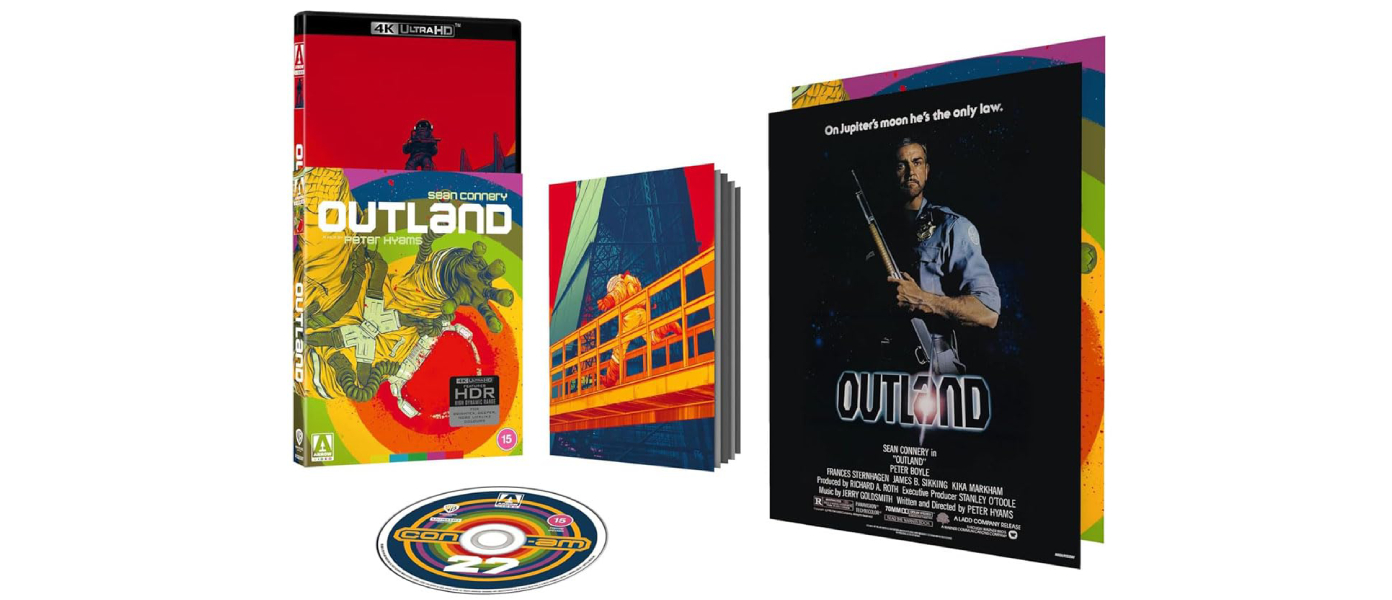
Now available on a 4K Ultra HD Limited Edition