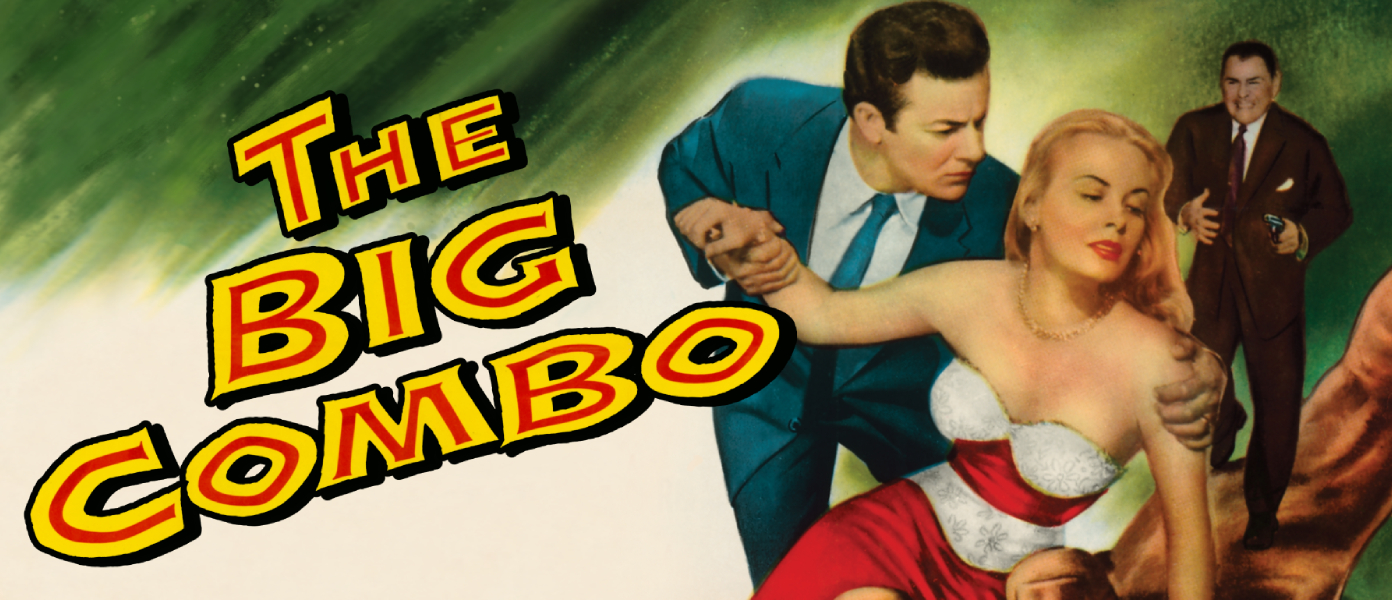

A police lieutenant is ordered to stop investigating deadly crime boss Mr. Brown because he hasn’t been able to get any hard evidence against him. He goes after Brown’s girlfriend, who despises him, for information instead.
Beginning with John Huston’s classic “The Maltese Falcon,” and largely concluding with “The Big Combo,” film noir had its heyday over a period of less than fifteen years, from 1941 to 1955. Neo-noirs, of course, resurface with regularity, but the original era pretty much came to an end in the mid-1950s. The title of the movie, while sounding like it might allude to an impromptu band, is actually an abbreviation for the big combination – a way to describe the systematic nature of organized crime syndicates, in this case run by a Mr. Brown (Richard Conte).
For years, at considerable cost to taxpayers, Mr. Brown has been relentlessly dogged by Detective Lieutenant Leonard Diamond, played by Cornel Wilde, with little to show for it. His boss, Captain Peterson (Robert Middleton), admonishes Diamond for a lack of results. He tells Diamond that he needs to move on and focus on crimes that can be more readily solved, and that he’s never going to get anywhere against such a well-connected mobster. Further, he accuses Diamond of having fallen in love with Mr. Brown’s girl, a woman named Susan Lowell (Jean Wallace), who was Wilde’s real-life wife at the time.
Susan is somewhat out of place in the underbelly of the noir criminal world, which helps inform the nature of this late-season entry into the genre. While most of the scenes – whether in the police station or the burlesque theater where Diamond’s girlfriend Rita (Helene Stanton) works – are bathed in dark tones and contrasts by famed cinematographer John Alton, Susan gets different treatment. When Susan appears onscreen, the lighting is usually much brighter to convey that she comes from a high-society background and is not a femme fatale or gun moll. As one of his few potential leads, Diamond relentlessly hounds Susan off and on in the hopes of obtaining a witness to Mr. Brown’s illegal activities.
The film opens with Susan running through the bowels of a boxing arena pursued by two of Mr. Brown’s henchmen – Fante (Lee Van Cleef) and Mingo (Earl Holliman) – tasked with keeping an eye on her. At first, it seems that the two men intend to do her harm, but when they corral her, they simply ask that she return to the boxing arena and finish watching the fight, pursuant to Mr. Brown’s instructions. She refuses, saying she wants to get something to eat instead. The film then cuts to a shot of a greasy, big, beefy steak filling a large plate on a white linen tablecloth, then pans up to her face, displaying more than a touch of nausea, by the looks of things. When she unexpectedly collapses on the dining room floor, Fante and Mingo rush Susan to a hospital. There, Lieutenant Diamond surreptitiously attempts to question her without success before Brown intervenes.
Diamond pokes and prods at the periphery of Brown’s organization without much luck. In the meantime, Captain Peterson continues to chastise Diamond for wasting department resources, prompting Diamond to ask for even more funding.
Along the way, the character of Mr. Brown – perhaps the most interesting of the varied cast – is carefully explored throughout the narrative. He belittles Joe McClure (Brian Donlevy), who used to run the operation before Brown took over. Mr. Brown relishes demeaning McClure as a weakling who lacks the backbone necessary to run the operation anymore. As he essentially says more than once, first place is first, and second is nobody. Similarly, Brown’s interactions with Susan are largely a demonstration of his dominance over her, despite – or even because of – her privileged past.
Diamond learns of a mysterious woman named Alicia (Helen Walker) and eventually tracks her down at a mental institution, where she is pretending to be insane. As the plot thickens, he later learns that Alicia is Brown’s wife. Diamond also identifies a former yacht captain named Nils Dreyer (John Hoyt), who may know something about the history of Brown’s illicit empire that could incriminate him.
“The Big Combo” is also notable because of the way it deftly skirts the Hollywood censors. In one instance, Brown seduces Susan as she faces the camera, consumed by desire. He disappears beneath her, leaving the audience to their imagination as to what happens next. More generally, the bond between Fante and Mingo hints at more than just collegial friendship, going as far as it dares to suggest that the couple is gay – likely a key reason that Brown allowed the two men to keep an eye on his girl so much of the time without worry.
Directed by Joseph Lewis, probably best known for “Gun Crazy,” “The Big Combo” represents a solid effort in his filmography, perhaps because so many previous noirs by so many other directors meant that he knew he needed to create something fresh. The screenplay was written by Philip Yordan, a journeyman in the trade with a knack for securing sole credit even when assisted by collaborators, something for which he became somewhat notorious.
The bonus features include audio commentary by film historian and noir expert Imogen Sara Smith, new essays by Ben Sachs, Alonso Duralde, Katie Stebbins, Scout Tafoya, and Garrett Clayton, as well as a filmed interview with author and critic Philippe Garnier, among other content. Aficionados of the genre, or even those who simply like to relax with an old movie, will find much to appreciate in this moody, menacing production. As such, “The Big Combo” serves as a very appropriate bookend for the timeless nature, albeit brief lifespan, of American film noir.
Now available on 4K Ultra HD™ and Blu-ray™