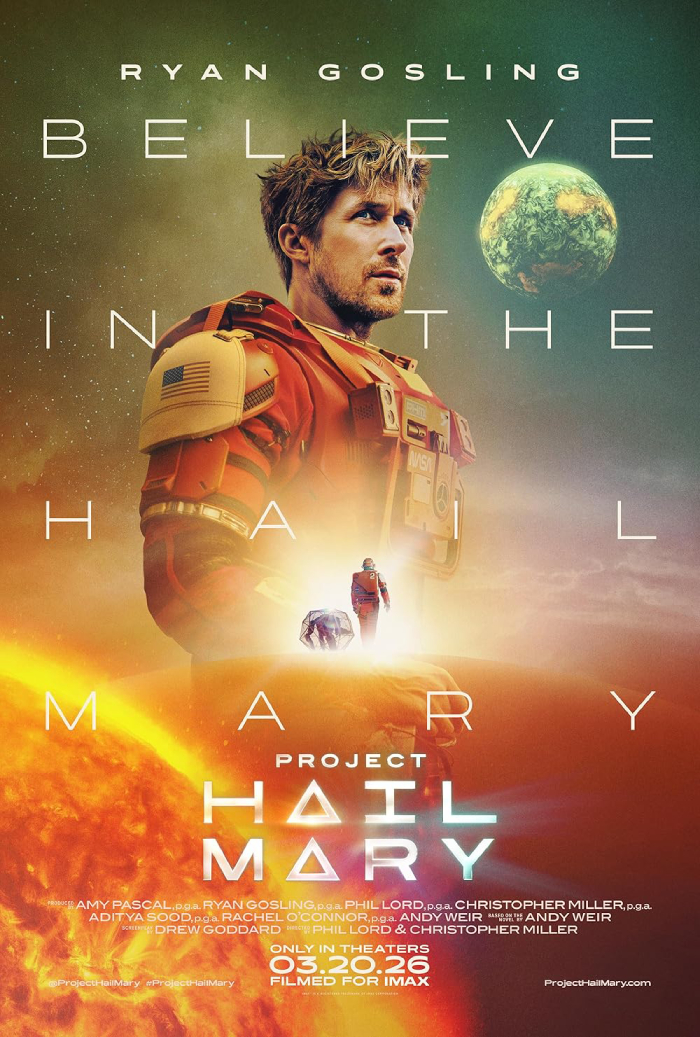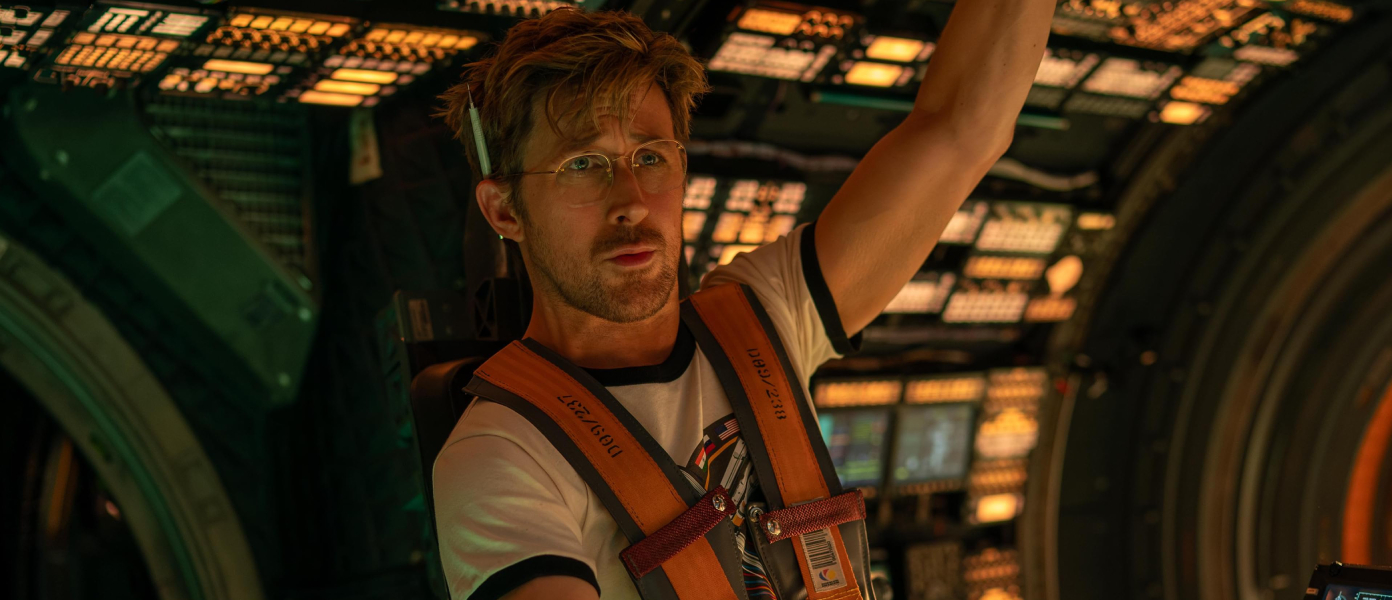

Science teacher Ryland Grace wakes up alone on a spaceship light-years from Earth. As his memory returns, he uncovers a mission to stop a mysterious substance killing the sun, and save Earth. An unexpected friendship may be the key.
In a day-long lecture/class on writing back in the mid-1980s in Austin delivered by Howard Waldrop, a science fiction writer perhaps best-known for the speculative fiction (SF) novel called ‘Them Bones,’ he told the students that if they were able to get an SF novel published, it would be more lucrative to give up the film rights and retain foreign publishing revenues. I was there as one of the students. His reasoning – correct at the time – was that moviemaking technology could not adequately translate most SF novels to the screen, would never likely be filmed, and as a result, the foreign copyrights would yield authors more tangible and immediate royalties.
Since then, of course, times have changed. Hollywood special effects, starting with either “2001: A Space Odyssey” or “Star Wars,” and the resulting incorporation of Industrial Light and Magic progressively changed the terms about what content imagined by authors could make its way onto the big screen. With the release of author Andy Weir’s “Project Hail Mary,” starring Ryan Gosling, shot in IMAX format, arriving soon in theaters, Waldrop’s old maxim clearly no longer applies. The epic proportions of this movie surpass the formidable earlier achievements of Christopher Nolan’s “Interstellar,” Stanley Kubrick’s “2001: A Space Odyssey,” and the excellent Denis Villeneuve’s “Blade Runner 2049,” also starring Ryan Gosling.
For those expecting a rewrite or sort of oblique sequel to “The Martian,” you will be disappointed – hopefully in a good way. The film deals with far more complex issues regarding our place in the universe, but also of loyalty, institutions, and the ultimate fate of humanity – at least over the next century or so, the apparent outer limits of how far ahead we can plan as a species, if even that.
In the three forms of fiction – Person vs. Person, Person vs. Himself/Herself, and Person vs. Nature – “Project Hail Mary” falls into all three categories, with nature taking the lead in the conflict. The source of the natural encounter consists of the unexpected emergence of Astrophage, an alien microbe initially referred to as dots and capable of reproduction. When streams of the dots begin traversing a path from the Sun to Venus, they are named after their discoverer and called the Petrova line. As the dots steadily reduce the warming effects of the Sun, the Earth is on track to revisit another ice age within thirty years – an event that will almost certainly result in the extinction of the Homo sapiens species, as well as most or all other organisms farther down the food chain.
Frequent flashbacks heighten the tension, which takes enough twists and turns to elicit a gasp or two from viewers before the closing credits. The film opens with Ryland Grace (Ryan Gosling) emerging from a medically induced coma on an enormous spaceship, hurtling its way to God knows where. His first guess is that the craft has made it as far as Neptune, based on how long he has been unconscious and perhaps the length of his beard and hair. Beyond that, he can’t remember much. Out of his comatose state, Grace struggles at first even to speak a coherent sentence. As he searches the ship, he finds the only two other crew members aboard dead – the captain and navigator. A molecular biologist, Grace slowly realizes he was the scientific member of the three-person team.
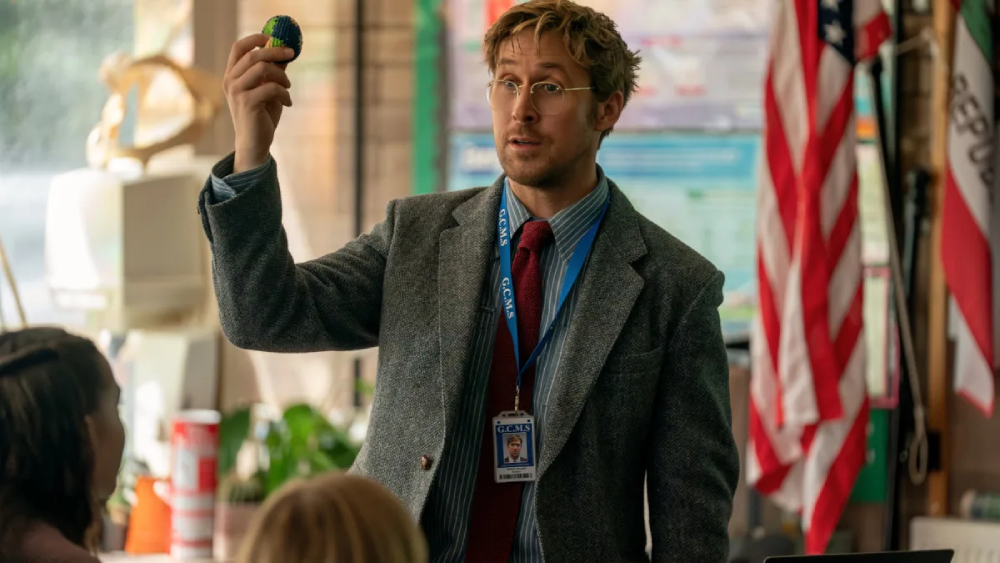
In drips and drabs, Grace’s pre-flight memories begin to return. He was a middle school teacher instructing his students about aspects of physics. During class, an unexpected visit by Eva Stratt (Sandra Hüller) recounts Grace’s doctoral research regarding the prospect of other types of life in the universe that might exist in environments requiring elements other than oxygen and nitrogen. Stratt reminds Grace of his insulting comments to academic peers who disagreed with his theories – at the time considered outlandish – which led to his fall from the academic community and, hence, his relegation to K-12 education, a vocation he is good at and finds fulfilling.
Stratt briefs Grace on the issue at hand: the loss of infrared radiation from the Sun on its way to Venus and the quest to counteract the effect. Later, she reveals that the phenomenon is not confined to the Earth’s Sun but to nearly all of the stars in the immediate cosmic vicinity. The one exception is Tau-Ceti, 4.27 light-years from Earth, which also maintains a Petrova line to the planet Tau-Ceti-b, but is apparently immune to the energy-extracting effects of the Astrophage. Stratt explains to Grace that she wants to know why Tau-Ceti is different and whether he thinks he can help. When Grace waffles, she thanks him for his time and sends him on his way. Unexpectedly, he pushes back, so Stratt replies that there are hundreds of other molecular biologists working on the problem and she needs commitment from any one of them to proceed. Grace ponders briefly and agrees to join the project, headfirst with both feet in at last.
The Astrophages represent a source of both immense power and danger, as the dots siphon energy from the Sun and other nearby stars, migrating to planets with carbon dioxide atmospheres. They simultaneously threaten the Earth in decades or less, but can also provide the propulsion necessary for an Earth ship to reach Tau-Ceti – at least for a one-way trip, i.e., with no provision for the crew to return. Such is the essence of the struggle Grace faces to come to terms with his own mortality – an eventuality intended to remind us of the fate we all must face sooner or later, one way or the other. Sometimes we have a choice, with some options more noble than others.
Much of the story’s intrigue stems from Grace’s intermittent recall of the events that led to his journey aboard a starship that uses current-day technology. It’s solid and real – and really expensive – with stainless steel, composite materials, and alloys. Grace’s frequent conversations with Stratt in flashbacks perhaps provide the most insightful plot elements of the film. As Grace gains greater familiarity with his ship, the giant craft rapidly approaches Tau-Ceti, with an uncertain outcome. To say much more would constitute divulging too many spoilers, at least for any credible critic. Suffice to say that “Project Hail Mary” constitutes a grand movie-going experience to be savored.
As in “The Martian” directed by Ridley Scott, several popular music numbers infuse the soundtrack, adding to the quality and clarity – and frankly the fun – of the narrative. Amy Pascal serves as lead producer, along with help from Ryan Gosling and novelist Andy Weir. Directed by Phil Lord and Christopher Miller, the approximately two-and-a-half-hour runtime does not detract at all from the highly compelling tale, which is significantly enhanced by crisp cinematography, an engaging score, and an extremely moving story. Rightfully taking its place among the best hard science fiction motion pictures of all time – and likely to figure prominently in next year’s Oscar nominations – “Project Hail Mary” revels in its scale and scope, bringing to audiences a fresh twist on hypothetical human-alien encounters.
In Theaters Friday, March 20th