

The son of a rich Italian industrialist discovers how hard it is to leave the path society has set for him.
An Italian film that harkens back to the early 1960s, “Corruption” is an obscure, oft-forgotten work that examines the disconnect between something resembling virtue and its comparatively decadent alternative. The Filming in black and white serves as a metaphor for the storyline – there is no gray area here.
The narrative begins with the prep school graduation of Stefano Mattioli (Jacques Perrin), accompanied by his well-dressed peers in the audience, all smiles, all good-looking kids ready to make their mark on the world. In the opening scene, the prep school professor (Filippo Scelzo) delivers his salutation remarks about the contrast between Catholicism and Marxism – a strange comparison. Nonetheless, this supposed dichotomy comprises the dilemma that Stefano faces.
Stefano’s father is a publishing magnate named Leonardo Mattioli, or Leo (Alain Cuny). He comes off as a nice enough guy at first, though it’s clear that he is a ruthless businessman on his best day, and something worse on others. He appears fairly obtuse at first, but he is anything but. Most of all, he is corrupt to the core, essentially embodying the movie’s title character.
One of the authors at the publishing house that Stefano admires, Morandi (Ennio Balbo), maintains leftist tendencies. He wears the distinction of having fought against the fascists in World War II, suffering imprisonment for years as a result. Leo publishes Morandi’s works because they still sell well, even though he has little use for the radical ideological content.
Stefano’s mother, Signora Matioli, played by Isa Miranda, appears in a hospital bed suffering, perhaps, from insomnia, though that’s not altogether apparent. Either way, she is desperate for sleep from weariness and perhaps a desire to simply check out. In the few moments she appears on screen, Stefano observes the doctors administering medication that will put her out for two days – a prospect that evidently pleases his mother.
Despite the windfall he stands to inherit, Stefano aspires to the priesthood, an avocation his father has little use for. Leo instead wants his son to join him in the family publishing business and eventually take the helm. Stefano remains adamant in his virtue until he takes a sailing excursion on his father’s boat, accompanied by an attractive woman named Adriana (Rosanna Schiaffino) at the older man’s invitation. Seductive glances, notwithstanding, Stefano displays a hostile demeanor, conflicted as he is about his moral and clerical aspirations.
While Stefano lives the life of a bourgeois, one might wonder whether the definition has changed over time, given his father’s vast social and political influence and the lavish wealth he enjoys. The best example of modern bourgeois that comes to mind is from “Eyes Wide Shut,” the grossly misinterpreted film by Stanley Kubrick that subtly defines the class delineation, among other things, between the merely wealthy on the one hand, and the really, really rich on the other. Specifically, the contrast between Dr. William Harford, played by Tom Cruise, representing the well-heeled bourgeoisie, and the rarefied aristocracy – the level above – played by Sydney Pollack as Victor Ziegler. Though Harford lives well, Ziegler lives in obscene opulence – obviously a member of the gentry. The class structure dictates that the bourgeoisie remain loyal to the aristocracy mostly because of the perks but also because of the implied penalties. At the end of the day, the bourgeoisie thrive only at the elites’ pleasure.
The final scene consists of a large group of young people at an outdoor party dancing in unison to contemporary music, another metaphor that essentially dooms Stefano to his conformist fate. It’s a prescient glimpse in the early sixties about where society was headed – a facade rampant with whispers of payoffs and subterfuge, hidden just beneath the surface.
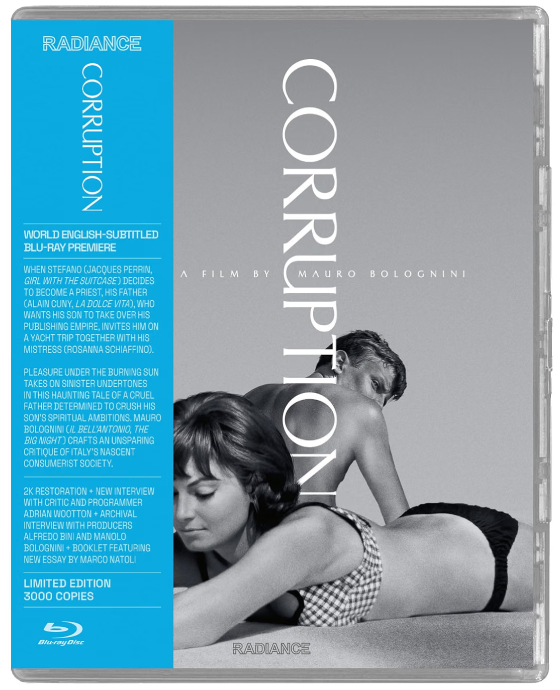
Special features include enlightening commentary by Adrian Wootton, CEO of Film London, the agency charged with developing the screen industries in the capital. He adeptly interprets the intentions of the screenwriters (Fulvio Gicca Palli and Ugo Liberatore) and director Mauro Bolognini. His references to Dante’s descent into hell and “The Last Temptation of Christ” figure prominently in his analysis – both apt parallels. “Corruption” embodies a fine depiction of the sort of dialectic that infused social commentary in the 1960s, entirely relevant to the present day. With any luck, the restored version on Blu-ray™ and Dolby Audio will find new audiences among international film lovers.
Available on Limited Edition Blu-ray™ September 15th from RADIANCE FILMS
 10k
10k 20k
20k 1.5k
1.5k 2.2k
2.2k