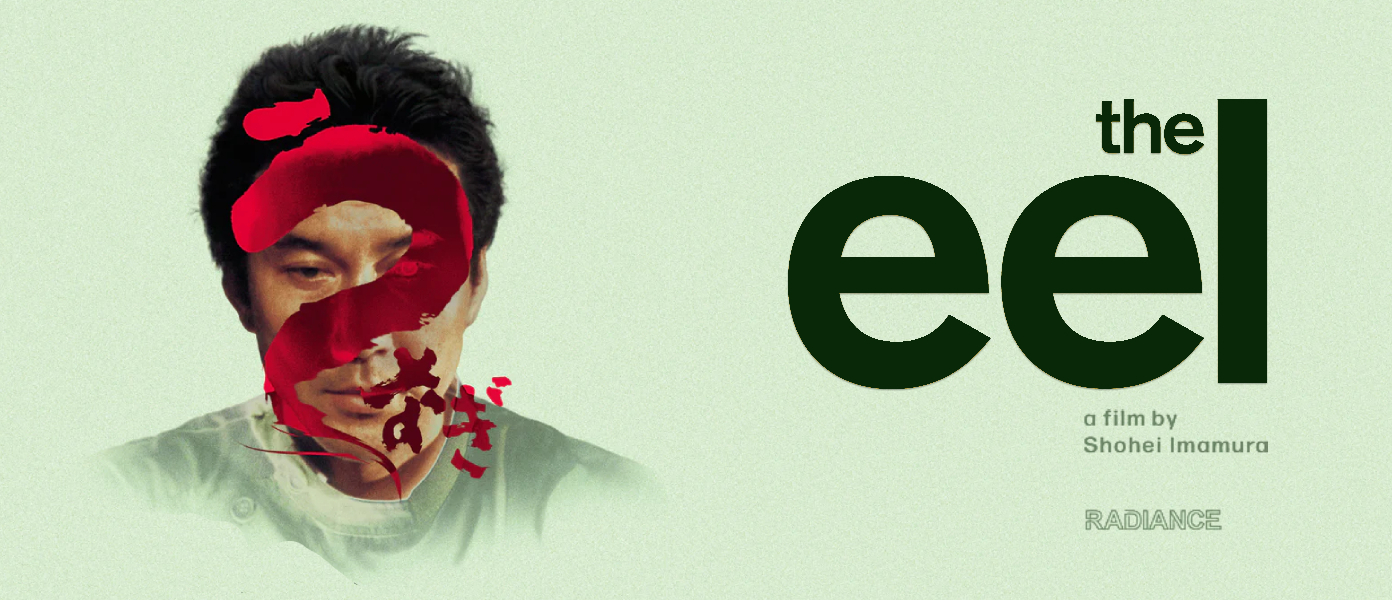

A businessman kills his adulterous wife and is sent to prison. After the release, he opens a barbershop and meets new people, talking almost to no one except an eel he befriended while in prison.
“The Eel” marked the second time that director Shōhei Imamura won the Palme d’Or at the Cannes Film Festival in 1997 (his first was for 1983’s “The Ballad of Narayama”). The film shared the award with Abbas Kiarostami‘s “Taste of Cherry.” Marking a return to filmmaking after nearly a decade, “The Eel” was the start of a streak for Imamura; two additional features soon followed the release of this film.
Despite a brutal beginning as Takuro Yamashita (Koji Yakusho) murders his wife following the discovery of her infidelity, the movie quickly settles into a calmness as Yamashita is released from prison years later and begins to reintegrate into society. The titular eel is a pet he has been keeping while in jail, taking it with him when he leaves. Yamashita seems more intent on nurturing the relationship with his pet than with the people he meets outside of prison.
Opening a barbershop, he begins forming friendships with the people around him. One day while fishing, he meets a woman, Keiko (Misa Shimizu), who has attempted suicide. Alerting the police and saving her life is the beginning of a relationship that has a life-changing effect on both Yamashita and Keiko.
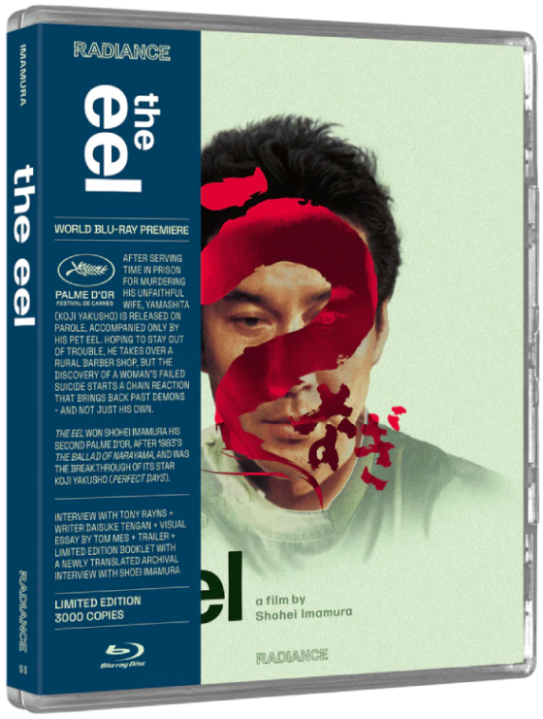
“The Eel” is released on a limited edition Blu-ray by Radiance Films. This disc contains two versions of the movie — a director’s cut, running 134 minutes, and the theatrical cut, running 117 minutes. There is no information to indicate which cut won the Palme d’Or. I chose to view the director’s cut.
I found this cut of the film to be slow-moving. That’s not necessarily a bad thing, especially considering how frenetic a lot of modern films have become. However, this cut felt like it dragged. I frequently found myself wishing the story would move on. There are flashbacks later in the movie involving Keiko. These are not telegraphed very well and are confusing until you realize that they are flashbacks. In addition, some of the storytelling choices, which I believe are there to cause the viewer to question Yamashita’s frame of mind, took me out of the movie. Despite these drawbacks, some elements work well. The acting is one notable positive.
The film’s transfer was also somewhat underwhelming. Most of the viewing did not appear to be from a high-definition source. The notes for the transfers state that the director’s cut uses a high-definition digital file. In contrast, the theatrical cut was assembled using this high-definition file and interstitial footage taken from a standard definition version. With that taken into consideration, I guess this movie looks as good as it can. There were no notable issues with the film’s audio file.
Radiance includes their usual assortment of on-disc interviews and visual essays as bonus features. Tom Mes’s visual essay is a good starting point, offering a broader history of Japanese cinema and its state in the late 90s when “The Eel” was released. The disc also includes interviews with film critic Tony Rayns and the film’s screenwriter Daisuke Tengan.
Although “The Eel” didn’t win me over, it was a worthwhile watch, even if it was just to mark another Palme d’Or winner off my watchlist. Film fans who haven’t had the opportunity to see this movie will probably want to get their hands on this disc. Personally, I think this is a one-time watch for me. If you can rent this disc somewhere, I’d suggest that over purchasing it or waiting for a sale, or the standard edition that should follow this release.
Now available on a Limited Edition Blu-ray from RADIANCE
 10k
10k 20k
20k 1.5k
1.5k 2.2k
2.2k