
The film follows François, a reckless young rebel who is forcibly committed to a psychiatric hospital by his wealthy, vengeful father after being caught stealing. Inside, François battles oppressive asylum methods and attempts to escape.
Following an altercation with his father, François (Jean-Pierre Mocky) is committed to a psychiatric institution. There, he falls under the care of the cold Dr. Varmont (Pierre Brasseur) and repeatedly attempts to escape.
The setup for director Georges Franju’s 1959 film “La Tête Contre Les Murs” (“Head Against the Wall”) is simple. He directs the feature, widely regarded as a critique of the French psychiatric system at the time, with confidence, crafting beautiful black-and-white imagery throughout. While the film looks fantastic, it is considerably more restrained when compared to more recent films tackling similar themes.
What should be the film’s emotional core doesn’t resonate. It isn’t convincingly established that François belongs in a psychiatric hospital. Sure, he’s rebellious and arguably irrational — he rides a motorcycle, steals money from his father, and then burns some important paperwork. It’s this latter act that allows his father to enter him into the asylum. However, despite being locked up unwillingly, François rarely conveys the desperation of someone wrongly confined. His behavior is as restrained as the film, never offering viewers a convincing reason for his continued confinement.
Franju sets up the film as a standoff between two schools of psychiatric thought — the old-school, crueler mentality of Dr. Varmont and the new-school, more humane methods of Dr. Emery (Paul Meurisse). This comparison doesn’t work particularly well. Although the patients clearly prefer Emery, Varmont isn’t portrayed as completely heartless.
Ultimately, the movie doesn’t make a convincing case for its central argument — especially given that Olivia de Havilland’s film “The Snake Pit” came out almost a decade earlier. This earlier movie offers a more convincing, shocking, and memorable take on similar themes. Attempting to view Franju’s film from a historical perspective, its compassionate portrayal of institutionalized patients was more revolutionary in 1959. Altogether, “La Tête Contre Les Murs” is intriguing enough for a single viewing, but I don’t think I’ll revisit it.
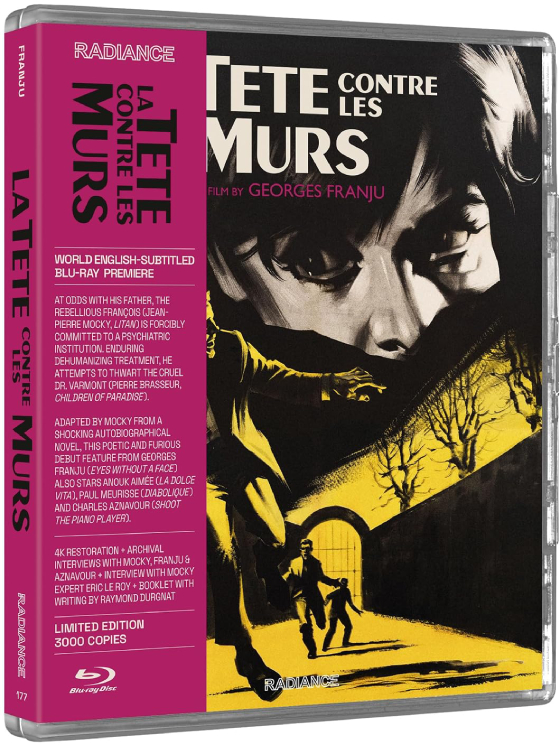
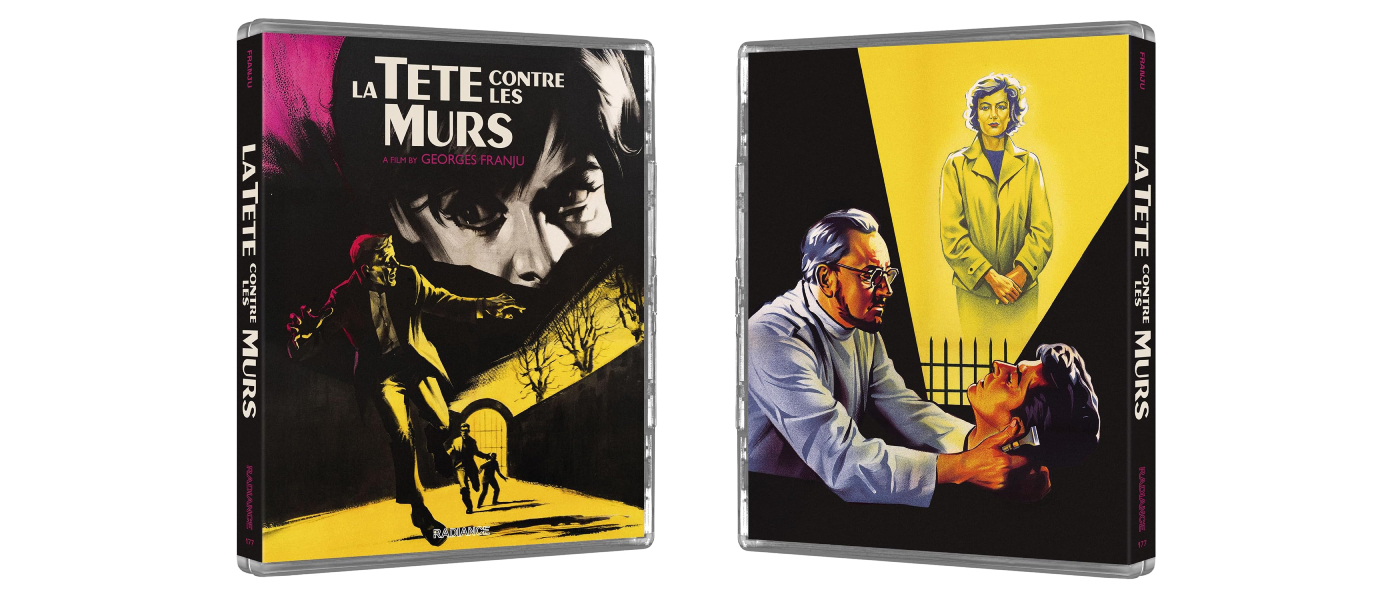
“La Tête Contre Les Murs” arrives on Blu-ray™ for its world English-subtitled premiere in a limited edition from Radiance Films. The disc is sourced from a new 4K restoration of the film, which looks fantastic overall. However, there are some sections and shots that look a bit faded. The audio presents the dialogue and sound effects clearly.
Extras include an archival interview with star and screenwriter Jean-Pierre Mocky, an archival interview with director Georges Franju and actor Charles Aznavour, and an interview with Mocky’s assistant and friend Eric Le Roy. The limited edition also includes a booklet with a writing excerpt from film critic Raymond Durgnat — a chapter from Durgnat’s book about Franju, which was originally published in 1967.
While the film wasn’t for me, Radiance Films has put together an excellent package for “La Tête Contre Les Murs.”
Now available on Limited Edition Blu-ray™ from RADIANCE FILMS