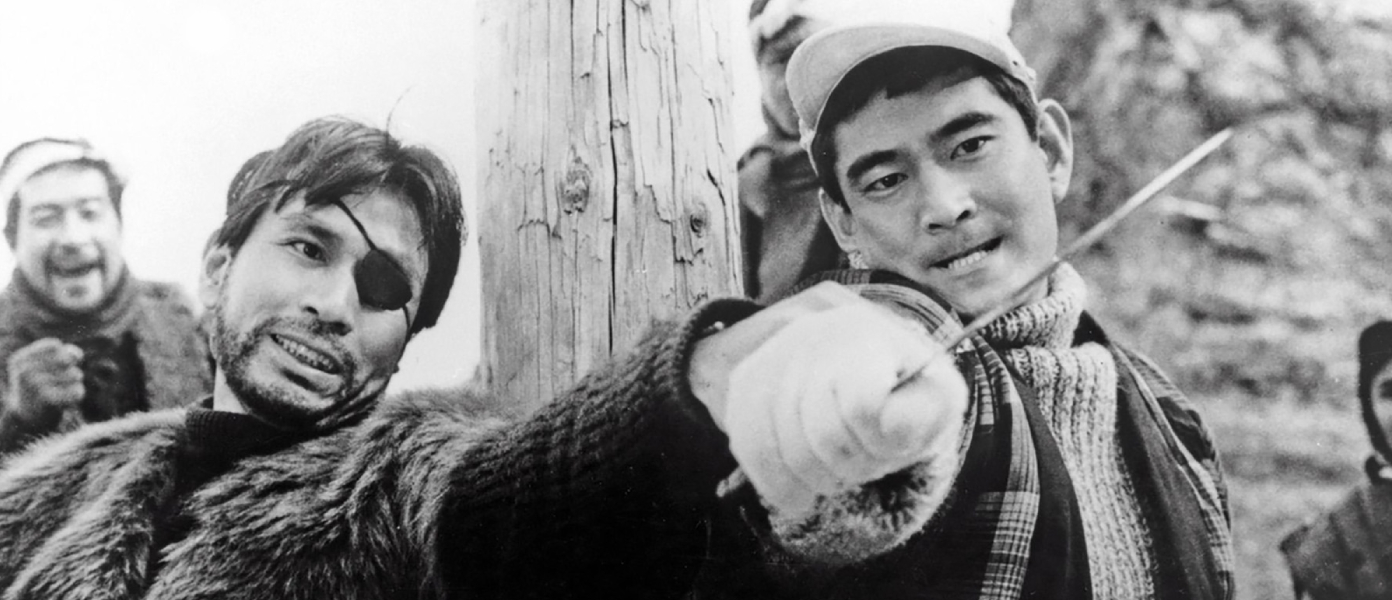

In a village subsisting on its herring fishery, a one-eyed criminal named Jakoman terrorizes the inhabitants. One of them, the son of the head of one of the fish companies by the name of Tetsu, decides to overthrow Jakoman and his cohorts.
Released in 1964, “Jakoman & Tetsu” is an early film by director Kinji Fukasaku, adapted from a script by Senkichi Taniguchi and Akira Kurosawa. The film is a departure from what Fukasaku (and 88 Films, for that matter) usually directs. “Jakoman & Tetsu” is more of a character study, focused on the people in a fishery during herring season.
Following the Toei studio logo, which features waves crashing onto rocky terrain, the film immediately segues into another shot of waves crashing onto rocky terrain, establishing the location for this film’s story. Fishery owner Kyubei (Isao Yamagata) is in the process of hiring men to work for the upcoming herring season. The year is 1946, and his son, Tetsu (Ken Takakura), is believed to have died in the war. Unbeknownst to Kyubei, Jakoman (Tetsuro Tamba), a rival, is among the men hired. Jakoman is intent on causing as much trouble for Kyubei as he can. Meanwhile, Tetsu returns (to his family’s surprise and delight) to help out.
“Jakoman & Tetsu” is a slow-moving film. Those expecting a crime saga or yakuza story — Fukasaku’s usual material — will be sorely disappointed. I was underwhelmed by the movie, especially considering it’s a collaboration between Kurosawa, considered one of the greatest filmmakers of all time, and Fukasaku. This movie does nothing to pull the viewer into the story, and ultimately is drawn out pretty thin. To put it simply, I found this movie dull.
There’s no information in the included booklet or on the case about the source for this disc’s transfer. The picture quality appears dated, and the elements used, including debris and lines, pop up continually throughout the film. Several scenes are so dark that it’s hard to single things out. Despite this, the film is watchable.
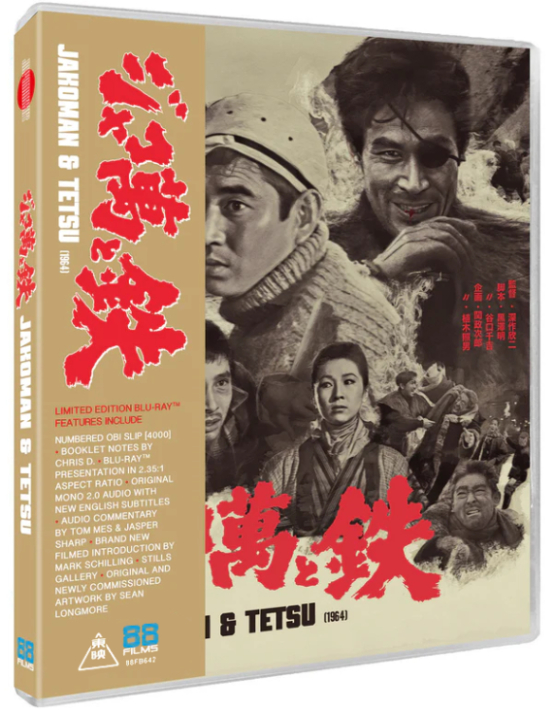
This Blu-ray edition is a limited release from 88 Films. Features limited to this edition include a booklet featuring an essay by Chris D and a numbered Obi slip. The artwork is reversible, featuring both the film’s original art and new art commissioned by Sean Longmore. Chris D.’s essay provides historical context before discussing the film. Thanks to this writing, I added several movies to my watchlist.
Special features include an audio commentary by Tom Mes and Jasper Sharp, as well as an introduction by Mark Schilling. I started my viewing with the introduction, which, in my opinion, rambled. By contrast, the commentary from Mes and Sharp, who wrote the book ‘The Midnight Eye Guide to New Japanese Film,’ is lively and engaging.
Personally, this was a movie that didn’t click with me. However, for movie buffs looking to delve deeper into this period of Japanese cinema, this is a worthwhile disc. The image is a little hard to see at times, but the film is watchable as presented. Plus, the features add some depth and context to the movie.
Available on a Limited Edition Blu-ray from 88 FILMS
 10k
10k 20k
20k 1.5k
1.5k 2.2k
2.2k