

A prison break, femme fatales, and a genre-defining western: Robert Hossein, one of French cinema’s great unsung stylists, directs and stars in three classics: “The Wicked Go to Hell,” “Nude in a White Car,” and “The Taste of Violence.”
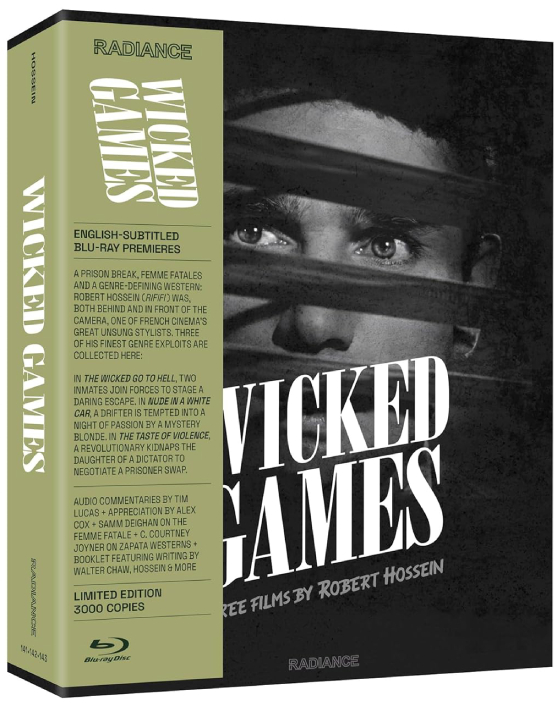
Three early works from French filmmaker Robert Hossein are the subject of Radiance Films’ box set “Wicked Games.” After watching each film and its supplements, it becomes clear that Hossein is far more significant to French cinema (and international genre cinema) than his obscurity would suggest. I’m a little ashamed to admit his name was one I did not recognize — despite him appearing in one of my favorite films, “Once Upon a Time in the West” — but this set has happily corrected that.
“The Wicked Go to Hell,” Hossein’s directorial debut, is the first feature. It follows a pair of inmates (Henri Vidal and Serge Reggiani) who get accused of snitching on a condemned fellow prisoner. Facing increasing pressure from their fellow convicts, the duo stage a breakout and eventually hole up in a seaside home, taking its young occupant (Marina Vlady) hostage.
Based on a novel and play by Frédéric Dard, the film is a confident and brisk debut. Hossein skillfully balances prison drama, escape tension, and dreamy noir, giving the film its frenetic energy. While the final act slows things down, drawing viewers in for an intimate confrontation, the film remains gripping.
Extra features for the disc include a commentary by Tim Lucas and a pair of featurettes. “Picking Strawberries,” by Lucas Balbo, provides background on the production and reveals period slang that reframes the relationship of the escaped convicts. “Behind Marked Eyes,” by Howard S. Berger, offers viewers a glimpse of Hossein’s directorial style and highlights additional titles by the director worth exploring. Lucas’ commentary is dense with information about the film and filmmakers.
The second film is 1959’s “Nude in a White Car,” also based on a work by Dard. While out on an evening stroll, Pierre (Hossein), a down-on-his-luck television host, is picked up by a mysterious woman in a white car. She drives him to a secluded area, seduces him, and suddenly turns violent, forcing him out at gunpoint before attempting to run him down. Pierre decides to uncover the woman’s identity, leading him to become embroiled in the lives of two sisters — Hélène (Odile Versois) and the paralyzed Eva (Marina Vlady).
Despite its deceptively simple story, “Nude in a White Car” is surprisingly compelling. Hossein hooks viewers with the mysterious opening encounter, allowing that moment to drive the remainder of the feature. The structure becomes cyclical as Pierre attempts to uncover the truth; both sisters continually give evasive answers and mysteriously smirk to themselves. Hossein, with his playful tone, keeps you guessing until the end.
Extra features include another informative commentary from Tim Lucas, an interview with actress Marina Vlady, and a visual essay by Sam Deighan. Deighan’s piece, “The Evolution of the Femme Fatale in Classic French Cinema,” intriguingly explores the influences and tropes shaping this cycle of cinema. Vlady’s interview is straightforward but offers fewer insights compared to other supplements.
The final film in the set is 1961’s “The Taste of Violence,” and it certainly is not the least. Hossein stars as Perez, a revolutionary in an unspecified Central American country who kidnaps the dictator’s daughter (Giovanna Ralli) in hopes of trading her for captured comrades. With a large bounty placed on her head, things don’t go according to plan.
Despite its title, the film contains surprisingly little bloodshed. Instead, Hossein crafts a quiet, subdued drama that focuses on the shifting dynamics between captor and captive. He frames the conflict against striking vistas, evoking the classic Western tradition. It is also fascinating to learn that this film kicked off the Euro-Western cycle, a subgenre that came to be dominated by Italian filmmakers.
Extras include a commentary from Tim Lucas, an interview with filmmaker Alex Cox, and an interview with author C. Courtney Joyner. Cox speaks passionately about Hossein, giving this film glowing praise. Joyner provides a concise overview of the Zapata Western subgenre, which focuses on films that feature Mexican revolutionary narratives.
Each film in the box set has been restored in 2K from the original negatives by Gaumont, and the results are uniformly fantastic. The transfers are organic, film-like, and clean, presenting these overlooked works with newfound clarity. Audio is crisp, free of hiss, and well-balanced.
Hossein is a filmmaker who has undeservedly disappeared into obscurity. Why his work isn’t better known is hard to say. Releases like this one, however, will perhaps bring his works to light. Radiance Films’ “Wicked Games” box set is highly recommended.
Now available on a Limited Edition Blu-ray
 11k
11k 19.8k
19.8k 1.5k
1.5k 1.8k
1.8k