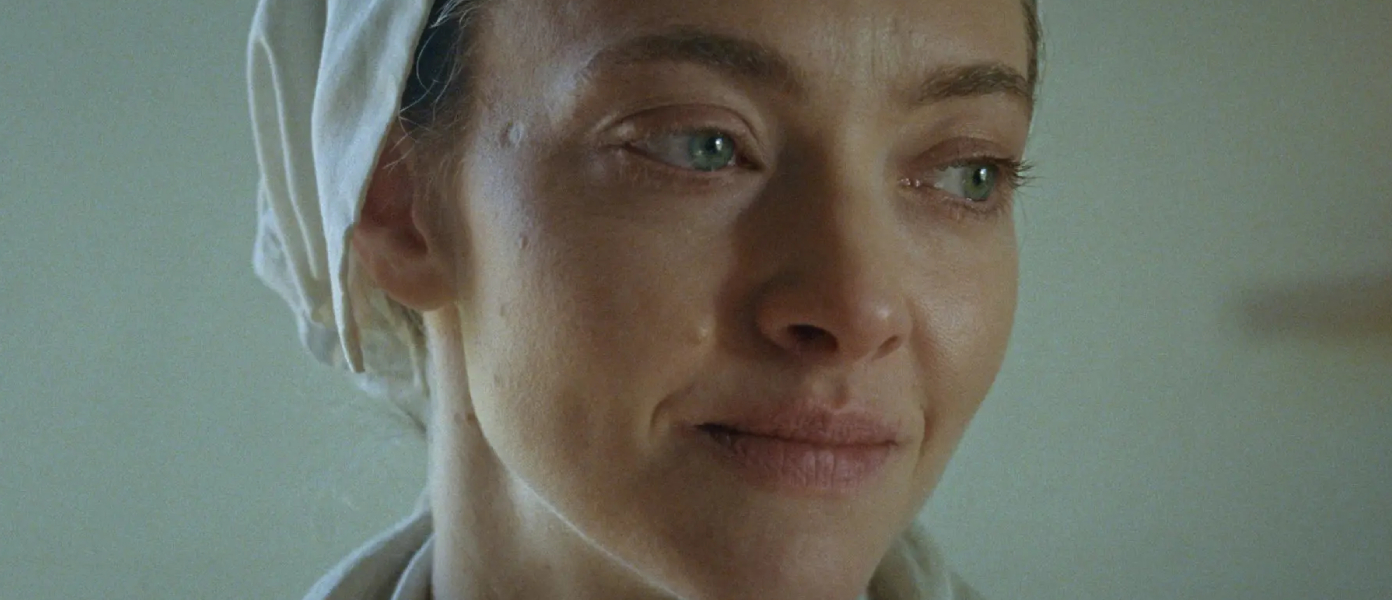

Ann Lee, the founding leader of the Shaker Movement, proclaimed as the female Christ by her followers. Depicts her establishment of a utopian society and the Shakers’ worship through song and dance, based on real events.
Mona Fastvold’s “The Testament of Ann Lee” is unlike any musical you’ve ever seen. The film immerses us in the beginnings of the Shaker religious movement of the 18th century through a raw, intense, and, at times, deeply unsettling lens.
Co-written by Fastvold and her partner, “The Brutalist” director Brady Corbet, the film uses the harsh life of deprivation and suffering in the mid-1700s as a crucible that forges radical faith among the lower classes.
Amanda Seyfried shines as Ann Lee, the movement’s founder and self-proclaimed messiah. Born in poverty, Ann’s early life was shaped by one unspeakable tragedy after another, serving to buttress her faith, eventually coming to believe she herself to be the second coming of Jesus Christ. Her brother, William, played by Lewis Pullman, joins the movement as one of her most loyal followers.
Narrated by Mary Partington (Thomasin McKenzie), “Testament” depicts the inception and growth of the radical sect of Quakerism, dubbed the “Shakers,” for the way their bodies tremble ecstatically during prayer. Their motto, “God created us in His image. Therefore, God must be both male and female,” is the backbone of their conviction that Ann is the second coming of Jesus Christ. This belief, along with their progressive practices of gender equality, leads to persecution by outsiders, who find their convictions blasphemous. The film doesn’t shy away from depicting the violence of these attacks by authorities and locals, fearful of witchcraft and heresy.
The bleak chapters of Ann’s life—religious persecution, stillbirths, the dissolution of her marriage to Abraham (Christopher Abbott)—are punctuated by surreal songs with unique choreography. We can feel the worshippers let the Holy Spirit move through them. There is a brief, refreshingly entertaining sequence aboard the Mariah as fellow seafarers plead with the Shakers to stop singing all the time.
The production design is one of “Testament”’s greatest strengths, meticulously recreating the mid-18th century with raw authenticity rather than romanticization. Dirt, blood, sweat, and wood color the film’s visual palette. Childbirth is depicted with graphic frankness—cutting umbilical cords, breastfeeding, stillbirths, and bodily injury are all shown in ways that recall the ritualistic gore of Ari Aster’s “Midsommar.” Though this is not a horror film, it often feels like one, testing the audience’s endurance through sensory assault.
Artistically, the film accomplishes precisely what it sets out to do: depict the inception of the Shaker movement, their journey to escape persecution, and their experience in America. Though the subject matter and its unapologetic depiction may unsettle audiences, “Testament” succeeds as a work of art.
In Theaters Friday, January 23rd

 11k
11k 19.8k
19.8k 1.5k
1.5k 1.8k
1.8k